
Lieferung heute & morgen

Qualitätsgarantie

Willkommens-Angebote freischalten: KOSTENLOSE Lieferung | Bis zu 80 % RABATT | Kostenlose 30-Tage-JoyPlus-Testphase
App herunterladen
A cluttered bathroom can make for a difficult start to the day. Towels, cleaning supplies, and toilet paper rolls pile up in corners because there's simply not enough storage space. A vanity unit seems like the obvious solution, but the purchase has its pitfalls. Many models look appealing online, only to turn out to be impractical or short-lived after purchase.
Before you make a decision, you should know the three most common mistakes that lead to disappointment and unnecessary expense:
These problems can be avoided if you know which technical features truly matter.
To find a durable and functional bathroom cabinet that perfectly suits your needs, you should check three crucial criteria. These will help you distinguish marketing promises from genuine product features.
The bathroom is the most humid room in the house. Water vapour and splashes are a constant stress on bathroom furniture. Therefore, look for the following specifications:
Measuring before you buy is essential. An under-sink bathroom cabinet must fit precisely.
A good vanity unit not only creates space but also organises it intelligently.
Based on these objective criteria, we have identified some models that are well-suited for specific needs and living situations in the UK and Europe.

Why this model is a good fit: Ideal for anyone looking for a quick, straightforward, and functional solution for a standard bathroom. As a freestanding model, it's perfect for rental properties as no wall mounting is required.
The model is made of lacquered Class E1 MDF panels, thus avoiding the risk of swelling. The existing siphon cut-out is clearly specified, which minimises the sizing and fit error.
The design is focused on functionality: two doors conceal the contents, while two internal compartments ensure organisation. The total load capacity is specified as up to 25 kg.

Why this model is a good fit: For users who value a clean, modern look and want a combination of concealed and open storage. The high-gloss finish looks elegant and visually brightens the bathroom.
The eco-friendly lacquered surface of the Class E1 MDF panels provides reliable protection against moisture. The magnetic door catch ensures stable and secure use, preventing rattling doors.
The combination of an open compartment for towels and two closed compartments offers a thoughtful layout for both quick access and concealed storage.
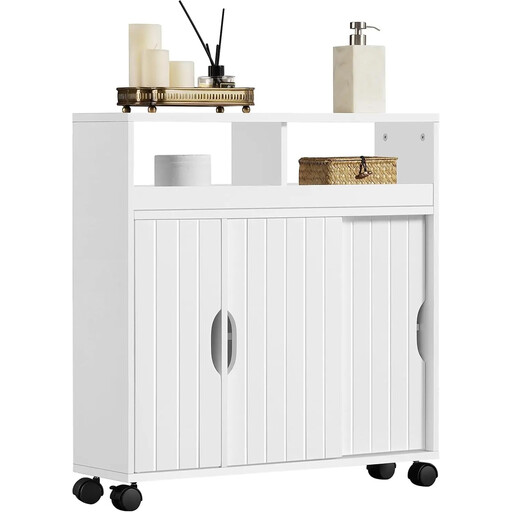
Why this model is a good fit: This model is not a classic vanity unit, but a slim rolling cart that makes optimal use of unused niches next to the sink or toilet. Ideal for very small bathrooms where every centimetre counts.
It completely bypasses the "sizing and fit error" as it fits next to the sink, not under it. The water-resistant coating on the FSC-certified MDF panels protects against moisture damage.
Mobility via four castors (two of which are lockable) allows for flexible use and easy floor cleaning. The adjustable shelves provide customisable storage space.
We have compiled a complete, up-to-date list of products that fully meet these strict selection criteria and relevant safety regulations.
1. How do I measure the siphon cut-out correctly? Measure two values: 1. The distance from the wall to the front edge of the drain pipe (this determines the depth of the cut-out). 2. The distance from the wall to the centre of the pipe. Compare these measurements with the technical drawing or the product's dimensions. Always allow for a little extra clearance.
2. Can I use a bathroom cabinet without a siphon cut-out under the sink? This is only possible if you have a countertop or vessel sink where the siphon disappears directly into the wall and does not lead downwards. For most standard sinks, a cabinet without a cut-out cannot be positioned under the basin. However, it can be placed next to it as an additional bathroom cabinet.
3. How do I properly care for an MDF bathroom cabinet to prevent it from swelling? Always wipe away water spots and splashes immediately with a dry, soft cloth. Avoid standing water on the surface. Ventilate the bathroom well after showering or bathing to reduce overall humidity. For cleaning, do not use aggressive or abrasive agents; use only mild cleaners and a damp (not wet) cloth.