
Lieferung heute & morgen

Qualitätsgarantie

Willkommens-Angebote freischalten: KOSTENLOSE Lieferung | Bis zu 80 % RABATT | Kostenlose 30-Tage-JoyPlus-Testphase
App herunterladen
A cluttered bathroom can make starting your day difficult. Tubes, bottles, and towels are scattered everywhere because there's not enough storage space. A vanity unit seems like the simple solution, but the purchase has its pitfalls. Many models look appealing online but turn out to be a poor investment after just a few months. Before you decide on a new under-sink cabinet, you should know the three most common and costly traps.
This guide will help you avoid these problems and find a vanity unit that truly fits your needs and your bathroom.
To avoid a bad buy, focus on three core technical aspects. These determine durability, a precise fit, and practical utility.
The bathroom is a high-moisture area. Water vapour and splashes are a constant stress on bathroom furniture. Therefore, look for the following features:
Nothing is more frustrating than a piece of furniture that doesn't fit. Before buying, be sure to measure three areas precisely:
A good under-sink cabinet creates order instead of just hiding things. Think about what you want to store and choose the right concept:
Here are some recommendations tailored to different needs and bathroom situations.

Why this model is a good fit: Ideal for renters and homeowners with a standard bathroom who are looking for a straightforward and functional solution in the common 60 cm format. The timeless design blends seamlessly into most interiors.
The model is made of lacquered MDF boards (Class E1), making it more resistant to moisture than simple foil-wrapped particle boards. The combination of doors and an open compartment avoids the trap of unstructured storage.
The open compartment provides quick access to frequently used items, while the closed section keeps things tidy. The magnetic door closure is a practical detail at this price point.
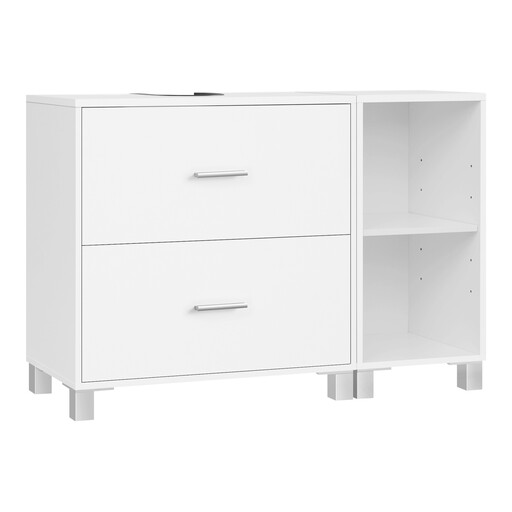
Why this model is a good fit: Perfect for anyone who needs more than just a standard under-sink cabinet. Those with an asymmetrical bathroom or who appreciate additional, customisable storage will benefit from the modular design.
This model solves the storage trap with a smart combination of drawers for small items and a separate side cabinet with an adjustable shelf. The flexible placement of the side cabinet helps to avoid the fit trap in unusual room layouts.
Modularity is its biggest asset. The side cabinet can be placed on the left, right, or even stand-alone. The shelf is adjustable to five positions, allowing for high adaptability to different bottle heights.
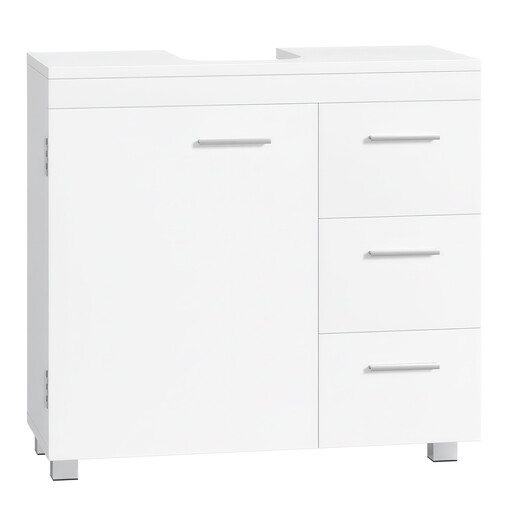
Why this model is a good fit: Specifically designed for the challenge of pedestal sinks. Anyone who thought they couldn't create storage space under their pedestal sink will find a suitable solution here.
This model avoids the ultimate fit trap by being explicitly designed for sinks with and without a pedestal. The thoughtful combination of three drawers and a door compartment also creates highly organised storage space.
Its versatility for different sink types is the clear advantage. The adjustable shelf in the cabinet compartment allows for the storage of tall bottles, while the drawers create order for small items.
We have compiled a complete, up-to-date list of products that fully meet these strict selection criteria and UK regulations.
Measure the width of the available space, the height from the floor to the underside of the sink, and the depth from the wall to the front edge. Additionally, note the distance from the wall to the centre of the drain pipe (trap) and its diameter. Carefully compare these measurements with the technical drawing or the dimensions provided in the product description.
Materials with high moisture resistance are crucial. Lacquered or melamine-coated MDF boards (Class E1) are a good choice. They are more resistant to swelling than unsealed particle boards. Ensure that the edges are also properly sealed, as this is where moisture is most likely to penetrate.
Yes, there are special models designed for pedestal sinks. These cabinets have a wider or specially shaped cutout in the top panel and often in the back panel as well to accommodate the pedestal. Look explicitly for the note "suitable for pedestal sinks" in the product description.