
Lieferung heute & morgen

Qualitätsgarantie

Willkommens-Angebote freischalten: KOSTENLOSE Lieferung | Bis zu 80 % RABATT | Kostenlose 30-Tage-JoyPlus-Testphase
App herunterladen
As a Joybuy Product Recommendation Officer, I see every day how difficult choosing the right kitchen appliance can be. A kettle with temperature control promises the perfect cup of tea or coffee, but not every model delivers on that promise. Many devices entice with features that disappoint in practice or are made from materials that compromise the taste. This guide will help you separate the wheat from the chaff and find a model that truly meets your needs.
Before you make a decision, it's important to know the typical weaknesses that often only become apparent after the purchase.
To make an informed decision, you should focus on a few critical technical parameters.
The material of the kettle body is crucial for taste and safety.
The ability to reach different temperatures accurately is the main advantage of these appliances. A digital kettle often offers the highest precision. Look for models that provide useful presets:
Some models offer thoughtful extras that make daily life easier. A kettle with a tea infuser transforms the appliance into a fully-fledged tea maker with temperature control, allowing loose-leaf tea to be brewed directly inside. A good kettle with a keep-warm function should reliably hold the selected temperature for at least 30 minutes without needing to re-boil the water.
Here are some recommendations tailored to different user profiles that meet the quality criteria mentioned above.
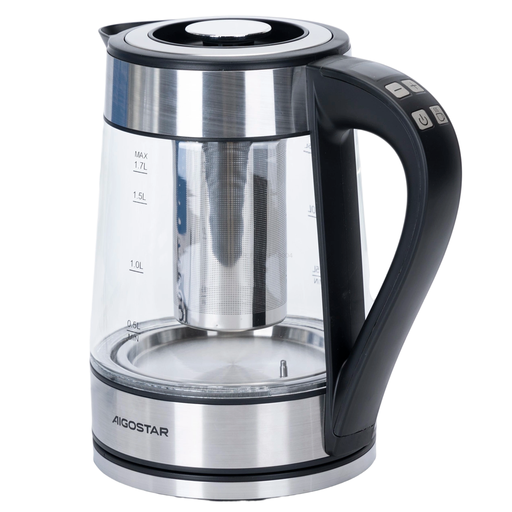
Why This Fits Their Persona: Ideal for tea and coffee lovers who refuse to compromise on temperature. The precise control and large capacity are perfect for preparing a wide variety of hot beverages for the whole family or guests.
Thanks to its 13-level temperature control and digital display, it bypasses the pitfall of inaccurate sensors. The current water temperature is always visible, ensuring maximum control.
Combines precise temperature selection, a keep-warm function, an integrated tea filter, and a large 1.7-litre capacity in one appliance.
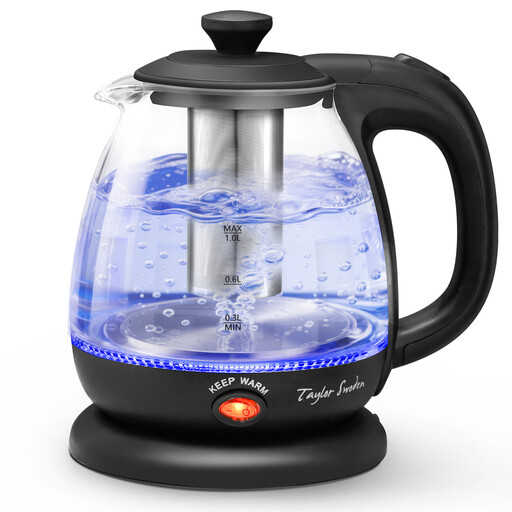
Why This Fits Their Persona: Perfect for the office, home office, or small kitchens. Its compact 1-litre design and integrated tea filter make it the ideal companion for anyone who wants to quickly and easily prepare a cup of their favourite tea.
This model relies on high-quality materials like borosilicate glass and a stainless steel tea infuser. This consistently avoids the trap of taste-altering plastics.
Compact design with 2-in-1 functionality (kettle and tea maker). The keep-warm function holds the water at 80-85°C, a suitable temperature for many types of tea.
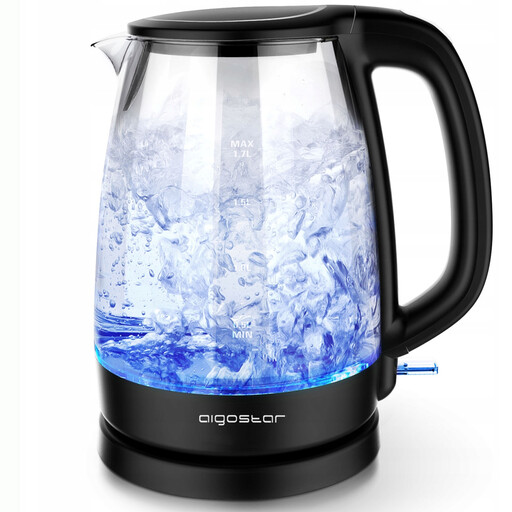
Why This Fits Their Persona: For users who value material purity but don't yet see the need for complex temperature controls. A solid, reliable kettle for daily use that focuses on safety and taste.
This model forgoes complex electronics and instead focuses on the essentials: a borosilicate glass body and a SUS304 stainless steel heating plate. This is how it avoids the pitfall of low-quality materials.
Focus on high-quality, taste-neutral base materials. Offers a large 1.7-litre capacity and essential safety features like automatic shut-off and boil-dry protection.
We have compiled a complete, real-time list of products that fully satisfy these strict selection criteria and UK safety regulations.
Descaling is straightforward and should be done regularly to maintain heating performance and hygiene. Fill the kettle with a mixture of one part household vinegar and two parts water. Let the mixture sit for an hour (do not boil). Afterwards, empty the kettle and rinse it thoroughly several times with clean water. Alternatively, you can use commercial citric acid-based descalers and follow the manufacturer's instructions.
The benefit strongly depends on your habits. If you frequently need hot water in quick succession—for example, for a second cup of tea or to prepare a soup—the function can be very practical and save energy, as the water doesn't need to be completely reheated. For users who only boil water once at a time, it is less relevant.
For preparing baby formula, a water temperature of around 40°C to 50°C is often recommended. The water should first be boiled to 100°C and then cooled to the desired temperature to ensure it is sterile. A kettle with precise temperature control can significantly simplify this process by bringing the boiled water to the exact right drinking temperature.