
Lieferung heute & morgen

Qualitätsgarantie

Willkommens-Angebote freischalten: KOSTENLOSE Lieferung | Bis zu 80 % RABATT | Kostenlose 30-Tage-JoyPlus-Testphase
App herunterladen
Whether it’s the living room, bedroom, hallway, home office or balcony, vases and planters for home décor combine practical use with a striking design feature. Choose from everything from a simple ceramic vase for dried flowers to a large floor planter for houseplants or a sheltered outdoor space.
However, many disappointing purchases aren’t down to the design, but to unclear product details. A narrow opening may not suit a full bouquet, a decorative plant pot may not have drainage, and a planter described as weather-resistant may only be intended for sheltered areas.
A large vase can look spacious in product photos, but may have a very narrow opening or a small base. Height matters for pampas grass and long branches; for fresh flowers, you should also consider the opening diameter, base diameter and stability.
The external height alone isn’t enough when choosing a large planter, either. The key factors are its internal capacity, how far the plant pot sits inside it and the space available around the planter.
Not every decorative vase is suitable for water. Some models are described as being for dried flowers or artificial flowers, or simply as a standalone home accessory. Before buying, check whether the material is waterproof and how the surface should be cared for.
For a plant pot for houseplants, you should also check whether it has a drainage hole. If not, you may need to use an inner pot with its own drainage.
Glass, ceramic, dolomite, stoneware and metal all react differently to knocks, moisture and temperature changes. A glass vase should be placed on a flat, stable surface. Ceramic and stoneware planters are usually heavier, but can still be damaged if dropped. An indoor and outdoor planter should be clearly described as having features such as UV or weather resistance.
For a vase on a shelf or table, the height and the diameter of the space it will occupy are key. For example, a 30 cm-high cylindrical vase with a diameter of 10 cm is suitable for single branches, slim floral arrangements or pampas grass. A wider opening is more practical for a fuller bouquet.
As a guide:
For a flower stand or tall planter, you should also take the total height, including the plant, into account. In walkways and beside doors, make sure the planter doesn’t obstruct movement.
A ceramic vase or a dolomite planter often suits minimalist, Scandinavian and classic interiors. Dust and water marks can show up more clearly on matt finishes, so clean them with a soft, damp cloth.
A glass vase lets you see the water level and stems, making it suitable for fresh flowers. However, fingerprints, limescale marks and small air bubbles may also be visible, depending on how it was made. Slight colour variations can occur in coloured glass as a result of the manufacturing process.
For outdoor use, specific details matter more than general claims such as ‘robust’. For example, the Beliani planter is described as being made from a mix of stone, polyresin and fibreglass, with a capacity of 31 litres and resistance to UV light and moisture. The drainage hole can be opened when needed or sealed with the supplied plug. Protected storage is recommended in extreme winter conditions.
A tall, narrow vase needs a sufficiently wide base. For glass models, don’t exceed the maximum load if the manufacturer hasn’t specified one. Heavy branches or very large floral arrangements can affect stability.
Drainage holes are useful in planters because they let excess water drain away. If there’s no drainage hole, use a suitable inner pot. You should also place a waterproof mat beneath an indoor planter, unless the product description recommends another solution.
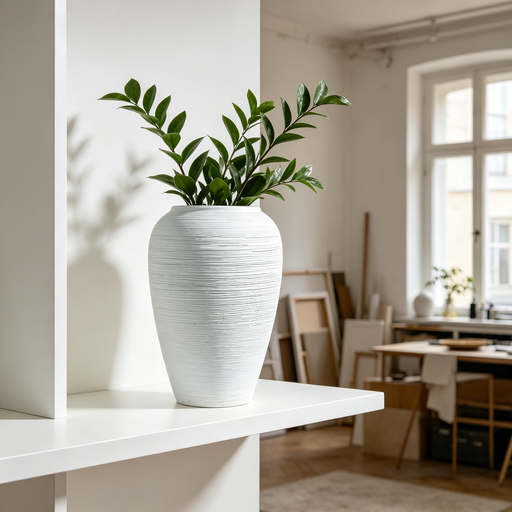
Why this product suits you: This 27 cm-high white ceramic vase is designed for dried and artificial flowers, and, according to the product description, fresh flowers too. Its textured surface makes it a stylish standalone piece for the living room, bedroom, home office or a shelf.
The stated dimensions of around 11 × 19 × 27 cm give you the width and opening size as well as the height, making it easier to work out how much space you’ll need.
Ceramic material, a textured surface and a neutral white colour; suitable for a range of decorative styles.

Why this product suits you: Its tall, slender shape, smooth upper section and fluted base suit modern interiors. At 35 cm high, it’s a good fit for sideboards, console tables and larger floral arrangements.
The product details give the height, width and depth as 10 and 35 cm respectively. The manufacturer recommends cleaning it with a soft, damp cloth.
Made from 100% dolomite, according to the product details; a two-part look combining smooth and fluted finishes; 4,100 ml capacity.

Why this product suits you: This clear glass vase, measuring 30 cm high and 10 cm in diameter, is suitable for roses, tulips, orchids, pampas grass and fresh or artificial flowers. It looks at home on tables, chests of drawers and sideboards.
The stated height and diameter make it easier to choose suitable flowers. For stability, place it on a flat, steady surface and avoid overloading it with heavy arrangements.
Smooth, polished glass; reinforced construction according to the product details; clean with a soft cloth and mild soap.

Why this product suits you: With a capacity of 31 litres, this tall planter can be used indoors as a decorative cachepot or outside in a sheltered spot. Its slender shape suits larger houseplants and grand entranceways.
The product description specifies the material, capacity, drainage hole and supplied plug. This lets you decide before setting it up whether water should drain away or be kept in the planter.
31-litre capacity; UV- and moisture-resistant according to the product details; described as suitable for indoor and outdoor spaces.
We’ve put together a complete, regularly updated list of products that meet these strict selection criteria and the safety regulations in force in the EU.
A vase for pampas grass should be tall enough and stable. A narrow opening keeps a few long stems together, while a wider neck gives fuller arrangements more room. Compare the height, opening diameter and base diameter before buying.
Lifespan depends on the material’s thickness, how it’s made, how it’s used and where it’s placed. Ceramic and glass can last a long time with careful handling, but they aren’t unbreakable. Knocks, an unstable position and sudden temperature changes increase the risk of damage.
Key things to consider are the internal dimensions, drainage, saucer and the weight of the plant. A decorative plant pot without drainage should be used with a suitable inner pot. For a large planter, also check that the floor and the surface it will stand on can support the combined weight of the planter, soil, water and plant.