Vegan snackers keeping an eye on fat
You want to compare the fat content of different nut products per 100 g, without assuming that ‘roasted without oil’ means ‘reduced fat’.


Roasting without oil doesn’t mean vegan nuts are lower in fat: according to EDEKA, ALDI SÜD and REWE, the cashew products covered here contain between 47.8 and 48 g of fat per 100 g. If you’re focusing on fat, compare the nutritional information on the same 100 g basis and check the current label or ingredients list to make sure the product is suitable for vegans. Unsalted and made without added oil describe different qualities from reduced fat.
You want to compare the fat content of different nut products per 100 g, without assuming that ‘roasted without oil’ means ‘reduced fat’.
You’re looking for unsalted nuts and want to check whether oil, seasonings or sweetening ingredients have been added before you buy.
You’d like a mix of different nuts rather than a single variety, and want to check the vegan labelling on the specific mix.
When buying vegan nuts, start by checking the fat content and ingredients of the specific pack. The roasting method, salt and seasoning can then help you choose, but they’re no substitute for comparing the nutritional information.
| What matters | What to check | Who it matters to |
|---|---|---|
| Fat content | Compare fat per 100 g rather than per serving, and treat ‘roasted without oil’ as a separate point. | I want to choose nuts based on their fat content, rather than relying on the roasting claim alone. This comparison is the main priority for around 50% of consumers. |
| Suitability for vegans | Check the current vegan label or ingredients list; if you have allergies, also check for may-contain statements. | When I buy a nut mix, I want to be able to rule out animal-derived ingredients by checking the pack. This reassurance is the main concern for around 30% of consumers. |
| Salt and additives | Check the salt per 100 g and the ingredients list, especially for seasoned products or mixes with fruit. | For my snack, a short ingredients list and minimal added seasoning matter more than a particular roasting method. Around 20% of consumers put this first. |
This describes how the product is prepared. REWE says its ültje pur Cashews and MAX Cashews are roasted without added oil; both are still listed as containing 48 g of fat per 100 g.
Compare the ‘fat’ figure in the nutritional information per 100 g, and consider the roasting method as a separate product feature.
For processed nut products, it’s the ingredients in the specific variety that matter. May-contain statements answer a different question and are particularly important if you have allergies or want to avoid possible cross-contamination.
Check the current pack for a vegan label or an ingredients list with no animal-derived ingredients. Read any may-contain statements as well if relevant.
According to REWE, the unsalted ültje pur Cashews contain cashew kernels. Seasoned varieties may contain other ingredients; the MAX Cashews described by REWE, for example, contain wheat flour and glucose syrup.
Decide whether you’d prefer a simple recipe or added seasoning, then check the ingredients and salt content of the pack you choose.
The details below relate to specific product ranges or varieties, not to a brand’s entire range.
EDEKA Bio Cashew Kernels are an example of a product with published ingredients and nutritional information.
According to ALDI SÜD, the FARMER NATURALS roasted cashews featured here carry a vegan label.
The ültje pur Cashews described by REWE are unsalted and oven-baked without oil.
Seeberger’s nut kernel mix is a vegan-labelled alternative to plain cashews.
ALDI Nord sells a range of nut products under TRADER JOE'S, including cashews and mixed nuts.
Choose between a cashew and cranberry snack mix and unsalted roasted cashews. If you’re comparing plain nuts with a nut and fruit snack, bear in mind that their ingredients differ. You can’t tell whether a product is lower in fat from its type alone.
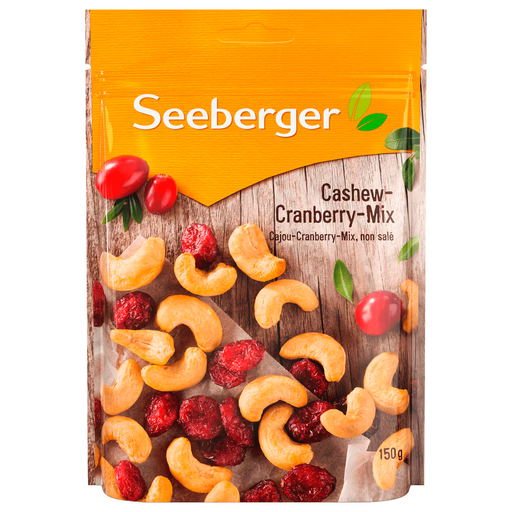 No image available
A good option if you’re looking for a snack made with cashews and cranberries rather than plain nuts. If you’re focusing on fat, compare the nutritional information per 100 g and check the ingredients and vegan suitability on the current pack.
 No image available
A good option if you’d like unsalted cashews rather than a nut and fruit mix. ‘Roasted’ and ‘unsalted’ don’t mean reduced fat. Check the nutritional information, ingredients and may-contain statements on the current pack.
No. According to EDEKA, ALDI SÜD and REWE, the cashew products covered here contain between 47.8 and 48 g of fat per 100 g; that doesn’t mean they can be classed as reduced fat. Compare specific products on the same 100 g basis rather than assuming the type of nut means less fat.
Not necessarily. REWE says its ültje pur Cashews and MAX Cashews are roasted without added oil or fat, but lists both as containing 48 g of fat per 100 g. The roasting claim and the overall fat content tell you different things.
Look for a vegan label or check the ingredients list on the current pack for animal-derived ingredients. If you have allergies or want to avoid possible cross-contamination, also read the may-contain statements; these are not the same as the ingredients list.
Store them in a dry place, away from heat; REWE gives this advice for the ültje pur Cashews described here. Also follow the storage instructions on your product’s packaging.