Who should take care when choosing?

Shoppers looking for vegan ingredients

You’re looking for a snack mix with no ingredients of animal origin. A clear vegan label makes it easier to narrow down your options, but you’ll still need to check the specific pack if you have other requirements.

Shoppers who also need to avoid allergens

You buy vegan products and also need to avoid specific ingredients such as tree nuts, peanuts, gluten-containing cereals, sesame or soya. In this case, the ingredients list and any precautionary allergen information matter more than the vegan claim alone.

Shoppers comparing nutritional values

You’d also like to compare fat, salt, protein and fibre in plant-based snacks. Values per 100 g give you a common basis for comparison, but nutritional information does not tell you whether a product is suitable for someone with an allergy.

What should you look for when buying?

First, decide whether the mix needs to be vegan and which specific ingredients or allergens you need to avoid. Then compare the nutritional values of the products that meet your requirements.

Criterion What to check when buying Who it matters to
Vegan ingredients Look for a clear vegan label and read the ingredients list on the pack. If I want to avoid animal-derived ingredients, I need a clear basis for choosing. This is the top priority for around 34% of shoppers.
Allergens and traces Check which allergens are highlighted in the ingredients list, as well as any warnings about possible traces of ingredients you need to avoid. If I have a specific allergy, I need to know whether the allergen is an ingredient or is mentioned as a possible trace. This is the top criterion for around 33% of shoppers.
Gluten, soya or sesame Check for a ‘gluten-free’ claim if you need to, and check the ingredients list and trace warnings for soya or sesame. A vegan recipe isn’t enough for me if I also need to avoid gluten, soya or sesame. Around 20% of shoppers put this first.
Nutritional values Compare fat, salt, protein and fibre per 100 g; check the serving size too if useful. If there are no specific ingredients that restrict my choice, I want to compare the nutritional values of different types of snacks on the same basis. This is the top priority for around 13% of shoppers.

Common pitfalls when choosing

  • Assuming ‘vegan’ means ‘allergen-free’

    Vegan snacks may contain ingredients such as tree nuts, peanuts, gluten-containing cereals, sesame or soya. A vegan label therefore doesn’t tell you whether a product is suitable for someone with a specific allergy.

    Make a note of the ingredients you need to avoid, then check the ingredients list, highlighted allergens and any trace warnings on the pack.

  • Assuming a trace warning tells you exactly what the risk is

    A warning such as ‘may contain nuts’ tells you neither the quantity nor the individual risk. According to Lebensmittelklarheit, additional precautionary labelling for possible traces is not currently regulated by law.

    If you have a specific allergy, don’t judge whether a product is suitable based only on whether such a warning is present or absent.

  • Judging a product by just one nutritional value

    Information about fat content doesn’t also tell you about salt, protein, fibre or allergens. Products from different snack categories can only be meaningfully compared using the same basis.

    Compare nutritional values per 100 g, and check ingredients and allergens separately.

  • Relying on online information instead of checking the pack

    Lorenz points out that old and new product labels may both be in shops at the same time. EDEKA also warns that online information may differ from the packaging.

    Use online product pages to narrow down your options, then check the label on the pack you have before eating the product.

Brands to help you choose

Lorenz

Lorenz labels some savoury snacks as vegan, including varieties in the Saltletts and Crunchips ranges.

  • Lorenz publishes ingredients and nutritional information for the varieties mentioned.
  • Vegan Saltletts contain wheat and barley malt extract; Lorenz lists milk as a possible trace in Crunchips African Style. Check the relevant pack.

funny-frisch

According to its product information, funny-frisch labels its Linsen Chips Sweet Curry Style as vegan and gluten-free.

  • For this variety, the manufacturer gives nutritional values per serving and per 100 g.
  • According to funny-frisch, the product may contain soya. The gluten-free claim does not mean it is soya-free.

GUT&GÜNSTIG

EDEKA’s own-brand range includes snack mixes made with several ingredients.

  • EDEKA publishes an ingredients and allergens list for the snack mix described.
  • The snack mix described contains milk ingredients, wheat, barley and sesame, so it isn’t a vegan option. According to EDEKA, product information may differ from the packaging.

Vemondo

Lidl Germany describes Vemondo as its own brand of vegan products.

  • The label can help you find vegan items in the range.
  • You’ll need to check the specific product to confirm whether a particular snack mix is vegan and which allergens it contains.

Suitable products at Joybuy

This selection includes a vegan crunchy muesli that could also work as a snack. It’s a muesli product, not a traditional savoury snack mix.
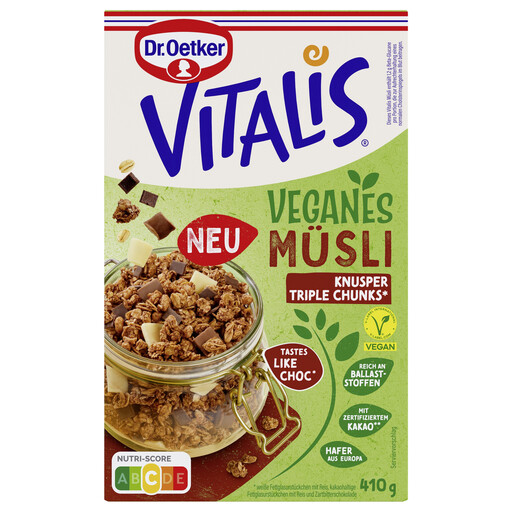
Dr. Oetker Vitalis Vegan Crunchy Triple Choc Muesli, 410 g

Dr. Oetker Vitalis Vegan Crunchy Triple Choc Muesli, 410 g

An option if you’re looking for vegan crunchy muesli rather than a savoury snack mix. It contains gluten and may contain pecans; if this is a concern, check the label on the current pack.

View at Joybuy

Frequently asked questions

Is a vegan snack mix automatically allergen-free?

No. Vegan means that animal-derived ingredients are excluded; it doesn’t mean all allergens are excluded. Vegan snacks may contain ingredients such as tree nuts, peanuts, gluten-containing cereals, sesame or soya. Check the pack for any ingredients relevant to you.

Is the V-Label enough if I have a food allergy?

No. The V-Label makes it easier to choose vegan foods, but it doesn’t confirm that a product is free from nuts, gluten or sesame, for example. Check the ingredients list and any trace warnings too.

What does a warning about possible traces of nuts mean?

It indicates the possibility of accidental contamination, but doesn’t specify the amount or the individual risk. Lebensmittelklarheit notes that these additional trace warnings are not currently regulated by law.

How do I compare the nutritional values of different pack sizes?

Start by comparing the values per 100 g, so the pack size doesn’t skew the results. Values per serving can also help you compare the amounts you’re actually likely to eat.

Which ingredients list should I follow if the recipe changes?

Check the label on the pack you have. Lorenz points out that products with old and new labels may be on sale at the same time; EDEKA also notes that online information may differ from the packaging.