
Lieferung heute & morgen

Qualitätsgarantie

Willkommens-Angebote freischalten: KOSTENLOSE Lieferung | Bis zu 80 % RABATT | Kostenlose 30-Tage-JoyPlus-Testphase
App herunterladen
The promise of a vegetable chopper is alluring: dice onions without tears, prep vegetables for a salad in record time, and achieve uniform results that are only possible with a knife after much practice. In reality, however, many models turn out to be short-lived kitchen gadgets that cause more frustration than joy. Before you make a purchasing decision, it's crucial to understand the typical weaknesses that often only become apparent after a few weeks of use.
Many users report three core problems that render an initially useful vegetable chopper unusable:
To avoid these pitfalls, you should check a few fundamental technical features before buying.
Instead of being dazzled by a long list of features, focus on the three parameters that determine durability and functionality.
The quality of the blades is critical. Look for models whose blades are made from robust stainless steel. A common and reliable material specification, for example, is 420-grade stainless steel. These blades stay sharp longer and are corrosion-resistant. The number and arrangement of the blades also influence efficiency. Multiple, staggered blades, as found in many multi-choppers, ensure a faster and more uniform result because the ingredients are caught from different levels.
The choice between a manual and an electric model depends on your cooking habits.
onion chopper with a pull-cord or push mechanism, offer precise control over the chop size. A few pulls will give you coarse pieces, while several will produce fine dice. They are cordless, compact, and often easier to clean. They are ideal for smaller quantities and soft to medium-firm vegetables.multi-chopper is the right choice if you regularly process larger quantities or hard ingredients like nuts, ginger, or raw meat. The motor power, measured in watts, is an important indicator of performance here. Models with multiple speed settings allow for more precise adaptation to the specific food.The collection container should be made of food-grade material. The most common options are plastic and glass.
The capacity should match your household size. For individuals or couples, containers up to 500 ml are often sufficient. Families or hobby cooks who prepare larger quantities are better served with a volume of 1000 ml (1 litre) or more.
Here are some models that represent a considered choice for specific user profiles based on their objective features.
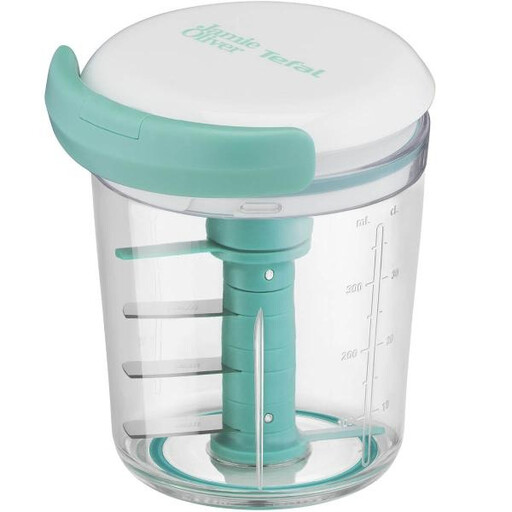
Why it's a good fit: Ideal for daily, small chopping tasks like onions, herbs, or garlic without having to pull out a large appliance. The manual pull-cord mechanism gives you full control over the desired chop size and is ready to use in an instant.
The patented system, featuring what the manufacturer claims is an extra-robust pull cord and sharp stainless steel blades, addresses the weakness of material fatigue. The simple construction allows for quick cleaning under running water.
Compact design, cord-free operation, and a leak-proof lid for clean work.

Why it's a good fit: For users who want to do more than just dice. With 6 interchangeable blades for slices, cubes, and julienne strips, this model functions as a true `mandoline slicer` and chopper in one. The large 1200 ml container is designed for preparing family-sized meals.
The blades are made from 420J2 stainless steel, which promises good edge retention. All parts are detachable and dishwasher-safe, which simplifies cleaning. The included safety hand guard minimises the risk of injury.
High versatility thanks to 6 different cutting inserts and a large capacity of 1200 ml.

Why it's a good fit: For anyone seeking power and efficiency. The 300-watt motor and two speed settings effortlessly process everything from soft fruits to hard vegetables and nuts. The two separate glass bowls allow for hygienic preparation without flavor transfer.
The non-porous glass bowls are dishwasher-safe, won't stain, and don't absorb odors, which eliminates the cleaning hurdle. The powerful motor ensures that the device won't be pushed to its limits, even with tougher ingredients.
Powerful 300-watt motor with 2 speeds and two separate glass bowls for hygienic, parallel processing.
A good kitchen gadget should make work easier, not harder. If you're looking for more models that impress with their material and performance specs, you'll find a suitable selection here.
First, check the product description to see which parts are dishwasher-safe. This usually includes the containers and often the blade inserts. The lid with the drive mechanism (especially on pull-cord or electric models) should only be wiped with a damp cloth. For manual cleaning, it's best to rinse all parts with warm water and dish soap immediately after use to prevent food from drying on. A small brush can help clean the blades safely.
Yes, many high-quality manual choppers with sharp stainless steel blades and a robust pull or push mechanism are capable of processing harder foods. It is advisable to pre-cut them into smaller pieces to avoid overloading the mechanism. However, for regularly chopping very hard ingredients or processing large quantities, an electric chopper is often the more efficient and durable solution.
The lifespan of the blades depends heavily on the material, frequency of use, and the type of food being processed. Blades made of high-quality stainless steel will remain sharp for years with proper use. To maintain their sharpness, you should avoid cutting frozen foods, bones, or other extremely hard materials. On most models, the blades are permanently installed in an insert and cannot be replaced individually.