
Lieferung heute & morgen

Qualitätsgarantie

Willkommens-Angebote freischalten: KOSTENLOSE Lieferung | Bis zu 80 % RABATT | Kostenlose 30-Tage-JoyPlus-Testphase
App herunterladen
A good vegetable chopper promises to be a significant time-saver in the kitchen. Instead of tedious manual chopping, it should transform onions, carrots, and potatoes into uniform cubes, slices, or sticks in seconds. However, the market is flooded with models whose promises don't hold up in practice. Before you make a purchasing decision, it's crucial to understand the common pitfalls that can quickly render a once-useful tool useless.
Many buyers get frustrated by three central problems:
A well-considered purchase will save you from these frustrations and ensure you get a durable and safe tool for your kitchen.
To avoid a bad purchase, you should focus your attention on a few crucial technical features. These determine the functionality, safety, and longevity of your vegetable chopper.
The quality of the blades is non-negotiable. Look for models where the blades are explicitly declared as being made of stainless steel. Higher-quality versions use specific alloys like 420J2 stainless steel, known for its good edge retention and high corrosion resistance. Sharp blades require less effort and deliver clean, precise cuts—essential for a good onion chopper, which preserves the cell structure and thus minimises the release of irritants. A spiralizer also needs consistently sharp blades to create uniform vegetable noodles.
The housing must withstand the pressure generated when cutting hard vegetables. Models made of ABS plastic are generally more robust and impact-resistant than those made of simple polypropylene (PP). A combination of stainless steel and plastic often offers a good balance of stability and ease of use.
An indispensable safety feature, especially for a mandoline or a vegetable slicer, is a finger guard (food holder). This allows you to process vegetables down to the very last piece without bringing your fingers near the blades. Non-slip rubber feet or a suction base provide additional stability on the work surface.
Consider which types of cuts you will primarily need. A multi-chopper offers the greatest flexibility with various inserts: from thick and thin slices to julienne strips and cubes. Those who frequently make homemade fries will benefit from a specialised French fry cutter with a sturdy lever mechanism. For preparing coleslaw, a wide cabbage slicer is ideal, while a simple vegetable grater may suffice for other tasks. A manual food chopper with a pull cord mechanism is excellent for onions, herbs, or nuts.
Instead of presenting an overwhelming list, we have matched a few products based on different user profiles.
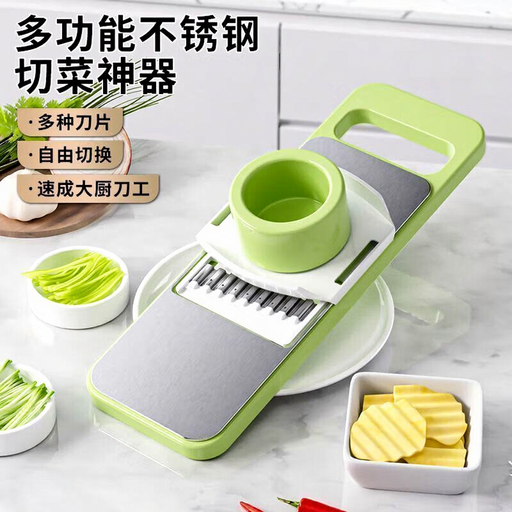
Why It's a Good Fit: Ideal for anyone looking for a simple yet safe solution for everyday cutting tasks. It offers basic functions without compromising on safety.
The included finger guard directly addresses the high injury risk of basic mandolines. The stainless steel blades are designed for normal household use and are more durable than those in many unbranded, low-cost products.
Focus on safety with an integrated finger guard. Three stainless steel blades for basic versatility (slicing, grating).
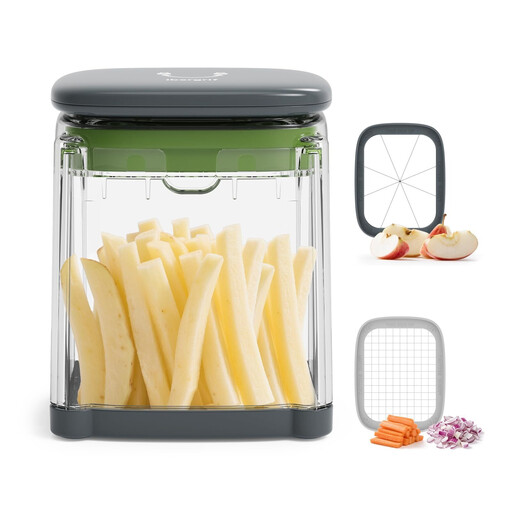
Why It's a Good Fit: This 3-in-1 system with a collection container is designed for cooks who regularly need different types of cuts—from fries and cubes to sticks for salads or stir-fries.
The closed system with a push mechanism ensures stability, as the vegetable is held firmly within the device. The 700ml container catches the cuttings directly, preventing a messy kitchen and simplifying handling compared to open slicers.
3-in-1 functionality (sticks, wedges, cubes). Blades made of 420J2N stainless steel. BPA-free material and dishwasher-safe parts according to the manufacturer.
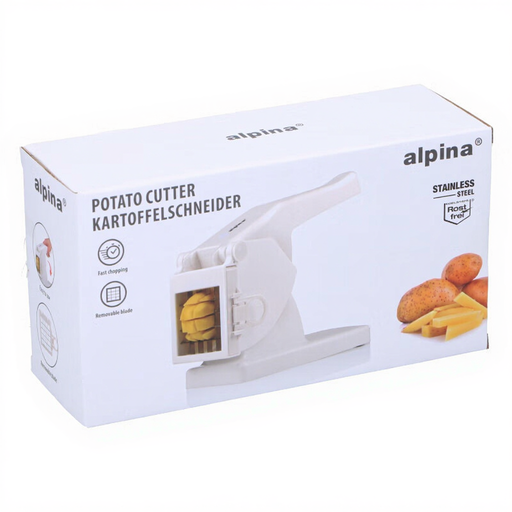
Why It's a Good Fit: A specialised French fry cutter optimised for a single task: quickly and uniformly cutting raw potatoes for perfect fries.
The sturdy lever construction of stainless steel and plastic is explicitly designed to withstand the high pressure of cutting hard, raw potatoes—a task where simple slicers often fail or break.
Specialised for making uniform French fries. Robust lever mechanism for easy and efficient force transmission.
We have compiled a complete, up-to-date list of products that meet these strict selection criteria and German safety regulations.
Even if blades are described as "stainless," they can develop surface rust if cared for improperly. Rinse the chopper and blades with clear water immediately after use to remove acids from fruits or vegetables. Then, dry the metal parts thoroughly before storing the device. For many models, hand washing is recommended to maintain the sharpness of the blades long-term.
Yes, for most use cases, an integrated collection container is a major advantage. It ensures a clean work surface by catching the cuttings directly. On many models, the container also serves as a stable base for the cutting inserts and for storing the accessories.
A safe vegetable slicer or mandoline should always come with a finger guard (food holder). This is essential for guiding the food safely over the blade. Additionally, non-slip feet or a rubberised base ensure that the device does not slip during use. A sturdy frame made of robust material is also an important safety feature.