For cooks who want fresh portions
If you want to make vegetable crisps at mealtimes, the main question is whether one basket will do or whether you need separate cooking areas.


If you usually cook small portions one after another and serve them fresh, a single basket is simpler. Two baskets make more sense if you want to cook portions independently. Compare the usable basket area, controls and counter space rather than just the total capacity. Choosing a particular appliance does not guarantee low acrylamide levels: the German Federal Institute for Risk Assessment recommends “golden, not burnt”.
If you want to make vegetable crisps at mealtimes, the main question is whether one basket will do or whether you need separate cooking areas.
If thin slices, controllable cooking and keeping an eye on how brown they get matter more to you than lots of automatic programmes, pay particular attention to the basket area and cooking progress.
If you regularly make small portions and have limited counter space, consider the appliance’s dimensions and how easy the baskets are to clean.
A good fit if: You cook small portions one after another and would rather only have one basket to clean.
The trade-off: While one portion is cooking, there isn’t a second cooking area available.
A good fit if: You want to cook two portions or dishes independently.
The trade-off: The total capacity is split between two baskets, and synchronisation doesn’t automatically mean you can serve food at different times.
| Buying priority | What to look for | Who it matters most to |
|---|---|---|
| Fresh portions at different times | Check whether you can start and set each basket separately, and whether you can use them individually. | If I want to make small portions fresh to suit different mealtimes, independent operation is important. Around 31% of consumers with this as their main priority would fall into this group. |
| Thin, crisp vegetable slices | Compare the usable basket area and check whether you can easily keep an eye on the slices and move them around while they cook. Allow for a small test batch. | For thin slices, I want enough room so they aren’t piled on top of one another, and I want to be able to monitor how they’re cooking. Around 25% of consumers who put this first would fall into this group. |
| Control over browning | Look for adjustable temperature and cooking time, and check the crisps while they cook. The German Federal Institute for Risk Assessment recommends “golden, not burnt”. | If I want to keep a close eye on browning, being able to check the food as it cooks matters to me. Around 25% of consumers with this as their main priority would fall into this group. |
| Counter space and cleaning | Measure the width and depth, as well as the available space above the appliance. Check the cleaning instructions for the specific version. | If counter space is limited, I want an appliance that fits and baskets that are easy to clean after several batches. Around 19% of consumers prioritising space and cleaning would fall into this group. |
Bosch and Philips synchronisation functions align cooking times so that everything finishes together. That’s not the same as automatically finishing portions at different mealtimes.
Choose two baskets because you can use the cooking areas independently, not just for a synchronisation function. If you already cook portions one after another, compare single-basket models too.
The capacity in litres doesn’t tell you how many thin slices will fit side by side. With a dual-basket model, the total capacity is split between separate compartments.
Compare the base area of the baskets with the size of your usual test batch, rather than looking only at the total capacity.
The German Federal Institute for Risk Assessment found high levels of acrylamide in the vegetable crisps it tested. These measurements don’t establish the acrylamide level in homemade crisps cooked in any particular appliance.
Keep an eye on how brown the crisps get, and don’t assume that measurements from other crisps or marketing claims apply to your portion.
The Series 6 Double Stack MAFD661B0 is an example of a model with two baskets stacked one above the other, for when cooking separate portions matters.
The Dual Basket NA351/00 has baskets of different sizes, making it worth considering if you cook portions of different sizes.
According to Cosori, the Turbo Tower Compact combines two baskets stacked one above the other with a compact width.
The Easy Fry Compact EY1458 is an example of a single-basket model for cooking small portions one after another.
Depending on the version, the following Joybuy models offer a viewing window, multiple containers or adjustable cooking settings. Before choosing, check that the basket area and controls suit the portions you make.
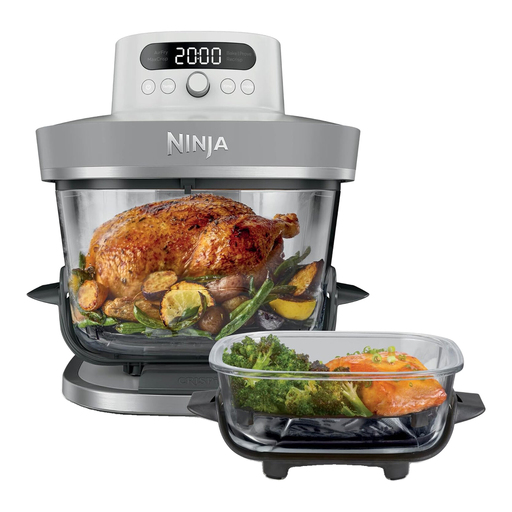 No image available
The transparent glass containers let you keep an eye on how the food is cooking.
The containers hold 5.7 l and 2.3 l and are listed as dishwasher-safe in the product description. Manual temperature and time settings are also specified.
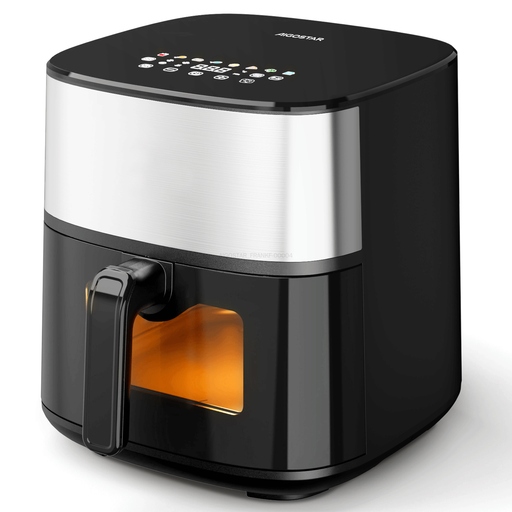 No image available
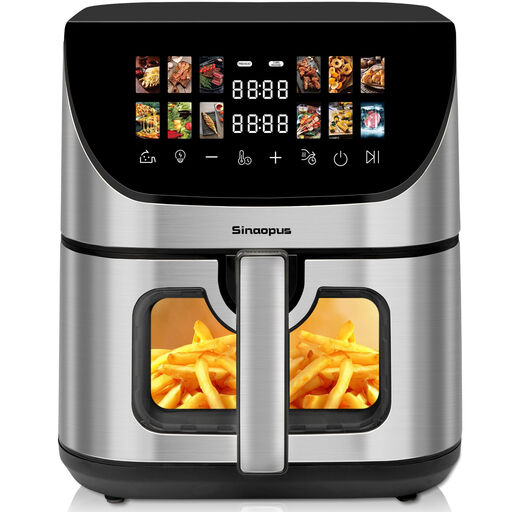
The viewing window with interior light can help you monitor how the food is cooking.
The product description lists an 8 l capacity and custom temperature and time settings via the touchscreen.
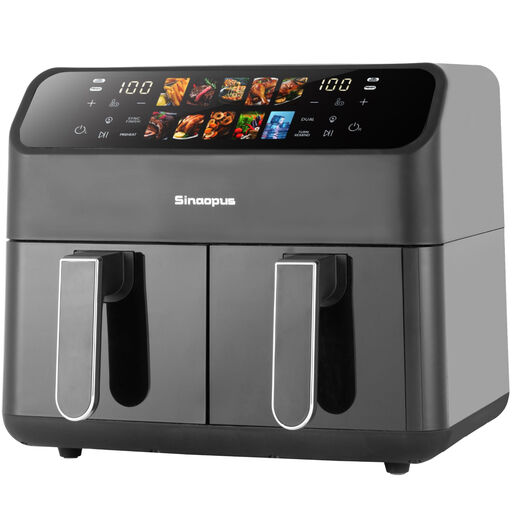 No image available
The product name specifies single or dual use and a viewing window.
Specifications include a 9 l capacity, 2200 W, a temperature range of 50–200 °C and ten preset programmes.
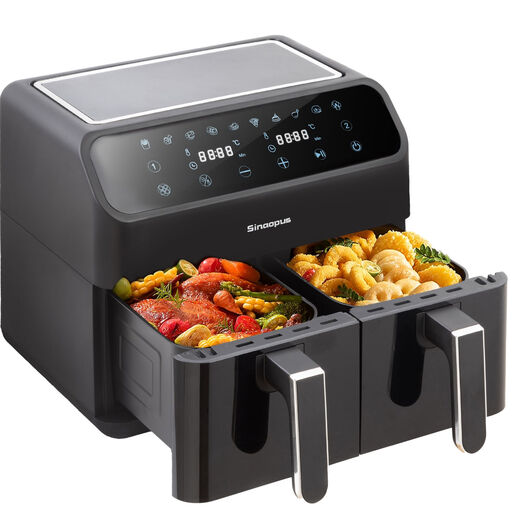 No image available
The product description lists two independent baskets for cooking separate dishes, with viewing windows to monitor cooking progress.
According to the product description, each basket holds 4.5 l, and the temperature and cooking time are adjustable.
 No image available
The viewing window lets you watch how the food is cooking.
Specifications include a 9 l capacity, a temperature range of 80–200 °C, a timer and a removable basket.
No. A programme name doesn’t guarantee the same result with every type of vegetable or slice thickness. Cut the slices evenly, watch out for moisture and check a small batch as it cooks. Philips’ preparation guidance recommends thin slices and removing moisture, but it isn’t a comparative test of air fryers.
Two baskets make sense if you want to cook portions independently. A synchronisation function aligns cooking times so that everything finishes together; it doesn’t automatically let you serve food at different times. So check whether the baskets can be operated separately and whether a single basket is big enough for your portions.
Keep an eye on how brown they get as they cook, and follow the German Federal Institute for Risk Assessment’s advice: “golden, not burnt”. The BfR-MEAL study found high levels of acrylamide in the vegetable crisps it tested; its measurements don’t represent tests of your homemade portion.
Follow the instructions for your specific model and let hot parts cool before cleaning them. Philips recommends unplugging the appliance and letting it cool before working on the inside or the heating element. Whether a basket is dishwasher-safe depends on the particular model version.
You can’t draw a general comparison of energy use for vegetable crisps from this information. Tefal’s energy figure relates to 300 g of frozen chips compared with an A-rated oven; it doesn’t tell you how much energy is used for vegetable crisps or several batches cooked at different times.