
Lieferung heute & morgen

Qualitätsgarantie

Willkommens-Angebote freischalten: KOSTENLOSE Lieferung | Bis zu 80 % RABATT | Kostenlose 30-Tage-JoyPlus-Testphase
App herunterladen
A vegetable cutter can save time when preparing salads, side dishes and vegetable stir-fries. However, models differ considerably in their cutting options, cleaning requirements and ease of use. Many product descriptions list numerous functions without explaining the details that really matter. If you focus only on a large number of attachments or an especially low price, you may end up buying a device that is difficult to clean in everyday use or does not suit your cooking style.
A multi-function vegetable cutter can slice, plane, grate or dice. However, the key question is which blades are actually included and whether they can be changed safely. Terms such as “multi-function” alone say little about practical use.
For fine strips, for example, you need a Julienne function. A vegetable cutter with a Julienne function is therefore better suited to carrots, cucumbers or courgettes than a simple vegetable slicer with just one cutting thickness.
“Stainless steel” does not automatically mean that the entire construction is made from stainless steel. On many devices, only the blades are made of metal, while the housing or blade holder is made from plastic. This is not necessarily a problem, but you should know this before buying.
Look for specific details such as blade material, housing material and dimensions. With a stainless steel vegetable cutter, it may also be relevant whether only the cutting edge or additional components are made from stainless steel.
Exposed blades pose a risk of injury, particularly when processing small pieces of vegetables. A vegetable cutter with a finger guard or pusher can keep your fingers away from the cutting area. Even so, a finger guard is no substitute for careful use.
Cleaning is equally important. Narrow gaps and permanently attached blades can make everyday use more difficult. Information such as “dishwasher-safe” should ideally be stated directly in the product details, rather than inferred from images or advertising claims.
First, consider which foods you regularly prepare:
For families or households that often prepare a variety of dishes, a model with several blades may be a sensible choice. If you mainly slice cucumbers and potatoes, however, you may not need an extensive range of features.
Stainless steel blades are easy to care for and resistant to corrosion in everyday kitchen use, provided they are dried thoroughly after cleaning. 304 stainless steel refers to a specific grade of stainless steel that is commonly used for kitchen utensils. However, the material specification alone does not provide a complete indication of the cutting performance or service life of the product as a whole.
Also check whether the blade holder is securely fitted and whether the device remains stable during use. Dimensions such as length, width and height are important if you plan to store the kitchen slicer in a drawer or cupboard.
A pusher or holder is an important feature for mandolines and exposed cutting surfaces. Use it even with larger leftover pieces, and do not guide food along the blade directly with your hand.
The following details are helpful for straightforward care:
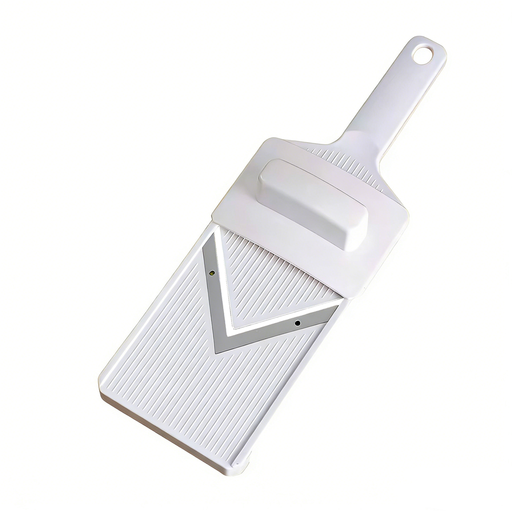
Why this product suits this profile: This model is aimed at households looking for a versatile device for preparing vegetables, with the flexibility to handle a range of slicing and grating tasks. The product name also indicates that it includes a board for grating cabbage.
Before buying, check the product page to see exactly which attachments are included and how the device should be cleaned. This helps you avoid relying solely on a general multi-function description.
Described as a vegetable shredder and slicer; designed for several preparation tasks, including cabbage.
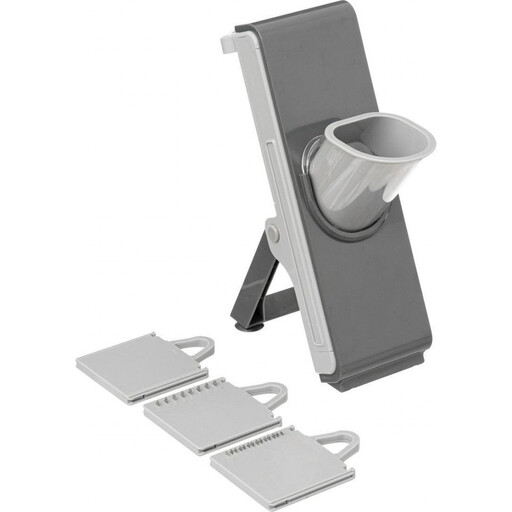
Why this product suits this profile: This mandoline combines several functions with specific material and dimension details. It is suitable for users who regularly prepare slices, grated ingredients or cut vegetables.
The product information specifies stainless steel for the blades, ABS for the housing or blade holder, and a pusher for use.
Stainless steel blades, a pusher with finger guard, dimensions of 26.5 × 15 × 9.5 cm and, according to the product information, dishwasher-safe.
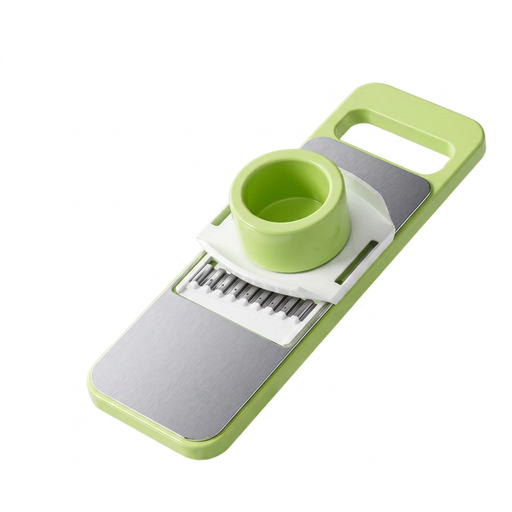
Why this product suits this profile: This model is designed for onions, potatoes and cucumbers, combining three functions: chopping, slicing and Julienne cutting.
The integrated hand holder keeps your fingers away from the blade area while cutting. Careful use and cleaning are still required.
Three stated cutting functions, food-safe stainless steel blades and a hand guard for holding food.
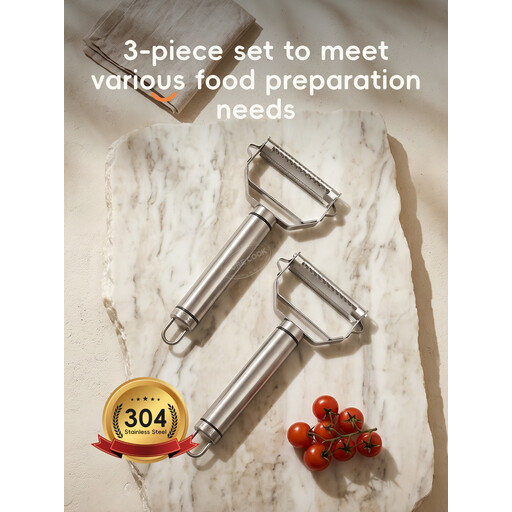
Why this product suits this profile: This set is aimed at users who frequently peel potatoes, carrots, apples or soft-skinned fruit and need different types of edges for the job.
The material specification states 304 stainless steel, while straight and serrated edges are clearly distinguished. The safety warning explicitly points out that the blades are sharp.
Three peelers, 16.8 × 6.6 cm each, straight and serrated blades and, according to the product information, dishwasher-safe.
We have put together a complete, regularly updated list of products that fully meet these strict selection criteria and the safety regulations applicable in the EU.
For carrots, you could choose a kitchen slicer, vegetable grater or a model with a Julienne function. The right option depends on the shape you want: a slicer creates slices, a Julienne blade produces fine strips and a grating surface creates grated carrots. When working with firm carrots, the food holder should be stable.
Its service life depends on the blade material, build quality, frequency of use and care. Wash the device after use, remove any residue from the attachments and dry metal parts before storing them. Do not continue using the product if the blades are blunt or damaged.
That depends on the model. Some products, including the 5five and PURECOOK models mentioned above, are described as dishwasher-safe in the product information. Before putting the device in the dishwasher, check whether this applies to all components. Sharp blades should be placed securely so that they do not damage other parts or pose a risk of injury when you unload the dishwasher.