
Lieferung heute & morgen

Qualitätsgarantie

Willkommens-Angebote freischalten: KOSTENLOSE Lieferung | Bis zu 80 % RABATT | Kostenlose 30-Tage-JoyPlus-Testphase
App herunterladen
A vegetable cutter can help you prepare salad ingredients, side dishes and fruit for the kitchen more quickly. However, not every model is right for every household. Some appliances advertise a wide range of attachments, even though they are awkward to change. Others appear versatile but lack adequate finger guidance or collect food residue in hard-to-reach areas.
Three common buying misconceptions are particularly widespread:
For a vegetable cutter, mandoline vegetable slicer or kitchen grater, the blade material is a key consideration. Stainless steel is often used for cutting and grating surfaces because it is suitable for kitchen use and relatively easy to maintain. Look for clear product information stating whether the stainless steel applies only to the blade or to other components as well.
A stainless-steel vegetable slicer can produce evenly sized slices when cutting cucumbers, potatoes or carrots. For hard foods such as nuts or hard cheese, however, a sturdy vegetable grater with a suitable grating surface is more practical. For plastic components, the product description should specify their function, such as serving as a collection container, handle or blade guard.
Sharp blades require controlled guidance. Useful features include:
A manual vegetable cutter works without a power connection and can usually be used flexibly. However, safety depends more heavily on the design and correct use. Vegetables should be guided using the holder provided for this purpose. Small leftover pieces should not be pushed towards the blade with your fingers.
Before buying, it is worth checking the dimensions and cleaning requirements. A large appliance needs more storage space, but can provide a more comfortable working surface when preparing larger quantities. Compact models are suitable for small kitchens and occasional use.
Also check:
A vegetable grater is suitable for cheese, chocolate, nuts or vegetables, while a vegetable chopper is better suited to smaller pieces of onions, herbs and fruit. For guacamole or sandwiches, an avocado slicer can be a useful specialist addition.

Why this product suits the profile: This manual kitchen helper has a 220-ml container and is designed for small quantities of onions, herbs, garlic, fruit or nuts, with no power connection required.
The clearly defined container makes the intended area of use easy to understand, rather than promising an unwieldy number of cutting attachments.
Manual pull-cord operation, a compact 220-ml capacity and suitability for several small ingredients.
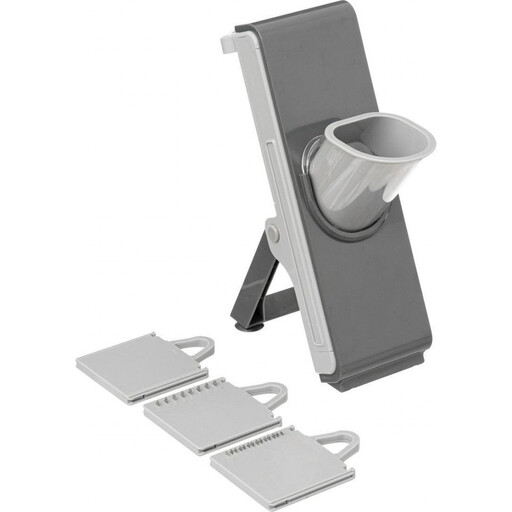
Why this product suits the profile: This mandoline features stainless-steel blades, an ABS plastic body, multiple functions and stated dimensions of 26,5 × 15 × 9,5 cm.
The manufacturer explicitly states how the materials are distributed. A pusher and finger guard are also included, so operation does not rely solely on direct finger pressure.
Cutting, shredding and chopping in one appliance; according to the product information, it is dishwasher-safe and comes with a two-year statutory warranty in the EU.
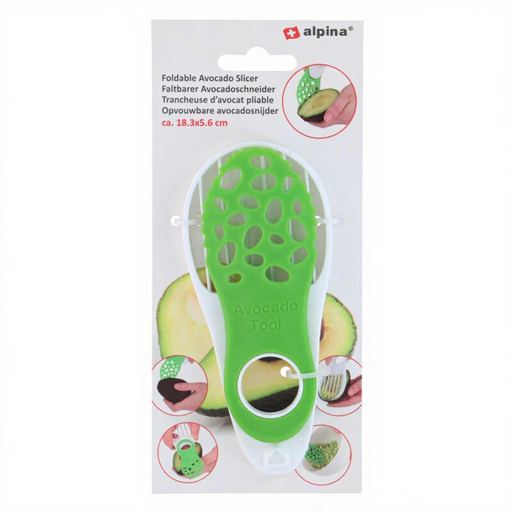
Why this product suits the profile: Designed for avocado halves, guacamole, salads and sandwich fillings, this compact tool combines three steps: removing the stone, slicing and peeling.
If you mainly prepare avocados, you do not necessarily need a large multi-purpose vegetable cutter with attachments you will never use.
Food-safe PP plastic, three dedicated functions and compact dimensions of 12,5 × 5,6 × 1 cm.
We have put together a complete, regularly updated list of products that fully meet these strict selection criteria and the safety regulations applicable in the EU.
For small quantities of onions, a manual vegetable chopper with a collection container can be practical. If you need evenly sized slices or strips, a vegetable slicer or mandoline is more suitable. A finger guard should always be used with sharp blades.
Its lifespan depends on the material, blade quality, cleaning and storage. Stainless-steel blades should be cleared of food residue and dried completely after use. Plastic components can be damaged by incorrect cleaning, strong impacts or high temperatures. Always follow the care instructions provided by the relevant manufacturer.
A manual vegetable cutter does not require electricity, so it incurs no ongoing energy costs during use. The main considerations are cleaning, changing attachments and, where necessary, replacing damaged blades or accessories. When making your decision, therefore, consider not only the purchase price but also how often and for which foods you will use the appliance.