
Lieferung heute & morgen

Qualitätsgarantie

Willkommens-Angebote freischalten: KOSTENLOSE Lieferung | Bis zu 80 % RABATT | Kostenlose 30-Tage-JoyPlus-Testphase
App herunterladen
A vegetable knife is one of the handy kitchen tools used for peeling, coring, cutting and garnishing. Even so, the wide choice can quickly lead to poor purchases. A striking colour, a supposedly especially sharp edge or the description ‘stainless’ alone says little about whether the knife suits your own way of working.
This guide explains which features matter before you buy and which models may suit different households, home cooks and frequent users.
A longer knife is not automatically more practical. For small ingredients and precise tasks, 8 cm vegetable knives are often easy to control. A 10 cm vegetable knife, on the other hand, offers a little more reach and is also suitable for larger apples, peppers or smaller pieces of meat, provided the manufacturer specifies this use.
If you choose solely by the maximum blade length, you may end up buying an unnecessarily cumbersome knife for delicate tasks.
A stainless steel knife is more resistant to corrosion than unprotected steel. However, residues from salt, acid or moisture can still affect the surface. Dishwasher salt, high temperatures and contact with other cutlery can also affect the edge.
The term dishwasher-safe describes the intended cleaning method, not necessarily the gentlest way to care for the knife. For high-quality or hand-forged models, hand washing is often advisable.
A serrated vegetable knife, or a vegetable knife with a serrated edge, can be helpful with soft fruit and smooth skins. The teeth grip into tomato skin, for example, without requiring much pressure. For evenly sized cubes or controlled cuts, a straight edge is often easier to guide.
The specific intended use is therefore what matters, rather than general advertising claims about sharpness.
A paring knife is usually particularly compact and designed for peeling. A tourné knife often has a curved blade for creating decorative shapes. A fruit knife overlaps partly with a vegetable knife, but depending on the model, it is more focused on soft fruit and small portions.
A straight edge is suitable for clean cuts through firmer foods, as well as for cubes, strips and delicate garnishes. A serrated edge is useful when the surface is soft but the skin is comparatively tough.
Sharpening a serrated knife is more demanding than sharpening a straight blade. If you want to maintain the edge yourself, you should take this difference into account before buying.
Look for specific details about:
When storing knives, do not leave them loose in a drawer. A knife block, knife bag, blade guard or suitable drawer insert reduces contact with other kitchen utensils.
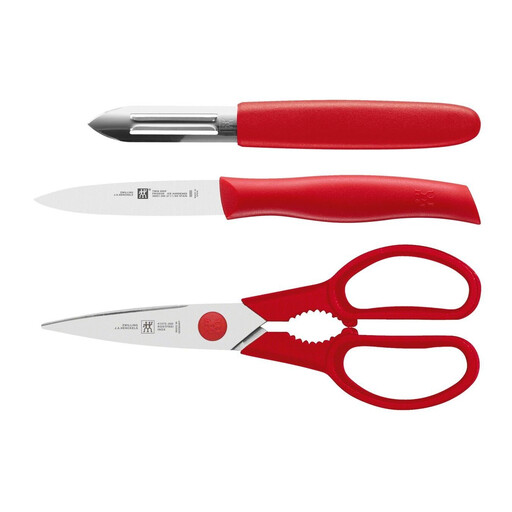
Why this product suits the profile: The set combines a paring or vegetable knife, a peeler and kitchen scissors. This gives households several tools for everyday food preparation.
The contents are clearly specified. Buyers do not have to combine several individual products with different handles and care instructions.
Three pieces, 18/10 stainless steel and textured, non-slip handles. According to the product details, the set is dishwasher-safe; hand washing is recommended to help protect it.
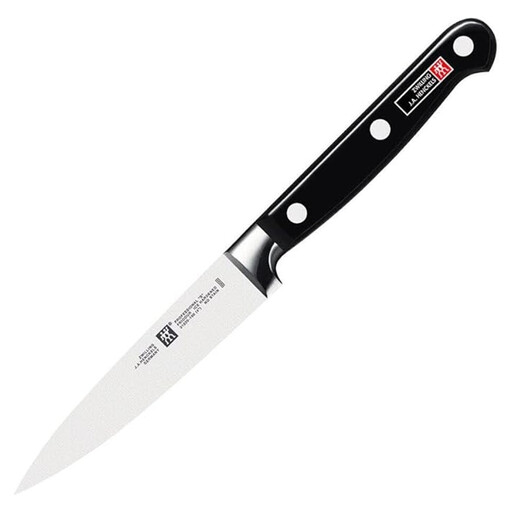
Why this product suits the profile: The 10 cm blade is designed for precise peeling, trimming and garnishing. Its forged construction is aimed at users who value clearly defined material and manufacturing details.
The product description specifies a blade made from special-melt steel, Friodur hardening and Sigmaforge construction. At the same time, hand washing is clearly stated as the recommended care method.
Forged from a single piece, with a slim 10 cm blade and a plastic handle with finger protection provided by the transition to the bolster. Hand washing is required.
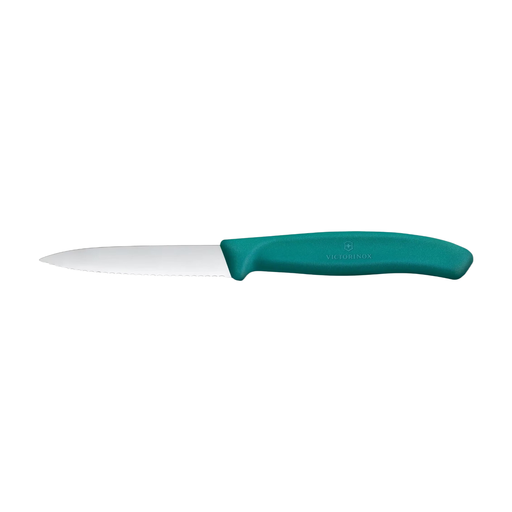
Why this product suits the profile: The 8 cm serrated blade is designed for soft fruit and vegetables with firmer skins. The low weight of 20 g supports quick, controlled movements.
The serrated edge is specified as a concrete product feature, rather than being promoted solely with a general claim about sharpness. Dishwasher suitability is also stated.
Corrosion-resistant stainless steel, ergonomic polypropylene handle, Swiss manufacture and an 8 cm serrated edge. Hand washing can provide additional protection for the edge.
We have put together a complete, regularly updated list of products that fully meet these strict selection criteria and the safety regulations applicable in the EU.
In Germany, legal requirements apply to carrying certain knives in public places. Kitchen knives should therefore only be transported securely packaged and solely for a legitimate, identifiable purpose.
It depends on the task. 8 cm offers a high level of control when working with small ingredients and on detailed tasks. 10 cm is practical if you regularly prepare larger fruit and vegetables or make longer cutting movements. Both sizes are sensible choices for a versatile kitchen knife.
A paring knife is usually particularly compact and designed for removing skins. A vegetable knife can also be used for cutting, coring, trimming and garnishing. The names overlap depending on the manufacturer.
Yes, provided the manufacturer explicitly states this. However, hand washing followed by drying is often gentler and helps preserve the edge and handle for longer. The care instructions should be followed particularly carefully for forged models or those that require hand washing.