What should you look for when buying?
For vegetable lasagne in a shared kitchen, first check that your dish will fit. Then consider where the oven will go, its power connection, cleaning and ongoing costs.
Use the oven you have
A good fit if: you can use the oven when you need it and your dish, with the amount you want to cook, will fit inside.
The trade-off: you’ll need to agree on when to use it and who will clean it. In return, no extra appliance takes up shared worktop space.
Choose a freestanding mini oven
A good fit if: you want to bake independently and have a safe spot for it, with a suitable power connection.
The trade-off: a smaller cooking space may limit the size of dish you can use, and the appliance will take up room.
| Consideration |
What to look for when buying |
Who should pay particular attention? |
| Dish size and portion quantity |
Compare your dish, including the handles, with the usable internal area and shelf height. |
If I’m cooking for several housemates, the dish needs to fit with its handles so I can make the amount I want in one go. Around 40% of consumers are likely to prioritise whether their dish will fit for this reason. |
| Space and power connection |
Check the clearance needed around the appliance and its power requirements, and consider what else is plugged into the same connection. |
If worktop space is limited, I want to know whether the oven can be positioned safely and how the shared power connection will be used. Around 30% of consumers are likely to focus on this. |
| Cleaning |
Check the cleaning instructions and details of removable parts or easy-to-reach internal surfaces. |
If several people use the oven, I want to be able to leave it clean for the next person after baking. Around 20% of consumers are likely to put cleaning first. |
| Energy use and running costs |
Compare energy figures only when they use the same measurement basis; for mini ovens, check what the figures apply to. |
If running costs matter to me, I want to understand energy figures on a like-for-like basis. Around 10% of consumers are likely to have this as their main consideration. |
Joybuy products for this topic
The products below include built-in ovens as well as freestanding mini and combination ovens. Before buying, compare the dimensions of your baking dish with the usable internal space of the model you’re considering.
 No image available
Bosch HBA571BB4 Series 2 built-in oven, 71 l
An option if you have a suitable space for a built-in oven.
71 l capacity; 3D hot air; pyrolytic self-cleaning.
View at Joybuy
 No image available
Comfee built-in oven, 60 cm, 70 l
For a kitchen with a suitable built-in space; check the dimensions of your baking dish first.
70 l capacity; 3 kW; grill; steam cleaning; LED display with timer; energy class A.
View at Joybuy
 No image available
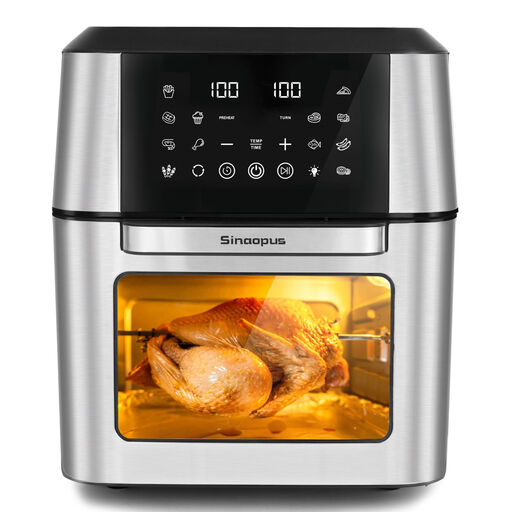
Sinaopus 12L XXL Air Fryer & Mini Oven, 1800 W
A combination option if you’re looking for an appliance that can bake as well as air fry.
12 l; touchscreen; timer; 12 programmes.
View at Joybuy
 No image available
Woltu BF12sz mini oven, 32 l
A freestanding option if you need an oven of your own and have enough space for it.
32 l; 1600 W; timer; crumb tray; temperature range 100 to 250 °C; described as suitable for baking and grilling.
View at Joybuy
 No image available
Woltu Mini Convection Oven, 28 l
A freestanding option if you’re looking for a separate mini oven with a fan-assisted function.
28 l; temperature control; timer.
View at Joybuy
Frequently asked questions
Is a 20 or 30-litre cooking space big enough for my lasagne?
You can’t tell from the capacity in litres alone. Measure your dish, including the handles, and compare its width, depth and height with the usable internal space of the specific oven. For the BG 1805/E, Rommelsbacher gives dimensions of 34 × 28 cm and recommends using a slightly smaller dish.
Can I put a countertop oven in a tight shelving space or plug it into a shared extension lead?
Don’t decide based on the appliance’s external dimensions alone. Follow the model’s installation and connection instructions; a freestanding appliance isn’t a built-in oven. The Institute for Loss Prevention and Loss Research has documented a fire after an extension lead was overloaded in a shared-flat kitchen.
Which energy figure is useful for comparing costs?
For a household oven covered by the EU label, energy use is given in kWh per standard cooking cycle for the specified heating functions. This isn’t a measurement of the energy used to cook your lasagne, and it can’t automatically be applied to every countertop oven. The European Commission lists small ovens as outside the scope of its information on household ovens.
What should I check about repairs and disposal?
Check whether spare parts and a repair service are available for the specific model; Severin lists a repair service for the TO 2068. A worn-out electric oven shouldn’t go in your household rubbish: according to the German Federal Environment Ministry, you can take it to a local authority collection point. Retailers’ take-back obligations depend on the relevant legal requirements.
Is a CE mark an official safety seal?
No. According to the European Commission, the CE mark is the manufacturer’s declaration that the product meets the relevant requirements; it doesn’t mean an EU authority has approved that individual appliance as safe. Among other things, Germany’s Federal Network Agency recommends checking the product’s identity, manufacturer information and safety instructions in German.


