
Lieferung heute & morgen

Qualitätsgarantie

Willkommens-Angebote freischalten: KOSTENLOSE Lieferung | Bis zu 80 % RABATT | Kostenlose 30-Tage-JoyPlus-Testphase
App herunterladen
A vegetable peeler is one of the kitchen tools we reach for most often. Even so, models can vary considerably in how the blade works, the handle feels, the materials used and how easy they are to clean. If you focus only on a sharp blade or a low price, you may not notice potential drawbacks until you use it every day.
Three common buying misconceptions are worth bearing in mind:
The blade design affects how easily and precisely you can remove the skin, while keeping waste to a minimum.
With a Y-peeler, the blade moves in the direction of the stroke, helping it follow the contours of the food. This design is commonly used for potatoes, carrots, apples, cucumbers and asparagus. A handle that can be used from either side may be useful for both left- and right-handed cooks.
A straight peeler is designed to remove as little skin as possible. This is useful for potatoes, carrots and apples when you want to waste as little flesh as possible. What matters is not just the advertised sharpness, but also whether the blade moves smoothly and sits securely in its holder.
A small paring knife is useful for trimming blemishes, preparing small fruits or making controlled cuts. Its compact blade allows precise handling, but it needs to be used with care. For peeling larger areas, a traditional peeler is usually quicker.
A ceramic peeler can be corrosion-resistant, but generally needs careful handling. Ceramic blades should not be used on hard surfaces or twisted while in use. Stainless steel blades are usually versatile and more hard-wearing for everyday use. Whichever type you choose, never test a sharp blade with your fingers.
Check whether you need a straight peeler, a Y-peeler or a model with a serrated blade. Straight blades are often used for firm skins, while serrated blades can be useful for softer foods. A fruit and vegetable peeler with multiple blades can be versatile, but only if you’ll use the extra functions regularly.
An ergonomic handle should feel secure in your hand and remain easy to control when preparing damp foods. If you have a lot of preparation to do, the weight, handle width and blade position all matter. Left-handed cooks should check whether the model is specifically suitable for use with either hand.
A lightweight peeler is often enough for home use. In catering businesses or when preparing larger quantities, a sturdy stainless steel design that’s easy to clean may be more practical. However, a heavy weight is not a reliable sign of quality.
For models listed as dishwasher-safe, check the manufacturer’s specific instructions. Knives and peelers with wooden handles are often recommended for hand-washing. Drying thoroughly after cleaning is a good idea, especially around joints and blade holders.
Also look out for:

Why this product suits this profile: This model is designed as a simple fruit peeler for everyday tasks such as peeling apples, potatoes and other vegetables.
The product details focus on the basic peeling function rather than highlighting extra features you may not use.
Designed for fruit and vegetables; compact design for everyday kitchen use.
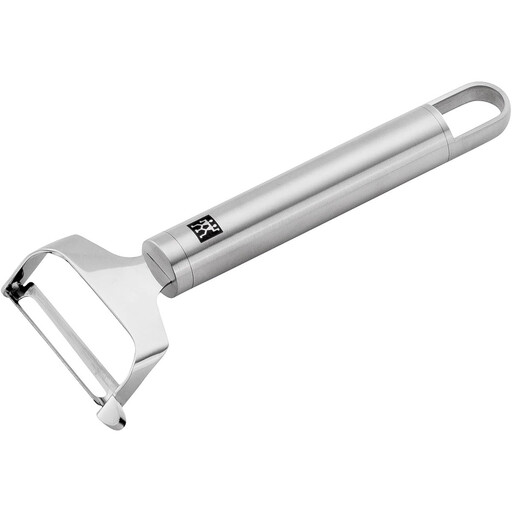
Why this product suits this profile: According to the product details, this Y-peeler has a flexible stainless steel blade and handle, and is suitable for both right- and left-handed users.
The product details clearly specify the material, dimensions of 17 × 6.5 × 2 cm, weight of 96 g and dishwasher suitability.
Flexible blade; stainless steel construction; stated to be suitable for either hand.
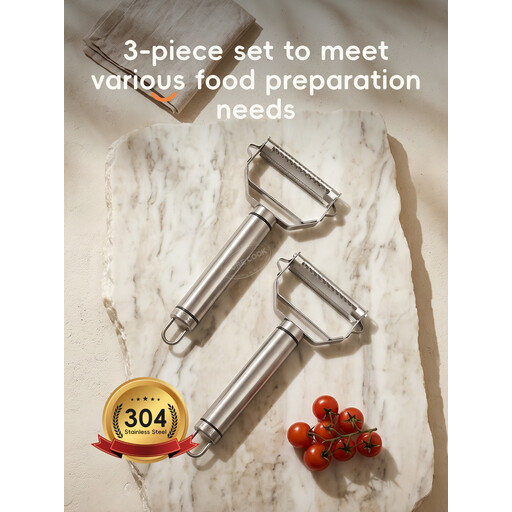
Why this product suits this profile: This three-piece set combines straight and serrated blades, and is designed for use at home, in catering, while camping and when preparing a variety of foods.
The different blades mean you don’t have to use the same type of blade for firm and softer skins.
Made from 304 stainless steel according to the product details; three double-sided peelers; listed as dishwasher-safe.
We’ve put together a complete, regularly updated list of products that meet these strict selection criteria and the safety requirements applicable in the EU.
A straight peeler or Y-peeler with a sturdy blade is suitable for potatoes. If you’re preparing large quantities, a model with an ergonomic handle that’s easy to clean may be more comfortable to use. Don’t continue using blades that are damaged or loose.
How long it lasts depends on the quantity of food you prepare, the blade material, cleaning and storage. Hard surfaces, unsuitable foods and abrasive sponges can damage the cutting edge. Without information from the manufacturer, it’s not possible to give a general estimate of its lifespan.
Some models are listed as dishwasher-safe in their product descriptions, while others should be washed by hand. For peelers with wooden handles or ceramic blades, or where the care instructions are unclear, hand-washing with a mild detergent and drying afterwards is the more cautious approach.