For preparing several lunchboxes at once
If you’re batch-cooking for several days, the usable tray area and skewer length are what matter. Check that your planned quantity will fit in one batch.


Before you buy, measure your skewers, the tray area you’ll need and the number of portions: oven capacity alone won’t tell you whether everything will fit in one batch. For larger quantities, a built-in oven or one that fits your kitchen may be a good choice. For smaller portions, a countertop oven could work, as long as the skewers and tray fit inside. An air fryer is another option if its basket has enough room and allows air to circulate. If you’re preparing lunchboxes, remember to plan how you’ll chill the food after cooking. Germany’s Federal Centre for Nutrition describes oven-cooked dishes as suitable for lunch breaks.
If you’re batch-cooking for several days, the usable tray area and skewer length are what matter. Check that your planned quantity will fit in one batch.
A countertop oven could be an option for smaller quantities. Measure the space available and check the positioning and ventilation requirements for the specific appliance.
If you want to choose the heating function to suit your recipe, check that the appliance has the features you need, such as top heat, a grill or a fan setting, and that your skewers will fit inside.
A good fit if: you’re cooking lots of skewers at once and already have a suitable oven or space for a built-in model.
Things to consider: A built-in model needs a suitably sized niche; a large oven isn’t automatically practical if you’re only cooking a few skewers.
A good fit if: you don’t need a built-in oven and your skewers and tray fit inside the usable cooking space.
Things to consider: Smaller appliances may need several batches, while larger countertop models take up more worktop space.
A good fit if: you’re cooking small portions and can fit the skewers in the basket with space between them.
Things to consider: The basket’s size may limit the length and number of skewers. If needed, check whether the appliance is designed to work with suitable skewer accessories.
| Priority | What to check before buying | Who is this important to? |
|---|---|---|
| Usable space | Compare the skewer length and quantity you need to the internal and tray dimensions. | If I’m preparing several lunchboxes at once, I want to get everything done in one batch if possible. Around 31% of consumers put usable space first. |
| Space available | Measure the worktop, door clearance and the clearances specified for the model. | In a small kitchen, the appliance needs to sit safely without taking up too much of the available space. Around 25% of consumers prioritise finding a suitable spot for it. |
| Heating function | Check that the model has the top heat, grill function or fan setting you need. | If I want to control how brown my skewers get, I need a setting that suits my recipe. Around 19% of consumers choose primarily based on the heating function. |
| Cleaning | Check what’s included, whether there’s a crumb tray and the cleaning instructions for the exact model. | If I batch-cook regularly, I want to be able to clean off residue from marinated skewers without unnecessary effort. Around 13% of consumers look at cleaning first. |
| Energy use | For suitable domestic ovens, check the energy use per standard cycle. Don’t compare different types of oven unless they’ve been tested under comparable conditions. | If I batch-cook often, I want to factor in the energy used for the cooking time I need. Around 12% of consumers put this first. |
The oven’s capacity won’t tell you how long the tray is or whether your skewers will fit on it. The internal dimensions can differ from the external ones.
Measure your skewers and planned quantity, then compare them with the tray and internal dimensions of the specific appliance.
If the skewers and tray don’t fit, you may need to cook in extra batches.
Feet and required clearances can increase the amount of space you need. For the Rommelsbacher BG 1805/E, the manufacturer specifies a worktop at least 55 cm wide, including space for the feet.
Before buying, check the width across the feet and all the positioning requirements for the specific model.
If the space is too tight, you may not be able to put the appliance where you planned and will need to find another spot.
The number of shelf positions listed doesn’t, by itself, tell you whether you can use several trays with your skewers at the same time.
Check the instructions, the trays supplied and which heating functions and shelf positions are approved for use.
If you can only use one suitable shelf position, cooking extra batches could take more time.
An oven can’t replace proper food storage. Germany’s Federal Institute for Risk Assessment highlights the risk of inadequate chilling for perishable foods during transport and storage.
Plan time to cool the food, keep it sealed and chilled, and make sure it can stay cold until your lunch break.
If you won’t have access to refrigeration on the way, you may need suitable extra equipment for transporting or storing your food.
Countertop ovens for different batch sizes; the BG 1805/E is an example of a larger freestanding model.
The TO 2068, with a capacity of around 20 l, is an example of a more compact countertop oven.
The KB M19, with a capacity of 19 l, is an example of a small countertop oven.
A built-in oven is one option if you have a suitable kitchen niche and plan to cook larger quantities.
The appliances below include built-in and countertop oven options for cooking vegetable skewers.
 No image available
This built-in model could be a good option if you have a suitable niche and want to prepare several lunchboxes at once.
Features listed in the product title include a 60 cm width, AirFry and 3D hot air. The product information says professional installation is required.
 No image available
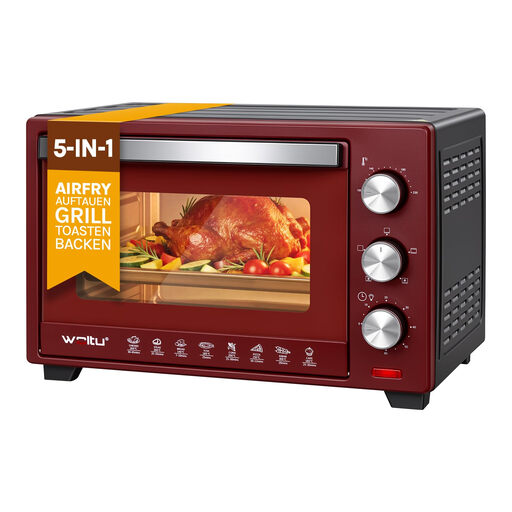
This countertop model could be a good option for a smaller kitchen, provided there’s room for it and the skewers and tray fit inside.
Features listed in the product title include a 32 l capacity, 1,600 W, a timer, a removable crumb tray and a temperature range of 100 to 250 °C. It’s designed for baking and grilling.
 No image available
A countertop oven could work if you’re cooking a smaller batch and your skewers and tray fit inside the usable cooking space.
Features listed in the product title include a 28 l capacity, temperature control and a timer.
No. What matters is the quantity you’re cooking, the length of the skewers and the usable space. If your existing oven can fit the portion you’re planning, there’s no need to buy another large oven just for this dish.
It depends on the requirements for the specific model. Check the positioning and ventilation guidance in the instructions. For the BG 1805/E, Rommelsbacher requires a base at least 55 cm wide, including space for the feet.
Once cooled, keep pre-cooked food sealed and chilled, and make sure it can stay cold until you’re ready to eat. Germany’s Federal Institute for Risk Assessment warns that inadequate chilling of perishable foods during transport and storage can pose a risk.
For domestic ovens covered by the label, it shows energy use per standardised cycle for top and bottom heat and for fan cooking, as explained by the consumer advice centre. It doesn’t measure the energy used for your specific recipe, so don’t compare different types of oven unless they’ve been tested under the same conditions.
The number of shelf positions alone won’t tell you. Check the instructions for your specific model to see whether it’s approved for using several trays at once with your chosen heating function and tray arrangement.