
Lieferung heute & morgen

Qualitätsgarantie

Willkommens-Angebote freischalten: KOSTENLOSE Lieferung | Bis zu 80 % RABATT | Kostenlose 30-Tage-JoyPlus-Testphase
App herunterladen
Manually slicing vegetables can be time-consuming and tedious, especially when you need uniform results for salads, gratins, or side dishes. A good vegetable slicer promises a solution: fast, precise cuts with minimal effort. However, the market is flooded with models whose promises often don't hold up to reality. Many buyers quickly find that their new kitchen gadget brings more frustration than relief.
As your Joybuy Product Recommendation Officer, I'm here to help you recognise the common pitfalls and make an informed decision. This guide focuses on the crucial features that define a durable and useful vegetable cutter, showing you what to look for before you buy.
When you buy a vegetable slicer, you expect efficiency and clean results. Unfortunately, certain flaws often lead to the device being left unused in a drawer. Be sure to avoid these three common problems:
To avoid buyer's remorse, you should focus on objective and verifiable criteria. These three aspects are crucial for the functionality and longevity of a vegetable slicer.
The quality of the blade determines the cutting performance. Look for models with blades made of hardened stainless steel. This material is corrosion-resistant and retains its sharpness for significantly longer. There are two main types of blades:
An adjustable vegetable slicer offers maximum flexibility. The ability to adjust the slice thickness, either continuously or in fixed increments, allows you to prepare everything from paper-thin carpaccio slices to thicker gratin slices with a single device.
A multi-function slicer further expands the range of applications. Look for included inserts that enable different types of cuts:
Safety is non-negotiable. A high-quality vegetable slicer must have a robust finger guard (also called a food holder) that securely guides the food and keeps fingers away from the blade. Non-slip rubber feet ensure a stable footing on the work surface.
A vegetable slicer with a collection container is another practical feature. It catches the sliced food directly, ensures a clean work environment, and makes further processing easier. The container should fit snugly under the slicer and have sufficient volume.
Here are some product recommendations tailored to different needs and kitchen habits.
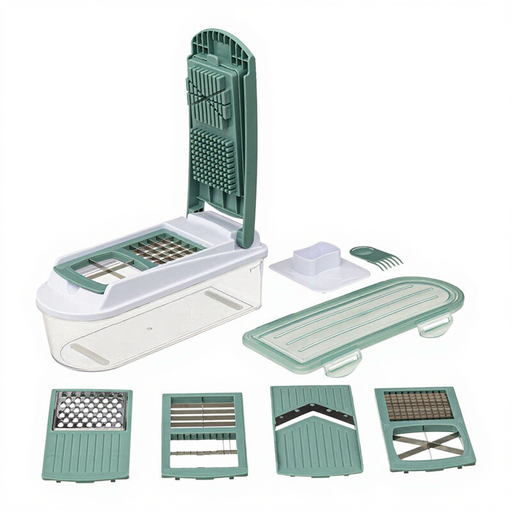
Why It's a Match: Ideal for families and home cooks who cook regularly and are looking for an all-in-one solution. This set covers a wide range of applications, from slicing and dicing to grating, saving valuable cupboard space.
The blades are made of stainless steel. The sturdy ABS plastic frame provides stability, while the included finger guard ensures safety. The collection container prevents mess and simplifies cleaning.
A comprehensive set with multiple inserts for maximum versatility. Integrated collection container with a lid for a clean kitchen and easy storage.
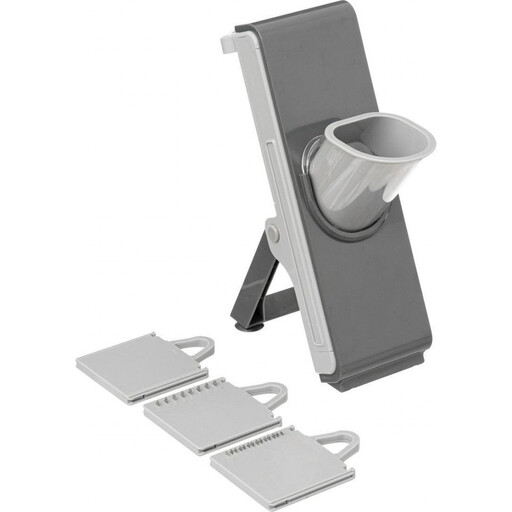
Why It's a Match: A solid choice for anyone looking for a classic **mandoline** for basic slicing and shredding tasks without investing in a large set. Compact and streamlined to the essentials.
This model relies on a sharp stainless steel blade and a stable ABS plastic frame. A finger guard is included to meet basic safety requirements.
Compact design for easy storage. Focuses on the core function of slicing, making it simple to handle and clean.
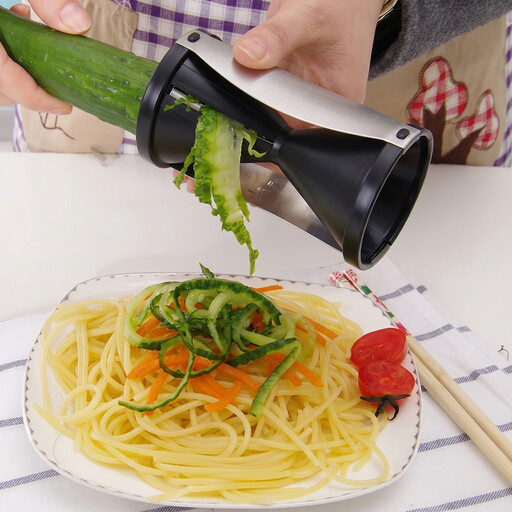
Why It's a Match: For anyone who wants to make vegetable noodles (zoodles), spirals for salads, or decorative garnishes. This **Julienne Slicer** is a specialised tool for creative and healthy dishes.
As a specialised tool, its design is focused on a single, safe function. The handling minimises direct contact with the blades, and the construction is optimised for processing vegetables like courgettes or carrots.
Creates uniform spirals and Julienne strips. A simple and effective method to incorporate more vegetables into your diet in a creative way.
We have compiled a complete, up-to-date list of products that fully meet these strict selection criteria and safety standards.
Remove coarse residue immediately after use under running water. Use a dish brush to clean the blades, always moving the brush away from the sharp edge. Many models have dishwasher-safe parts, but always check the manufacturer's instructions. Slicers that can be disassembled are the easiest to clean thoroughly.
The lifespan of the blades depends heavily on the material (hardened stainless steel is preferable) and the frequency of use. With regular household use, a high-quality blade should remain sharp for several years. Avoid cutting very hard foods or contact with bones to preserve sharpness.
Yes, in most cases, a vegetable slicer with a collection container is a worthwhile investment. It ensures a clean work surface, as the sliced food is not scattered on the countertop. Additionally, the sliced vegetables can be collected, temporarily stored, or further processed directly in the container, making the entire cooking process more efficient.