
Lieferung heute & morgen

Qualitätsgarantie

Willkommens-Angebote freischalten: KOSTENLOSE Lieferung | Bis zu 80 % RABATT | Kostenlose 30-Tage-JoyPlus-Testphase
App herunterladen
A vegetable slicer can save time when preparing salads, potato dishes, side dishes and raw vegetables. However, the appliances differ considerably in terms of blades, operation and cleaning. If you focus only on the number of functions or eye-catching marketing claims, you can quickly end up buying a model that sees little use in everyday life.
A vegetable slicer with several blades sounds versatile. What matters, however, is which cutting styles are actually included: slices, cubes, sticks, julienne strips or grating. Some appliances offer several inserts that differ only slightly from one another. Before buying, you should therefore be clear about which foods you regularly want to prepare.
A mandoline vegetable slicer is often suitable for carrots, cucumbers and potatoes. If you want to chop onions, herbs or smaller quantities of vegetables, you are more likely to need a vegetable chopper or onion cutter. A vegetable grater, meanwhile, is designed for cheese, carrots or chocolate and does not automatically replace a slicer.
Slicing and grating blades need to be sharp to cut vegetables evenly. This creates a risk of injury if the finger guard is missing or the food becomes too small for the holder. Look for a hand guard, a vegetable holder and a non-slip base. When using the appliance, always keep your fingers away from the cutting area.
Fine graters and blades can retain vegetable residue. A complicated design with lots of individual parts makes cleaning take longer and may mean that the appliance is used less often. Check whether the inserts can be removed, whether the material is dishwasher-safe and whether the manufacturer specifically recommends hand washing.
For a typical household, an appliance with two or three clearly different functions is often sufficient. For example, a 3-in-1 model may slice, shave and grate. With a multi-function vegetable slicer, the description should clearly state which blades are included.
A potato cutter or onion cutter is generally designed for one specific task. This can be more useful than an appliance with numerous inserts if you frequently prepare precisely these foods.
A stainless steel vegetable slicer, or a model with stainless steel blades, is resistant to many foods and can be used over a long period with the right care. Handles and housings are often made from plastic, ABS or metal. Plastic is lightweight and can make the appliance easier to handle, while metal constructions often provide greater weight and stability.
Look out for the following details:
An egg slicer does not use conventional knife blades, but tensioned wires. Models such as the Leifheit Combi are therefore specifically intended for boiled eggs, kiwis and boiled potatoes. Hard stones or frozen foods should not be processed with these appliances.
A compact appliance is easier to store in drawers, but may offer a smaller working surface. For families or frequent food preparation, a stable base and a sufficiently large feeding area are useful. An electric food slicer also involves motor power, slice thickness, carriage length and safety controls.
With electric appliances, you should also check whether the slice thickness can be adjusted, whether the carriage can be removed and how easy the appliance is to clean after use. An electric food slicer is more suitable for regular quantities and larger pieces of food than for occasional small portions.
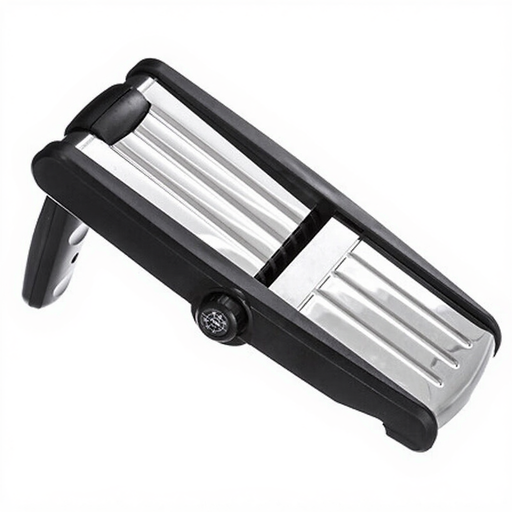
Why this product suits this profile: Three interchangeable stainless steel blades cover slicing, julienne cutting and grating. This makes it suitable for households looking for several essential functions without needing an electric appliance.
The functions are described through three specific blades. Its compact design takes up less space and makes storage easier.
Stainless steel and ABS construction; dimensions of 24,5 × 13 × 12,7 cm; weight of 365 g.
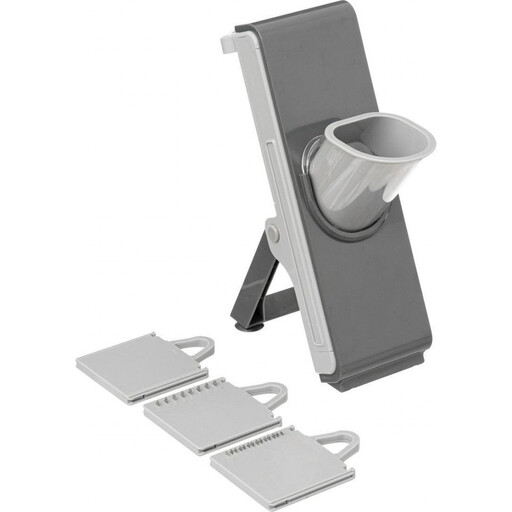
Why this product suits this profile: This mandoline combines slicing, grating and chopping. A pusher acts as a finger guard; according to the product details, the appliance is dishwasher-safe.
The product details specify the blade material, housing material, dimensions and care instructions. This makes it easier to assess the materials and cleaning requirements before buying.
Stainless steel blades, ABS blade holder, pusher and dimensions of 26,5 × 15 × 9,5 cm.

Why this product suits this profile: If you regularly slice bread, fruit or vegetables in larger quantities, an electric food slicer with adjustable slice thickness could be a practical choice.
According to the description, the slice thickness can be adjusted up to 23 mm. A removable carriage and safety switch are also specified.
All-metal construction, two blade variants and electronically adjustable speed.
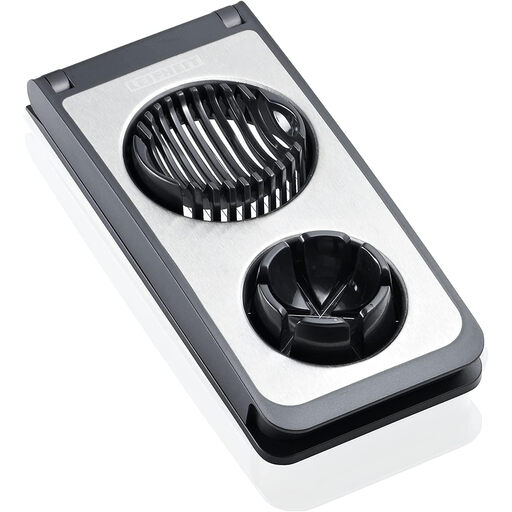
Why this product suits this profile: For boiled eggs, kiwis and potatoes, this 3-in-1 egg slicer produces round and oval slices as well as wedges.
The intended uses and care instructions are clearly defined: hand washing, no frozen foods and keeping your fingers away from the stainless steel wires.
Stainless steel housing and rust-resistant wires; folding mechanism; dimensions of 14 × 4 × 24,5 cm.
We have put together a complete, regularly updated list of products that fully meet these strict selection criteria and the safety regulations applicable in the EU.
With a vegetable grater, do not remove residue from the openings by hand. A holder is useful for small pieces of food. Electric appliances should be unplugged after use before removing the carriage or blades.
A vegetable slicer, a julienne blade or a coarse vegetable grater are suitable for carrots. If slices and strips are needed regularly, a multi-function vegetable slicer with clearly labelled inserts is a practical choice. Check whether the vegetable holder grips long carrots securely.
Its lifespan depends on the materials, blade care, cleaning method and frequency of use. Stainless steel blades and rust-resistant wires can last a long time when handled correctly. Blunt, bent or damaged cutting parts should no longer be used.
An electric food slicer can be worthwhile for households that regularly slice larger quantities. However, it requires more worktop space, electricity and cleaning than a manual vegetable slicer. For occasional salads or a few potatoes, a manual appliance is usually sufficient; for regular, uniform slices, an electric model may be a better fit.