
Lieferung heute & morgen

Qualitätsgarantie

Willkommens-Angebote freischalten: KOSTENLOSE Lieferung | Bis zu 80 % RABATT | Kostenlose 30-Tage-JoyPlus-Testphase
App herunterladen
A vegetable slicer can save you plenty of time when cooking, meal prepping and preparing salads. However, vegetable mandolines, vegetable graters, manual vegetable slicers and electric food slicers differ considerably in terms of operation, safety and cleaning. A large number of attachments does not automatically mean that a device is practical for everyday use in the kitchen.
The following points will help home cooks, families and frequent users assess marketing claims objectively and choose the right kitchen helper for slicing and chopping.
A multi-function vegetable slicer is often supplied with numerous attachments for slices, julienne strips, cubes or grating. However, what really matters is whether the attachments can be changed easily and stored safely. Loose blades increase the effort involved and can cause injuries when being removed.
Before buying, check:
The blades on vegetable mandolines, potato cutters and onion choppers need to be sharp to process food cleanly. This creates a risk of injury when the food is guided by hand towards the end. A hand guard or food holder should therefore be part of the basic equipment.
With a pull-cord vegetable chopper, the container should also remain stable during use. Non-slip elements on the base can improve control, but they do not replace careful handling.
Fine grating surfaces, narrow blades and hard-to-reach gaps can retain food residue after use. A device bought solely because of its low price can therefore create more work in everyday use than a simply designed model.
Look out for:
The manufacturer’s instructions take precedence. For example, hand washing is recommended for the Leifheit Eierschneider Combi ComfortLine and the ProLine model; according to the product description, they are not intended to be cleaned in the dishwasher.
For a vegetable mandoline, vegetable grater or manual vegetable slicer, the blade material is an important consideration. Stainless steel is widely used because, with proper care, it is resistant to corrosion and easy to wipe clean. The PURECOOK peeler, for example, is specified as being made from 304 stainless steel.
However, the material specification alone does not tell you everything. The following are equally important:
With an electric food slicer, you should also check the motor power, cutting thickness and safety functions. The Ritter Sono¹ is specified with a cutting thickness ranging from wafer-thin to approximately 20 mm, a removable carriage with an 18 cm cutting path, and momentary and continuous switches.
Not every vegetable slicer is suitable for every task. A cabbage slicer is designed for fine or evenly sized strips, while a vegetable chopper is more suitable for smaller pieces of onion, herbs, garlic or nuts. An egg slicer is designed for soft, cooked foods and should not be confused with a robust potato cutter for raw potatoes.
Before choosing a product, consider which foods you regularly want to prepare:
A compact device is easier to fit into a small kitchen, but it should still have a sufficiently large stable base. The 5five multi-function device is specified as measuring 26.5 × 15 × 9.5 cm and weighing 550 g. This kind of information is useful when planning storage space.
For families or meal-prep users, a larger collection container may be helpful. A small vegetable chopper with a capacity of 220 ml, on the other hand, is more suitable for individual ingredients and smaller portions. Also check whether the container remains securely closed while chopping.
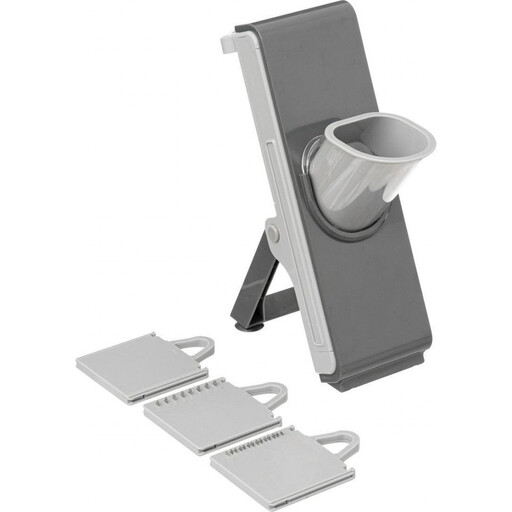
Why this product suits this profile: This manual device combines slicing, grating and chopping, and is intended for both domestic and professional kitchens. Its stated compact dimensions make it easy to store.
The product description lists a food holder as a finger guard and states that it is dishwasher-safe. This makes the safety and cleaning aspects easier to assess before buying.
Stainless-steel blades, an ABS plastic holder and several preparation options in one device.

Why this product suits this profile: This electric food slicer is designed for bread, fruit and vegetables and, according to the product details, allows cutting thicknesses of up to approximately 20 mm. Its manufacture in Gröbenzell near Munich is also specified.
The cutting thickness and the 18 cm carriage are clearly specified. The momentary and continuous safety switches, along with the removable carriage, provide additional information about operation and cleaning.
Electric operation, glass base, removable carriage and a serrated blade for different foods.

Why this product suits this profile: This manual vegetable chopper has a stated capacity of 220 ml and is operated using a pull cord. It is suitable for small portions of onions, vegetables, ginger, fruit, nuts or herbs.
The limited capacity makes its intended use clear. If you regularly prepare large quantities, you can check before buying whether you will need to work in several batches.
Compact format, manual operation without a power connection and suitability for several soft or smaller ingredients.
We have put together a complete, regularly updated list of products that fully meet these strict selection criteria and the safety regulations applicable in the EU.
Before using the device for the first time, clean all removable parts according to the manufacturer’s instructions. Always guide food using the holder provided and keep your fingers away from blades, wires and grating surfaces. Damaged or bent blades should not be used again.
With an egg slicer, also bear in mind that hard stones, frozen food or particularly firm ingredients can damage the wires. A fruit and vegetable peeler should be dried thoroughly after washing before being placed in a drawer.
For meal prep, models with several cutting options and a stable collection container are practical. A multi-function vegetable slicer is suitable for greater variety, while a vegetable chopper with a small container is better suited to individual ingredients such as onions, garlic or herbs.
Its lifespan depends on the materials, blade attachment, frequency of use and care. With proper cleaning, stainless-steel blades can remain usable for a long time. Aggressive cleaning products, unsuitable dishwasher programmes and processing foods the device was not designed for can accelerate wear.
A manual vegetable slicer does not require electricity and therefore has no ongoing energy costs. However, processing large quantities involves more manual work. For frequent, evenly sized slices, an electric food slicer may be more practical, provided its space requirements, cleaning needs and purchase price suit your household.