
Lieferung heute & morgen

Qualitätsgarantie

Willkommens-Angebote freischalten: KOSTENLOSE Lieferung | Bis zu 80 % RABATT | Kostenlose 30-Tage-JoyPlus-Testphase
App herunterladen
A vegetable slicer can make preparing salads, side dishes, and meal-prep portions much easier. The range extends from compact mandoline slicers and box graters to electric food slicers. However, product claims can easily lead to disappointing purchases when important details such as blades, cleaning, and storage space are overlooked.
Multifunctional vegetable slicers are often promoted with a wide range of interchangeable attachments. Yet the number of blades is not the only factor that matters. Check whether the attachments lock securely into place, can be changed easily, and can be cleaned thoroughly after use. Narrow gaps may trap food residue and increase the cleaning effort.
The term “stainless steel vegetable slicer” alone says nothing about the precise material quality or care requirements. The material used for blades and wires should be stated explicitly. Even stainless steel components can develop stains if cleaned incorrectly or exposed to moisture for extended periods. Instructions such as “hand-wash only” should be taken into account before purchase.
Very sharp blades and wires make cutting easier, but they also increase the risk of injury if handled carelessly. A finger guard, non-slip base, or stable handle can make a significant difference in everyday use. Electric appliances should additionally feature a safe momentary and continuous switch, as well as a secure way to guide the food being sliced.
First consider which foods you regularly prepare. A simple mandoline slicer, for example, is suitable for producing uniform slices. A model with several blades may also create julienne strips or grated ingredients. A four-sided box grater generally offers several grating and slicing surfaces, but it requires sufficient space and a secure position on the worktop.
For hard-boiled eggs, kiwis, or potatoes, an egg slicer is often more practical than a large vegetable slicer. If you want to prepare carrots, cucumbers, courgettes, and cheese in different ways, look for clearly described attachments and a suitably sized collection container.
Stainless steel blades are suitable for many kitchen applications, provided they are rinsed thoroughly and dried after use. With plastic housings, look for sturdy connections and a surface that is as smooth as possible. Dishwasher compatibility should only be assumed when it is explicitly stated in the product specifications.
Hand washing may be required for delicate wires or sharp blades. Also check whether replacement parts are available and whether the supplier identifies a responsible person for the EU market. These details do not replace an individual safety assessment, but they provide a stronger basis for choosing a product.
For small kitchens, rented apartments, and meal-prep workstations, compact manual kitchen tools are often easier to store. Electric appliances, by contrast, require a permanent position, a power outlet, and sufficient space to guide the food safely.
With an electric food slicer, the cutting area, maximum slice thickness, and blade type are particularly important. According to the product description, the Ritter sono¹ is designed for slices ranging from paper-thin to approximately 20 mm. The Ritter serano⁷ is described as offering a maximum slice thickness of up to 23 mm, two blades, and electronic speed adjustment. These specifications should be compared with the foods and recipes you plan to prepare.
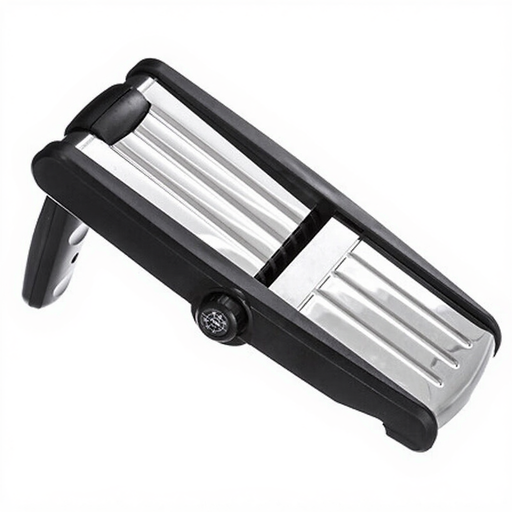
Why it suits this profile: This compact manual tool is designed for households that want to prepare slices, julienne strips, and grated ingredients with a single kitchen accessory.
The product description specifies three interchangeable stainless steel blades and exact dimensions of 24.5 × 13 × 12.7 cm. This makes it easier to assess the required storage space before buying.
Three functions: slicing, julienne cutting, and grating; materials listed: stainless steel and ABS plastic; weight according to the description: 0.365 kg.
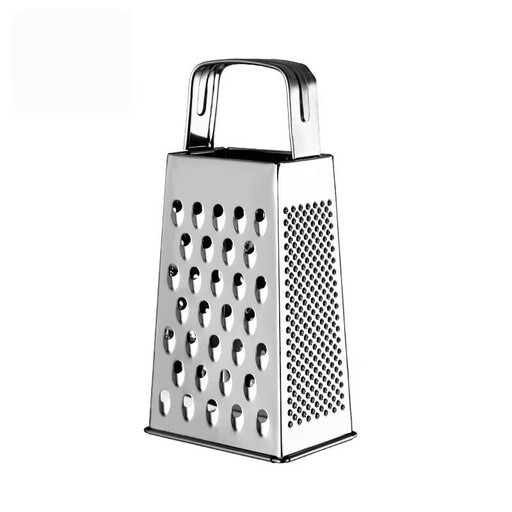
Why it suits this profile: Families and home cooks who want to grate and slice vegetables, cheese, or other ingredients get four surfaces in a classic box-grater design.
The four-sided design makes the available working surfaces immediately clear. Before buying, however, check that the grater can stand securely on your worktop.
Four-sided design; stainless steel according to the product name; suitable for manual grating and slicing.
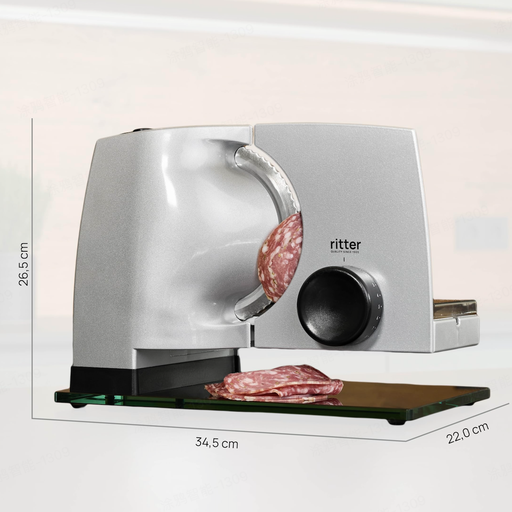
Why it suits this profile: Anyone who regularly slices bread, fruit, and vegetables to a consistent thickness may want to consider an electric appliance with guided food carriage.
The description specifies a removable food carriage, a safety glass plate, and momentary and continuous switches. This makes key operating and cleaning considerations clear in advance.
Slice thickness according to the product description: paper-thin to approximately 20 mm; 18-cm cutting path; serrated blade; made in Germany according to the supplier’s information.
For hard-boiled eggs, an egg slicer with several cutting options is generally more suitable than a standard mandoline slicer. According to the product description, the Leifheit Egg Slicer Combi ProLine offers three functions for round and oval slices as well as wedges. It features rust-resistant stainless steel wires, a folding mechanism, and a stainless steel housing. Hand washing is recommended.
The Leifheit Egg Slicer Combi ComfortLine also offers three functions, rust-resistant stainless steel wires, and a non-slip base. According to the specifications, neither appliance is designed for frozen foods or hard pits. The wires must not be touched with the fingers and the products are not suitable for children.
The complete selection of vegetable slicers makes it easier to compare blades, functions, materials, and designs for different kitchen requirements.
For meal prep, several cutting styles, an easy-to-clean design, and a suitable collection container are all important. A multifunctional vegetable slicer can be useful when you prepare a variety of recipes. For larger quantities, an electric food slicer may be more convenient, but it requires additional space and electricity.
Service life depends on the materials, workload, cleaning routine, and storage conditions. Blades should be stored dry and should not be used for foods that the instructions deem unsuitable. With electric appliances, the availability of replacement parts and repair options are additional factors worth checking.
A manual vegetable slicer does not require electricity and is usually ready to use straight away. An electric appliance can save time and effort when processing larger quantities frequently. For that reason, do not compare the purchase price alone. Also consider the storage space, cleaning effort, noise level, and the cutting capacity you actually need.