People who batch-cook together
If a group cooking session produces more stock than you need straight away, you’ll need space for the cooled portions and a way to freeze them for future meals.


First, check whether your existing four-star freezer compartment can fit the cooled portions of stock alongside your other supplies and freeze the new batch – you may not need an extra appliance. If you regularly run short of space or freezing capacity, the right option will depend on batch size, floor space, access to individual portions and how much you use over the year. A chest freezer can be an alternative to an upright freezer for larger stocks of food. The Verbraucherzentrale says chest freezers use less energy, but it’s worth considering how you’ll organise individual portions before you buy.
If a group cooking session produces more stock than you need straight away, you’ll need space for the cooled portions and a way to freeze them for future meals.
If you’re storing stock for different cooking days, it’s useful to be able to pick out the labelled portion you need rather than having to break up a large frozen block.
An extra freezer needs to fit the space you have and your actual storage needs. If your existing freezer compartment is suitable and has enough room, you may not need another appliance.
A good fit if: there’s room for the stock portions and other supplies, and the freezing capacity can handle the new batch.
The trade-off: you won’t need another appliance, but spare storage space alone doesn’t tell you whether it can freeze a new batch.
A good fit if: you regularly take out individual portions and would like to use drawers to keep things organised.
The trade-off: net capacity, freezing capacity, external dimensions and kWh/year all need to suit your needs and available space.
A good fit if: you need to store larger quantities and have enough floor space.
The trade-off: the Verbraucherzentrale says chest freezers use less energy than upright freezers. Think about how you’ll organise the inside to get at smaller portions easily.
First, compare the amount you plan to freeze in one cooking session with the freezer’s capacity and available storage space. Then consider whether your containers will fit, where the appliance will go and its stated annual energy consumption.
| What matters to you | What to check when buying | Who is this especially important for? |
|---|---|---|
| Amount you can freeze at once | Check the stated freezing capacity in kg/24 h and the available net capacity of the freezer compartment you’ll actually use. | If a group cooking session produces a large batch of stock, I want to know how much the appliance can freeze. Around 33% of consumers put batch capacity first. |
| Individual portions | Check the drawers and usable compartment dimensions against your freezer-safe containers. | If I want to take out stock for different cooking days, well-organised compartments that fit my containers are important. Around 27% of consumers prioritise portion organisation. |
| Available space and appliance size | Compare the external dimensions and door opening with the space available. Don’t confuse net capacity with external dimensions. | If space for an additional appliance is limited, I want to find one that fits without allowing for more capacity than I need. Around 20% of consumers prioritise available space. |
| Energy consumption | For appliances of a suitable size, compare the stated kWh/year on the EU energy label. | If the appliance will be running between group cooking sessions, I want to take its stated annual energy consumption into account. Around 20% of consumers focus on ongoing electricity costs. |
Capacity in litres tells you how much storage space is available, but not how much fresh stock the appliance can freeze within 24 hours.
Divide the stock into the portions you plan to store, then check both the storage space required and the stated freezing capacity of the compartment you intend to use.
To freeze freshly made stock, the compartment you use must be suitable for freezing fresh food. A compartment intended only for storing food that’s already frozen won’t do the job.
Check for a four-star rating and the stated freezing capacity of the compartment you plan to use.
Liquids need room to expand as they freeze. A container that isn’t freezer-safe or is filled too full may split.
Use freezer-safe containers and leave enough room when filling them with liquid. The Verbraucherzentrale recommends filling soup containers to only three-quarters full.
An appliance with more storage space isn’t automatically the right choice if you don’t need the extra room for stock. The Verbraucherzentrale says oversized freezers use energy unnecessarily.
Choose a size that suits your stock batch and other supplies, then compare the stated kWh/year for suitable models.
The GS5231-NF-H-040C weiss is a 161-l option for households considering an upright freezer with a more modest net capacity.
The GSN36VWEP is a larger drawer-style option for households storing other supplies alongside stock.
According to Beko, the RFNE312E43WN is a freestanding 275 l freezer for storing larger quantities.
According to Liebherr, the GN 46Vd25 Plus NoFrost offers a 199-l option between smaller and larger upright freezers.
The products below include additional upright freezers and a chest freezer. If you want to freeze fresh stock, check whether the freezer compartment in each specific appliance is suitable and what freezing capacity is stated.
 No image available
The described drawer layout may be useful for storing stock portions separately; check that your containers will fit.
161 l; No Frost; three freezer drawers; temperature range −14 °C to −22 °C.
 No image available
The three drawers are handy for storing portions separately; check their internal dimensions against your freezer containers.
85 l; three drawers; four-star freezer compartment; manual temperature control; reversible door; white.
 No image available
Its compact design may suit a limited space; check that the net capacity is enough for your stock portions.
35 l; four-star mini freezer; removable internal compartment; reversible door; 41 dB.
 No image available
The described layout may help you sort different supplies; check that the compartments fit your stock containers.
204 l; NoFrost; Super Freeze function; six shelves or drawers; 39 dB; energy class E.
 No image available
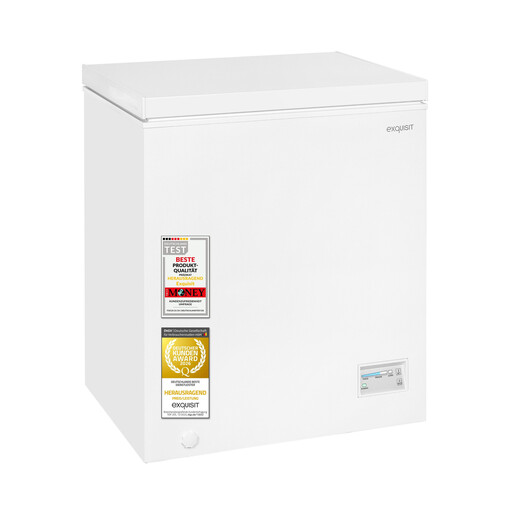
A chest freezer may suit your storage needs; consider how you’ll organise and take out individual stock portions.
142 l; four-star freezer compartment; removable basket; fast-freeze function; reversible door.
Yes. The German Federal Institute for Risk Assessment recommends cooling hot food quickly to below 7 °C for longer-term storage. Make cooling a separate step in your group cooking session rather than leaving a large pan standing for a long time while you wait for freezer space to become available.
Use freezer-safe containers and leave enough room for the liquid to expand as it freezes. The Verbraucherzentrale recommends filling soup containers to only three-quarters full. Labelled individual portions are easier to pick out for future cooking days.
The Verbraucherzentrale gives −18 °C as the optimum freezer temperature. For suitable appliances, compare the net capacity and stated kWh/year. Since 1 March 2021, the EU energy label for household freezers has used a scale from A to G.
An old freezer must not go in household rubbish. The German Environment Agency points out that when you buy a new equivalent appliance, you can also return a large old appliance free of charge when buying online with delivery. Before placing your order, check exactly what collection and other services are available.