
Lieferung heute & morgen

Qualitätsgarantie

Willkommens-Angebote freischalten: KOSTENLOSE Lieferung | Bis zu 80 % RABATT | Kostenlose 30-Tage-JoyPlus-Testphase
App herunterladen
A vegetable peeler is part of the everyday kitchen kit in many German households. Potatoes, carrots, apples and cucumbers can usually be prepared more quickly with one than with a kitchen knife. However, not every model peels smoothly. Some blades catch on uneven surfaces, while others remove too much flesh or feel uncomfortable to hold during longer use.
That’s why it’s worth looking at the product’s actual features before you buy, rather than relying on general marketing claims.
A sharp blade is not automatically suitable for every food. A straight vegetable peeler often works well on potatoes and carrots. For tomatoes, peaches or kiwis, a serrated blade may be a better choice, as it puts less pressure on the soft skin while peeling. A tomato peeler is therefore more than just an ordinary vegetable peeler in a different colour.
“Stainless steel” does not always specify the exact alloy. Some products, for example, state that they use 304 stainless steel, while others simply say stainless steel without further details. 304 stainless steel is used for kitchen utensils because of its corrosion-resistant properties, but that does not mean it will last indefinitely. The blade fitting and how the peeler is cared for also affect its lifespan.
A ceramic peeler has a rust-resistant blade and is generally easy to clean. However, ceramic can be damaged by drops or sideways pressure. This type of peeler should not be used on hard or frozen foods, or on foods it is not designed for.
A peeler labelled dishwasher-safe can generally be cleaned in the dishwasher. However, product instructions often still recommend washing it by hand soon after use and drying it thoroughly. This can help protect the blade’s sharpness and the surfaces of both the blade and handle. Hand-washing is particularly advisable for wooden handles, as moisture can affect the material over time.
The blade shape determines what the fruit peeler or fruit and vegetable peeler is suitable for:
A fruit and vegetable peeler with several blades can be more versatile. However, check whether you’ll actually use all the features. A vegetable peeler set with several parts takes up more storage space and needs more cleaning than a single peeler.
For everyday food preparation, a secure grip and controlled movement matter. Look for:
A compact potato peeler or small paring knife can be precise for detailed work. For larger quantities, a classic Y-shaped peeler is often easier to guide evenly.
Smooth stainless steel surfaces are usually quick to rinse clean. However, residue can collect around moving parts, serrated blades or the join between the handle and metal. So “dishwasher-safe” shouldn’t be your only selection criterion. After cleaning, dry the peeler thoroughly and store it safely out of children’s reach.
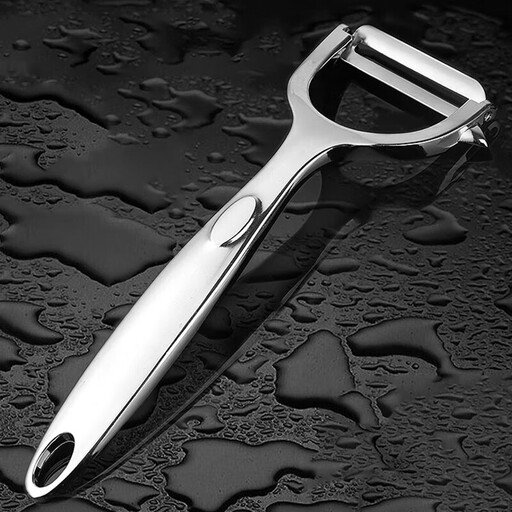
Why this product suits this profile: The single peeler is designed for everyday tasks such as peeling potatoes, carrots and apples, and takes up very little storage space.
The product details specify a zinc alloy, a sharp blade and easy cleaning. No unnecessary extra features are assumed.
A single peeler with an ergonomic design; dishwasher-safe according to the product description.
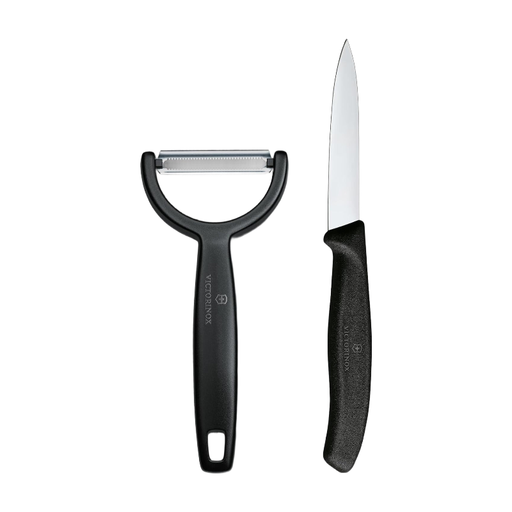
Why this product suits this profile: The set combines a swivel peeler with a pointed paring knife, covering peeling, slicing and dicing.
The features and components are clearly specified. Its suitability for left- and right-handed users is explicitly stated.
Stainless steel blades, lightweight polypropylene handles and a dishwasher-safe design according to the product description.
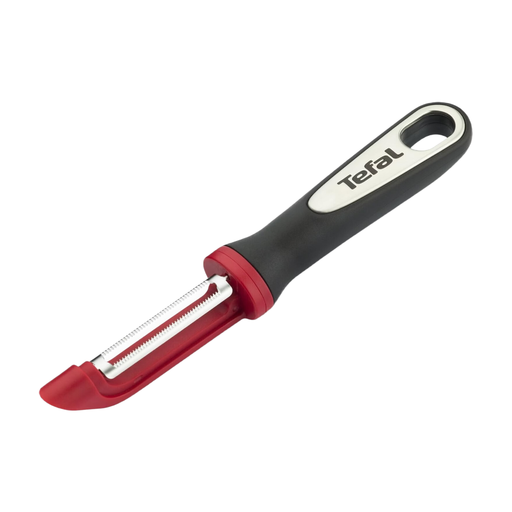
Why this product suits this profile: According to the product description, the double-serrated stainless steel blade is designed for tomatoes, peaches and other soft-skinned fruit and vegetables.
The serrated blade is designed for soft skins, making it clearly different from a standard vegetable peeler.
Plastic handle, stainless steel blade and a dishwasher-safe design according to the product details.
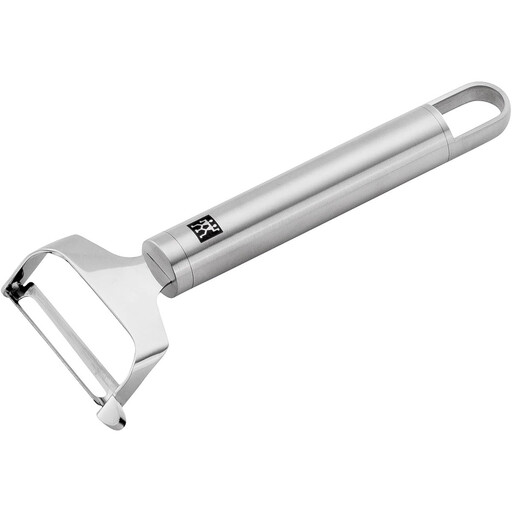
Why this product suits this profile: The movable swivel blade is designed to follow curves and adapt to different shapes of fruit and vegetables. The peeler can be used by both right- and left-handed users.
The blade’s movement is specified as a clear design feature, making it easier to assess how well it handles irregular shapes.
18/10 stainless steel according to the product details, a movable swivel blade and a dishwasher-safe design.
We’ve put together a complete, regularly updated list of products that meet these strict selection criteria and fully comply with the safety regulations in force in the EU.
Always store sharp blades well out of children’s reach. If the blade or handle is visibly damaged, stop using the product.
A straight vegetable peeler or a swivel peeler is usually suitable for firm skins. Look for a stable blade fitting, a secure handle and a blade that can move smoothly across the surface.
Ceramic blades are rust-resistant and easy to rinse clean. However, they can be more susceptible to knocks and sideways pressure. Stainless steel models are often more versatile; suitability depends on the blade shape and the manufacturer’s instructions.
A set can be useful if you regularly tackle different tasks, such as peeling, cutting julienne strips and preparing soft-skinned fruit. If you only need a peeler for one everyday task, a suitable single peeler often takes up less space.