
Lieferung heute & morgen

Qualitätsgarantie

Willkommens-Angebote freischalten: KOSTENLOSE Lieferung | Bis zu 80 % RABATT | Kostenlose 30-Tage-JoyPlus-Testphase
App herunterladen
If you regularly prepare vegetables, fruit, cheese or bread, you will expect three things above all from a kitchen aid: consistent results, safe handling and hassle-free cleaning. However, when it comes to vegetable slicers and kitchen mandolines, eye-catching product claims do not automatically lead to the right choice. Specific information about the blades, materials, dimensions and operation is what really matters.
A multifunctional kitchen slicer can slice, grate, shave and produce julienne strips. However, if there is no precise information about the number and type of blades, it remains unclear what results are actually possible. Terms such as ‘all-in-one’ or ‘multifunctional’ are no substitute for a technical product description.
You should therefore check:
‘Stainless steel’ initially refers only to a group of materials. For a stainless-steel cheese grater or vegetable mandoline, the product should also provide details about the specific type of steel, its construction and cleaning requirements. For example, the SS HANDLE GRATER SP is specified as being made from INOX 430 precision stainless steel. This is more informative than a general description without material details.
The handle also matters: a narrow or slippery handle can make it harder to maintain control when grating hard cheese, nuts or chocolate.
Fine grating openings and narrow blade slots can trap food residue. A dishwasher-safe vegetable mandoline reduces the need for manual cleaning, but it must still be positioned safely in the dishwasher. Sharp attachments should not be left loose among other dishes.
You should also look for:
For a vegetable mandoline slicer, consistent slice thickness is particularly important. A model with different blades may be suitable for slices, strips, grating or julienne cuts. Your choice should match your everyday kitchen needs: if you mainly slice cucumbers and potatoes, you may need fewer attachments than a household that regularly prepares salads, vegetable stir-fries and side dishes.
A manual vegetable slicer works without electricity and can usually be stored compactly. However, the working speed depends more heavily on the user’s strength and technique. A finger guard is an essential feature on all manual mandolines and slicers.
Stainless-steel blades are suitable for many applications and can provide long-lasting performance when cared for correctly. For plastic parts, the product description should clearly state whether they are used as the housing, blade holder or food holder. This makes it easier to assess stability and cleaning requirements.
Dimensions are also useful when choosing a grater: the SS HANDLE GRATER SP measures 5,8 × 2 × 25,2 cm and weighs 0,100 kg. This makes it easy to store in a drawer or a narrow kitchen cupboard.
An electric food slicer or electric bread slicer is particularly suitable for households that regularly cut bread, fruit, vegetables or other foods into even slices. In addition to the maximum slice thickness, you should consider the following:
A high slicing speed is not automatically an advantage if the appliance is difficult to clean or unsafe to operate. For families and frequent users, a well-designed construction and the availability of spare parts or repair options are just as important as performance.
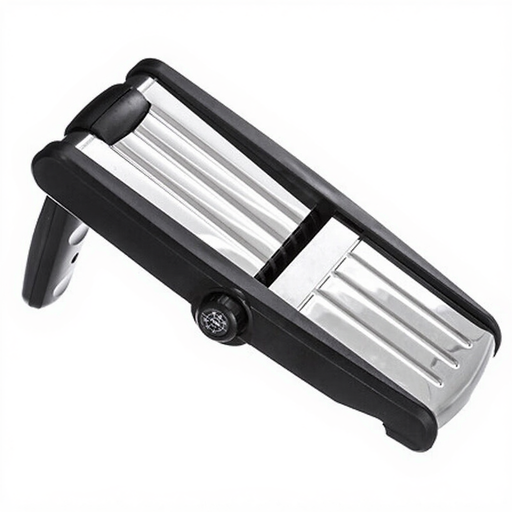
Why this product suits this profile: Three interchangeable stainless-steel blades cover slicing, julienne cutting and grating. Measuring 24,5 × 13 × 12,7 cm and weighing 0,365 kg, this kitchen slicer remains compact.
The three blades are clearly specified. This makes it easier to assess the range of functions than with a merely general multifunctional description.
Interchangeable stainless-steel blades; low weight and compact dimensions.

Why this product suits this profile: According to the product description, this electric food slicer was developed and manufactured in Germany. It slices bread, fruit and vegetables from wafer-thin to approximately 20 mm.
A removable carriage makes cleaning easier. The safety momentary and continuous switches address safe operation when slicing electrically.
Safety glass base plate; 18-cm slicing path and ECO motor according to the manufacturer’s specifications.

Why this product suits this profile: For frequent slicing, this appliance offers a metal construction, a 24-cm slicing path and electronic speed control.
The slice thickness of up to 23 mm, as well as the smooth and serrated blades, are clearly specified. This prevents you from choosing based on vague performance claims.
Two blades; electronic speed control and removable carriage according to the product description.
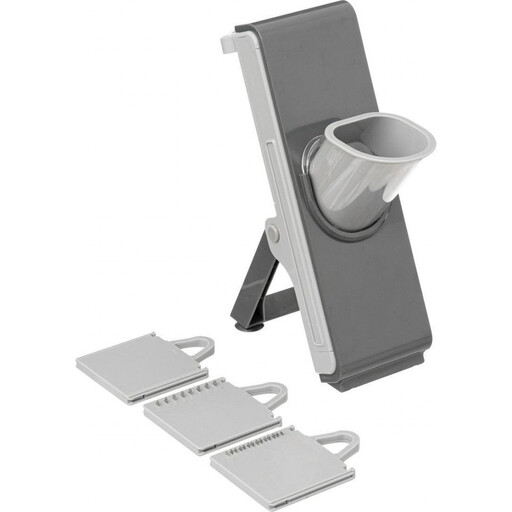
Why this product suits this profile: This mandoline features stainless-steel blades, an ABS blade holder and a finger-safe food holder. According to the product details, it is dishwasher-safe.
The included food holder helps address the risks associated with manual slicing. Dishwasher suitability is expressly stated rather than inferred solely from the material.
Slicing, grating and chopping; stainless-steel blades and stated dishwasher suitability.
We have compiled a complete, regularly updated list of products that fully meet these strict selection criteria and the safety regulations applicable in the EU.
For families, a model with a food holder, several cutting styles and straightforward cleaning is a sensible choice. A manual mandoline does not require electricity and is ready to use quickly. If you frequently slice bread or vegetables, an electric food slicer with a removable carriage may be more practical.
Its lifespan depends on the blade material, use, cleaning and storage. Stainless-steel blades should be dried thoroughly after washing. Avoid hard objects that are not intended for the relevant application, and store cutting attachments safely. With electric appliances, repair options and the availability of spare parts may be important for long-term use.
Power consumption depends on the motor output, operating time and operating mode. If you only slice a few pieces, you will generally use the appliance for a short time. A manual vegetable slicer uses no electricity during operation, but requires more manual effort. Your choice should therefore be based not only on energy consumption, but also on how regularly and for which foods the appliance will be used.