First, choose a vertical mouse in the right handedness and size for the people who’ll actually use it. If people switch between left and right hands, a mouse shaped for just one hand may not work for everyone. Then check that it connects to every club computer and that features such as quiet buttons, a USB receiver or a cable suit the desk. A vertical design alone doesn’t guarantee health benefits or mean that it will suit everyone.
Who uses the desk?
People who manage the rota for extended periods
If you regularly update entries, look for a mouse that fits your hand and has easy-to-reach buttons. The German Federal Institute for Occupational Safety and Health (BAuA) recommends positioning your mouse and keyboard appropriately, with enough room to rest your hand and arm.
Teams with different people using the desk
If several people share the same desk, consider the handedness and hand size of everyone who’ll use it. Logitech and CHERRY offer separate right- and left-handed versions, so it’s worth deciding which one you need in advance.
Teams using different computers
If the rota is updated on several computers, check which connections and wireless options are available on each one. CHERRY specifies a nano USB receiver, while Trust says the Bayo+ has a USB receiver and supports two Bluetooth connections.
What should you look for when buying?
The BAuA recommends leaving enough room to position your mouse and keyboard flexibly, and to rest your hand and arm. So check the desk setup as well as the mouse.
| What matters |
What to check before buying |
Who should pay particular attention? |
| Fit and posture |
The specific mouse’s handedness and size recommendation; whether the buttons are easy to reach. |
If you spend a long time updating the rota, choose a shape that suits your hand and has buttons you can reach comfortably. Around 28% of consumers put fit first. |
| Different hands |
Which hand each person uses, and whether you need separate left- and right-handed versions. |
If left- and right-handed people take turns at the desk, check whether one mouse will suit everyone or whether separate versions would be a better choice. Around 22% of consumers focus above all on use by people with different handedness. |
| Computer connection |
Available ports and permitted wireless connections on every computer; where to keep a removable receiver. |
If you update the club rota on different computers, the chosen connection needs to work with each one. Around 22% of consumers prioritise computer compatibility. |
| Click noise |
Whether the specific version is explicitly described as having quiet buttons; don’t assume the clicks are quiet just because of the scroll wheel. |
If other people are working at the shared desk at the same time, the noise from the click buttons may be a deciding factor. Around 17% of consumers focus above all on quieter clicks. |
| Purchase and running costs |
Compare the specific battery, rechargeable battery or wired version, as well as what’s included. |
If you’re considering ongoing costs, check the power supply and receiver as well as the purchase price. Around 11% of consumers prioritise purchase and running costs. |
Common misconceptions
-
An ergonomic design will automatically suit everyone
Manufacturers specify different hand sizes and left- or right-handed versions. So a vertical design won’t automatically suit everyone sharing the desk.
Before you buy, find out who’ll use the mouse and which hand they use, then check the size recommendation for the specific model.
-
Multi-device support means it will work with every club computer
Bluetooth, a USB receiver and a USB-A cable each require compatible ports or wireless connections to be permitted. If the connection isn’t available, you may be unable to work when switching computers.
Check every computer you plan to use, and decide where to keep any removable USB receiver.
-
A manufacturer’s claim about reducing strain is a health guarantee
Manufacturers’ claims about ergonomics don’t prove that a product will have the same effect for everyone. For computer work, the BAuA also considers support for the hand and arm, desk layout and static posture.
Consider how the mouse fits and the whole workstation. If you already have symptoms, don’t treat product descriptions as medical guarantees.
Useful brands to consider
Logitech
For the Lift and MX Vertical, the specific model and handedness are key when choosing a mouse for a shared desk.
- Logitech describes the Lift as having quiet buttons and offers a left-handed version; these are the manufacturer’s claims.
- The Lift is designed for small to medium-sized hands. That doesn’t mean it’s proven to fit everyone or have health benefits for everyone.
CHERRY
The MW 4500 and MW 4500 LEFT are separate vertical mouse versions for right- and left-handed users.
- CHERRY specifies a nano USB receiver that can be stored inside the mouse.
- Check that the receiver works with the computer’s port and can be found easily when the desk is shared.
Trust
The Bayo+ is designed for switching between compatible devices using a USB receiver and Bluetooth connections.
- Trust specifies a rechargeable battery and connections via a USB receiver and two Bluetooth pairings.
- Multi-device support doesn’t remove the need to check computer permissions or make sure the shape suits the people using it.
Kensington
The manufacturer describes the Pro Fit Ergo K75501EU as suitable for medium to large hands.
- Kensington specifies a little-finger rest and a receiver that can be stored inside the mouse.
- The manufacturer’s hand-size guidance and the comfort study shown on the product page don’t prove that it will work for this desk or for everyone.
Perixx
The PERIMICE-508 offers a wired USB-A option, while the PERIMICE-819 is sold as a compact mouse with silent clicks.
- The models give you a choice of wired and wireless connections.
- According to the manufacturer, the PERIMICE-819’s forward and back buttons aren’t available on macOS. Also check the connection and hand fit for the specific version.
Joybuy products for managing the rota
The Joybuy products below are vertical mice for a shared desk used to manage a rota. Depending on the model, they focus on quiet clicks, wireless connectivity or switching between several devices.
 No image available
6-button wireless vertical mouse
The product description mentions quiet-click technology, which may be useful at a shared desk.
- 2.4 GHz wireless
- Rechargeable battery with USB-C connection
- 800–1600 DPI
- Six buttons
View at Joybuy
 No image available
Wireless vertical mouse with dual connectivity
If you switch between computers, check that this mouse works with their Bluetooth or USB receiver connections.
- Bluetooth and 2.4 GHz connectivity
- USB-C charging port
- Three DPI settings: 800, 1200 and 1600
- Six programmable buttons
View at Joybuy
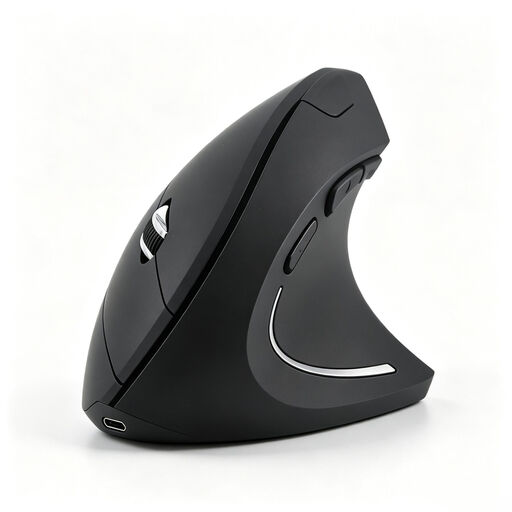 No image available
KINSI 5-button wireless vertical mouse
The product description mentions quiet click buttons. Also check that the shape suits everyone taking turns at the desk.
- 2.4 GHz USB receiver
- Rechargeable, with USB-C charging port
- Adjustable DPI: 800–4800
- Five buttons
View at Joybuy
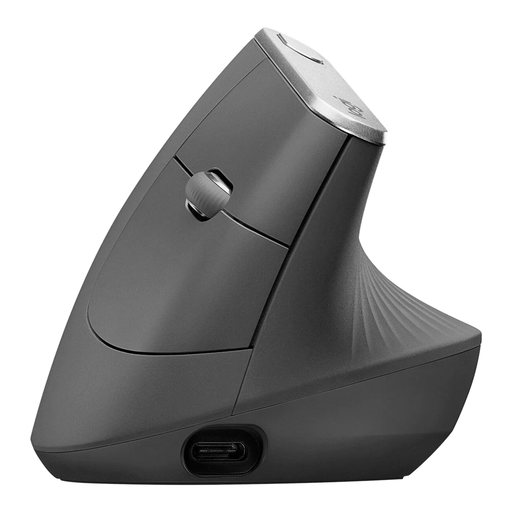 No image available
Logitech MX Vertical
For switching between computers, the product description says you can switch between up to three devices. Check the connection options on each club computer.
- Bluetooth and USB receiver
- Connects to up to three devices
- Rechargeable battery
- 4000 DPI sensor
View at Joybuy
Frequently asked questions
Is a vertical mouse enough to prevent hand or arm problems?
No. You can’t assume a particular benefit based on the design alone. The BAuA highlights the importance of choosing the right hand size, positioning the mouse and keyboard appropriately, and avoiding prolonged static postures. It doesn’t say that everyone must use a vertical mouse.
How should I set up the mouse at a shared desk?
Leave enough room to position your mouse and keyboard comfortably and rest your hand and arm. Then check the connection on every computer you’ll use. CHERRY, for example, specifies a nano receiver, while Trust also offers Bluetooth for the Bayo+.
How can I stop a wireless receiver going missing at a shared desk?
Choose a designated place to store any removable receiver, and check how the specific mouse is powered. CHERRY says its receiver can be stored inside the mouse, while Trust describes the Bayo+ as rechargeable.
What if a mouse ordered online doesn’t fit or is faulty?
Your statutory rights if a product is faulty are separate from any voluntary guarantee. According to the consumer advice centre, online consumer contracts generally come with a 14-day right to cancel after receiving the goods. Check the terms of your purchase and whether any exceptions apply.
What should I know about wireless mice and disposal?
For the specific wireless device, check that the necessary ports and wireless connections are available, and ask to see the relevant documentation. The German Federal Network Agency explains that products covered by the relevant EU harmonisation legislation must carry the CE mark; this mark is not proof of ergonomic benefits. According to the German Environment Agency, a mouse that’s no longer needed should be disposed of separately as waste electrical and electronic equipment.


