
Lieferung heute & morgen

Qualitätsgarantie

Willkommens-Angebote freischalten: KOSTENLOSE Lieferung | Bis zu 80 % RABATT | Kostenlose 30-Tage-JoyPlus-Testphase
App herunterladen
A vessel sink makes a bold design statement in any bathroom. However, its stylish look can be quickly undermined by an ill-fitting faucet. Choosing the right faucet for a vessel sink is crucial for both daily functionality and aesthetics. The wrong choice not only leads to frustration but can also require costly modifications.
As your Joybuy Product Recommendation Officer, I'm here to help you avoid the common pitfalls and make an informed decision. We'll focus on the objective criteria that truly matter, cutting through the marketing hype.
Many buyers are guided by images without checking the technical specifications. This often leads to two problems that severely limit everyday usability:
To avoid these mistakes, you should check three core aspects before buying. These will determine if a tall basin faucet is right for your setup.
Measuring is essential here. The spout height refers to the vertical distance between the faucet's base and the water outlet (the aerator).
The material determines your faucet's durability, maintenance, and health safety.
A tall bathroom tap should not only look good but also be practical.
Based on these objective criteria, we have identified several models that offer a suitable solution for specific user profiles and requirements.
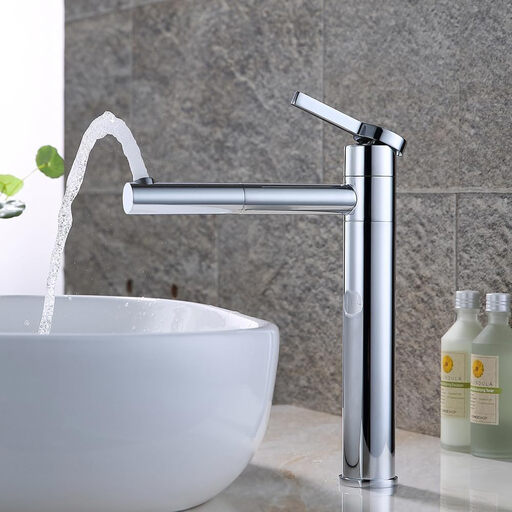
Why this model is a great fit: Ideal for users with large vessel sinks or double vanities who need maximum freedom of movement. The dual-swivel mechanism makes cleaning the basin or washing hair significantly easier.
With a spout height of 220 mm, it solves the problem of a faucet being too low. Being made from lead-free 304 stainless steel bypasses the trap of inferior materials.
The dual 360° swivel function of both the spout and the faucet body offers a level of flexibility rarely seen in this class. The integrated ABS aerator provides a soft, water-saving stream.
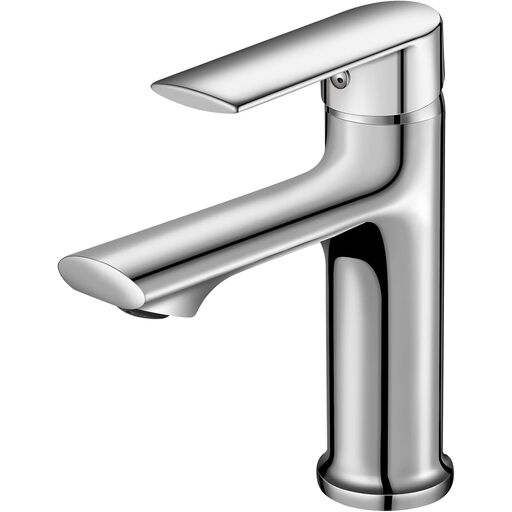
Why this model is a great fit: Perfect for standard vessel sinks where a thoughtful design focused on splash prevention is a priority. Its clean design language fits well in modern, uncluttered bathrooms.
The 15° angled spout is a deliberate design feature to combat the splashing problem. With a spout height of approx. 16 cm, the faucet offers a good compromise for many basin shapes.
The design feature of the angled spout directly addresses a common practical issue. Installation is straightforward thanks to standard 3/8-inch connections, making it suitable for most vanities.
The right faucet depends heavily on your individual sink and usage habits. We have compiled a comprehensive list of products that meet our selection criteria.
A general recommendation is that there should be a gap of 10 to 15 cm between the bottom of the spout and the top rim of the sink. This provides enough room for your hands and minimises splashing. Measure the height of your vessel sink and add this value to determine the minimum spout height required.
A solid stainless steel faucet is made entirely of this rust-proof, lead-free material. It is extremely durable and hygienic. A chrome-plated brass faucet has a core made of a brass alloy, which is coated with a layer of chrome. Here, the quality and longevity depend heavily on the thickness and adhesion of the chrome plating, as well as the composition of the brass.
Most modern faucets are designed for easy DIY installation and come with the necessary mounting hardware and flexible connection hoses (often with standard 3/8-inch compression nuts). If you have basic DIY skills and can safely shut off the water supply, installation is usually possible without professional help. Always follow the manufacturer's included installation manual.