
Lieferung heute & morgen

Qualitätsgarantie

Willkommens-Angebote freischalten: KOSTENLOSE Lieferung | Bis zu 80 % RABATT | Kostenlose 30-Tage-JoyPlus-Testphase
App herunterladen
A Victorinox 8 cm vegetable knife is designed for a wide range of kitchen tasks: peeling fruit and vegetables, removing the core from tomatoes, chopping herbs and preparing small ingredients directly on the chopping board. Its compact blade offers excellent control, but it does not replace a large chef’s knife.
Even so, choosing the right one can often lead to mistakes. Product names may differ only in colour, blade finish or tip shape. If you overlook these details, you could end up with a knife that is not ideally suited to your needs. As a Joybuy Product Recommendation Officer, I therefore focus on clear specifications such as blade length, edge type, material, weight and cleaning instructions.
A vegetable knife with a straight edge is suitable for controlled cuts, peeling, removing cores and chopping firmer ingredients. The cutting motion is similar to using a traditional paring knife.
A vegetable knife with a serrated edge grips soft or smooth skins more effectively. Tomatoes, plums, peaches and other delicate foods can be cut without the skin yielding too much with each stroke. For highly precise peeling, a straight edge is usually easier to control.
According to the product information, several Victorinox Swiss Classic knives in this selection are dishwasher-safe. This makes everyday cleaning easier. However, the combination of heat, detergent and contact with other cutlery can put more strain on the edge and surface than gentle hand washing.
If you want to keep the blade sharp for as long as possible, clean the knife immediately after use with a soft cloth or sponge, dry it thoroughly and avoid storing it loose in the cutlery drawer.
According to the available product data, each of the 8 cm models weighs around 20 g. This is practical for small, repetitive cutting tasks, but may feel unfamiliar to people who prefer heavier knives. The size of the handle should also be considered: a lightweight knife is not automatically equally comfortable for every hand.
An 8 cm blade is a versatile middle ground for a small kitchen knife. It offers more reach than a 6 cm paring knife while remaining easier to handle than a 10 cm model. This length is suitable for apples, potatoes, cucumbers, carrots and smaller portions.
The available tip shapes include centred and pointed designs. A pronounced tip can be helpful when removing blemishes, stalk ends and pips. Check the product description carefully before buying, as similar model names may cover different variants.
The Victorinox vegetable knives featured here are made from corrosion-resistant stainless steel. Stainless steel is easy to care for and suitable for everyday kitchen use, but still needs to be stored dry. Acidic foods such as tomatoes and citrus fruit should not be left on the blade for long periods.
The straight edge is well suited to precise cuts and traditional peeling tasks. A serrated edge is a practical alternative for soft fruit, tomatoes and delicate vegetables. A set containing both variants can be useful if you regularly prepare different types of food.
The models feature a polypropylene handle. This material is lightweight and resistant to moisture. The 8 cm variants are listed with overall lengths of around 18.9 cm, a width of approximately 2 cm and a height of about 11 mm.
For care, a wooden or plastic chopping board is recommended. Stone, glass and ceramic boards can blunt the edge more quickly. For safe storage, use a knife block, a magnetic strip with sufficient spacing or a drawer insert with blade protection.
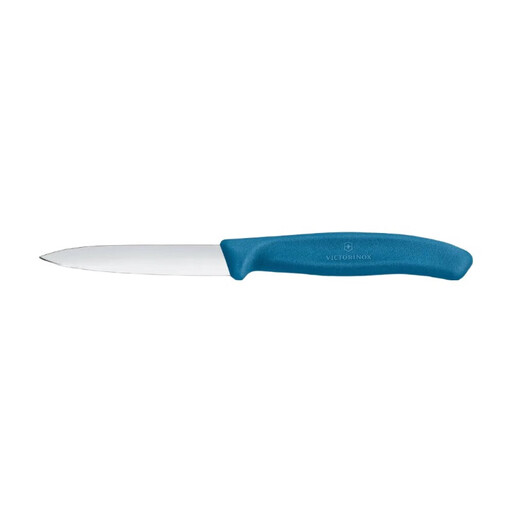
Why this product suits the profile: The straight 8 cm blade and low weight of 20 g cover typical peeling, cutting and coring tasks. The blue polypropylene handle makes it easier to distinguish from other kitchen utensils.
The specifications clearly state the blade length, straight edge, handle material and dishwasher suitability. This makes it easy to distinguish this variant from serrated models.
8 cm stainless steel blade, 20 g weight, ergonomic polypropylene handle and dishwasher-safe cleaning.
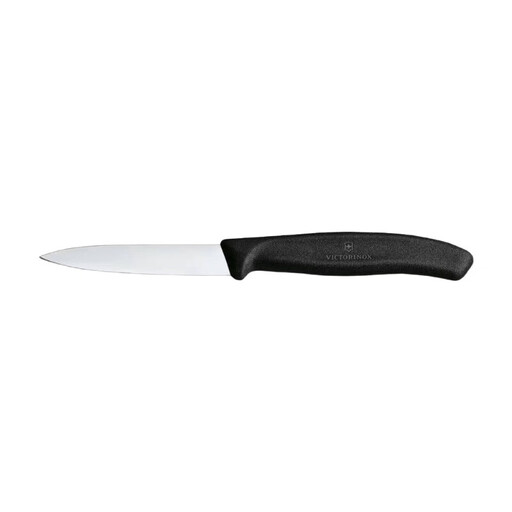
Why this product suits the profile: The black finish blends discreetly into domestic kitchens, work areas and professional catering environments. The centred tip supports controlled cutting and coring tasks.
The straight blade is clearly specified. This prevents you from buying a serrated knife when you plan to do regular peeling and precise cutting.
8 cm stainless steel blade, 20 g weight, polypropylene handle and Swiss origin.
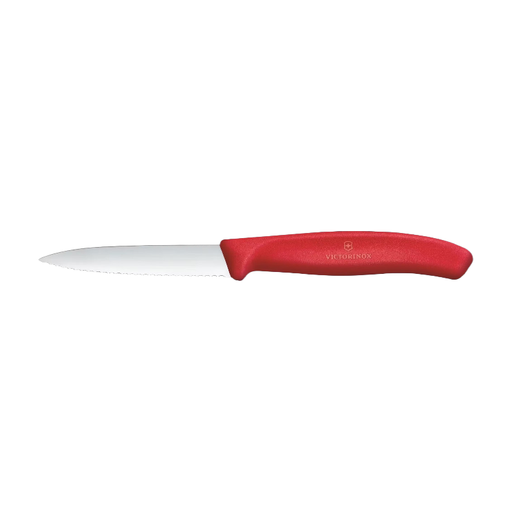
Why this product suits the profile: The serrated 8 cm blade is designed for tomatoes, soft fruit and delicate vegetables. It is a useful complement to a straight paring knife when different foods are prepared every day.
The serrated edge is explicitly stated in the product specifications. This means the blade type is not judged solely from the product photo or colour.
Serrated stainless steel blade, 8 cm length, low weight and dishwasher-safe polypropylene handle.
We have put together a complete, regularly updated list of products that fully meet these strict selection criteria and the safety regulations applicable in the EU.
Yes. A straight 8 cm blade is suitable for peeling, cutting, coring and preparing smaller diced pieces. For very large ingredients or extensive preparation work, a longer chef’s knife is more practical.
That depends on the food you are preparing. A straight edge supports controlled peeling and precise cuts. A serrated edge is particularly useful for tomatoes, soft fruit and delicate skins. If you regularly carry out both types of task, you can choose a set or two different knives.
It is not possible to give a reliable fixed service life. Among other things, it depends on the chopping board, cutting technique, cleaning method and frequency of use. Gentle hand washing, dry storage and avoiding hard cutting surfaces can help keep the edge in good condition for longer.