
Lieferung heute & morgen

Qualitätsgarantie

Willkommens-Angebote freischalten: KOSTENLOSE Lieferung | Bis zu 80 % RABATT | Kostenlose 30-Tage-JoyPlus-Testphase
App herunterladen
A Victorinox kitchen knife can be a practical choice for home cooks, family kitchens and professional catering environments. However, not every model is suitable for every ingredient. If you focus only on the brand name, striking colour or supposedly ultra-sharp blade, you can easily end up buying a knife that does not meet your needs.
Typical buying mistakes include:
How you intend to use the knife matters more than its appearance. For small ingredients and precise preparation, Victorinox vegetable knives or Victorinox fruit knives with short blades are suitable. Straight blades support controlled peeling, slicing and chopping. A serrated edge can be useful for tomatoes, soft fruit or bread rolls, as the blade grips the surface.
For bread, cakes and pastries, consider Victorinox bread knives with a serrated edge. A Santoku knife usually has a broad, relatively straight blade and is suitable for slicing or dicing vegetables, fish and meat. However, a Victorinox Santoku knife is not intended to replace a specialist boning or filleting knife.
The right blade length depends on the ingredients and your work surface:
When choosing stainless steel kitchen knives, buyers should pay attention to the stated blade length and the blade material. Stainless steel is resistant to corrosion, but it is not completely unaffected by improper cleaning or damp storage. A Victorinox boning knife or filleting knife may also require a flexible or narrow blade, depending on the model, when preparing meat or fish precisely.
A kitchen knife with an ergonomic handle should be easy to guide without having to constantly adjust your grip. Polypropylene and Fibrox handles are easy to care for on the models mentioned here, although they feel different in the hand depending on their design. For families or catering businesses, a highly visible handle in red, black or another colour can also make it easier to identify and assign knives.
According to the product details, several models are kitchen knives suitable for dishwashers. Nevertheless, to maintain consistently good cutting performance, hand-washing with mild washing-up liquid followed by immediate drying is recommended. Chopping boards made from stone, glass or ceramic can put greater strain on the cutting edge. Wooden or plastic boards are generally more suitable for regular kitchen work. Storing knives loose in a drawer increases the risk of damage and injury; a knife block, blade guard or drawer insert are more practical alternatives.
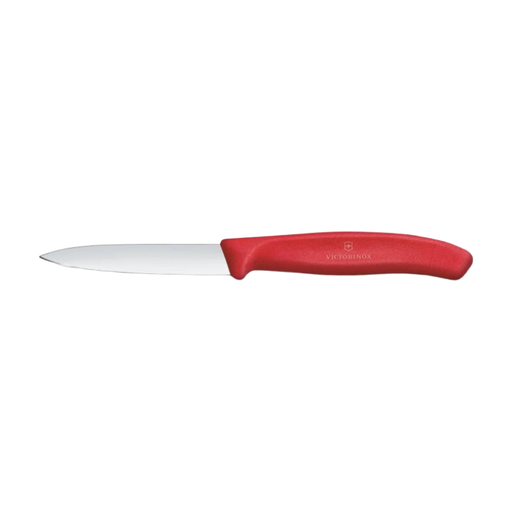
Why this product suits this profile: This compact single knife handles typical tasks such as peeling, slicing and finely chopping fruit and vegetables. The 8 cm blade and 20 g weight make it easier to maintain control on smaller work surfaces.
The short, straight stainless steel blade is clearly designed for small kitchen tasks, rather than being used as an all-purpose tool for bread or large roasts.
8 cm blade length, polypropylene handle, dishwasher suitable according to the product details and made in Switzerland.
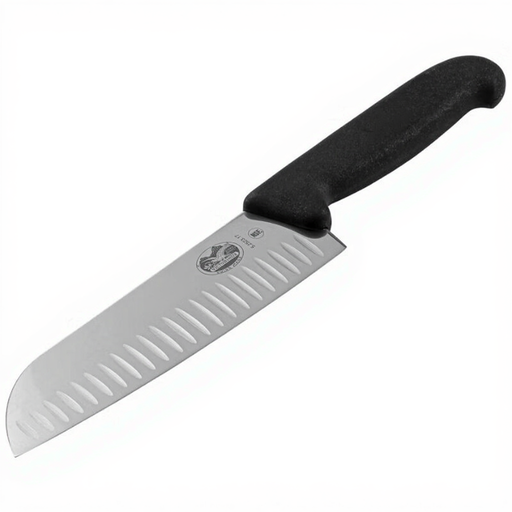
Why this product suits this profile: The 17 cm blade is versatile enough for everyday preparation of vegetables, fish and meat. The Fibrox plastic handle with its non-slip finish is designed for users who value a secure grip and regular kitchen use.
The clearly stated blade length and defined Santoku use help prevent the knife from being mistaken for a bread knife or boning knife.
17 cm stainless steel blade, Granton edge according to the product name and dishwasher suitable according to the product details.
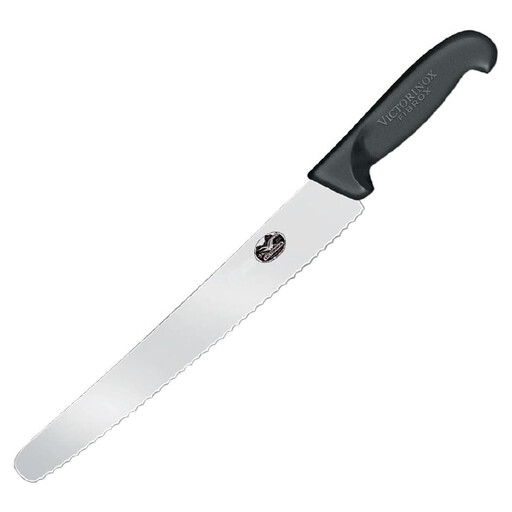
Why this product suits this profile: The long, serrated blade is designed for bread, cakes and pastries. This size is practical for families, baking enthusiasts or catering businesses that regularly slice larger baked goods.
The serrated edge is clearly intended for baked goods. This prevents a short vegetable knife from being used for tasks that require a longer blade.
26 cm blade length, serrated edge, ergonomic handle and dishwasher suitable according to the product details.
A Victorinox knife set makes sense if you regularly carry out several cutting tasks or if multiple people work in the kitchen. For example, a 2- or 3-piece set with straight and serrated blades can cover peeling, tomatoes, soft fruit and small vegetable preparation tasks. A 6-piece set may also include a peeler and other specialist knives.
Before buying, check whether you will actually use all the knives included. For a small kitchen, a set containing three similar Victorinox fruit knives may be more suitable than a larger selection filled with unused specialist shapes. For bread, meat and vegetables, combining individual knives may be a more targeted solution.
We have put together a complete, regularly updated list of products that fully meet these strict selection criteria and the safety regulations applicable in the EU.
Several of the models listed are stated to be suitable for dishwashers. However, hand-washing with mild detergent followed by immediate drying is gentler and helps preserve the cutting edge. The individual product description should be the deciding factor before you buy.
How long the knife remains sharp depends on the chopping board, cutting technique, food and care. Stone, glass and ceramic surfaces can blunt the blade more quickly. Regular honing with a suitable tool can help maintain its performance; if there is visible damage, the knife should no longer be used.
For small preparation tasks, a Victorinox vegetable knife with an 8 to 11 cm blade is suitable. If you frequently cut vegetables, fish and meat, you can choose a 17 cm Santoku knife. For bread and pastries, a model with a 21 to 26 cm serrated blade is a better choice. Your ingredients, work surface and preferred level of handle comfort remain the key considerations.