
Lieferung heute & morgen

Qualitätsgarantie

Willkommens-Angebote freischalten: KOSTENLOSE Lieferung | Bis zu 80 % RABATT | Kostenlose 30-Tage-JoyPlus-Testphase
App herunterladen
A new kitchen knife often looks straightforward on product pages: stainless steel blade, ergonomic handle, dishwasher-safe. In practice, however, details such as blade length, edge, handle material and storage determine whether a knife suits the way you work. This applies just as much to home cooks as it does to restaurants, catering teams and professional kitchen staff.
Some Victorinox kitchen knives are listed as dishwasher-safe. That does not mean machine washing is the best choice for every use. High temperatures, detergents and contact with other cutlery can put additional strain on the blade and handle. To maintain consistent cutting performance for as long as possible, we recommend washing by hand with mild washing-up liquid and drying immediately afterwards.
Extra care is needed with knives featuring wooden handles: they should not be soaked or cleaned in the dishwasher.
A long Victorinox chef’s knife is not automatically suitable for every kitchen. A 25 cm blade offers a large cutting surface, but it also requires more space and careful control. For smaller chopping boards or more delicate work, a 12 or 18 cm model may be more practical.
Length is also important when choosing a Victorinox bread knife. The model featured here has a 26 cm serrated blade, making it suitable for larger loaves, cakes and pastries.
Colours such as red, pink, orange and green make it easier to identify knives during everyday kitchen tasks. However, they reveal little about a knife’s actual purpose. Before buying, you should check:
A Victorinox chef’s knife with a straight edge is suitable for many cutting tasks, including vegetables, meat and herbs. A santoku knife is generally more compact and designed for slicing, chopping and rocking cuts. A Granton edge with indentations can reduce contact between the blade and food.
A Victorinox bread knife with a serrated edge cuts through hard crusts and soft interiors without requiring the blade to be guided across the surface as it would with a smooth edge. Straight or serrated carving knives are suitable for roasts and other larger cuts of meat.
Blade length should always be matched to the available workspace and your own cutting technique.
The models listed here feature stainless steel blades. Several products are specified as using corrosion-resistant or rust-resistant stainless steel. This makes maintenance easier, but it does not replace prompt cleaning and drying, particularly after cutting acidic foods.
Depending on the range, the handles are made from plastic or thermoplastic elastomers. Fibrox and Swiss Classic models feature ergonomically designed plastic handles. The Grand Maître range uses sturdy handles and forged knives. For everyday use, the key considerations are whether the handle feels secure, offers good slip resistance and suits the size of your hand.
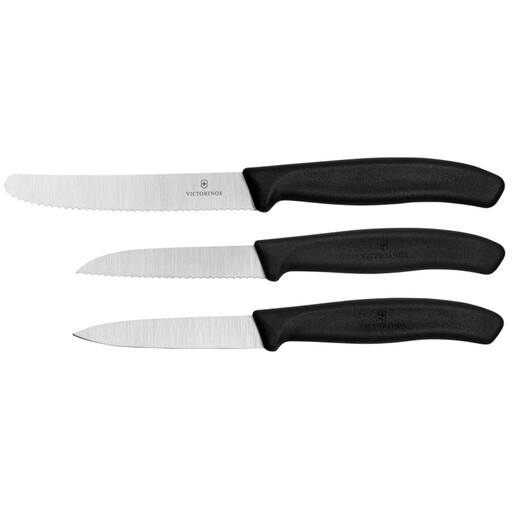
Why this product suits this profile: This three-piece set covers everyday tasks such as peeling, slicing and removing cores. It includes two 8 cm knives and an 11 cm tomato knife.
The clearly defined knife types mean you do not have to use one general-purpose knife for every small task. The product details also specify stainless steel blades and dishwasher suitability.
Three knives for different preparation tasks, ergonomic plastic handles, plus straight and serrated edges.
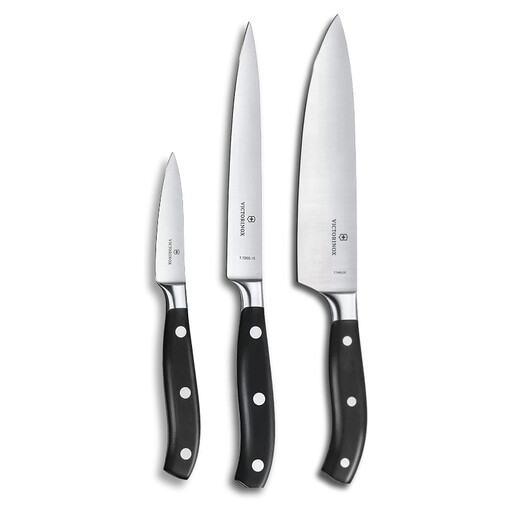
Why this product suits this profile: The set combines an 8 cm paring knife with two 20 cm knives for chopping, dicing and slicing meat, fish, fruit and vegetables.
The different blade shapes and sizes are clearly specified. This lets you choose the set according to the task rather than simply its design.
Forged knives, stainless steel blades, a total weight of 714 g according to the product data, and listed as dishwasher-safe.
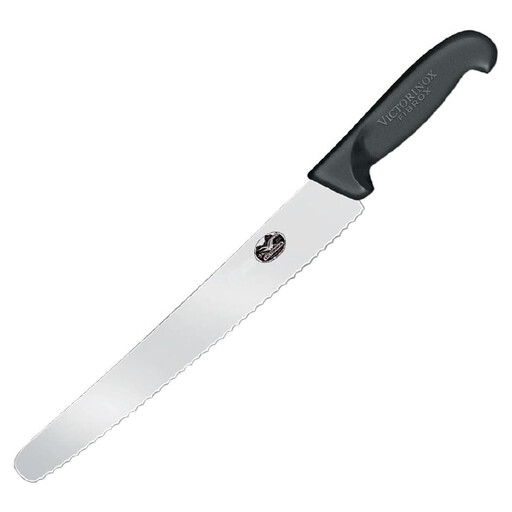
Why this product suits this profile: For bakeries, breakfast services, catering or households that regularly eat bread, the 26 cm serrated blade is designed for bread, cakes and pastries.
The serrated edge is clearly designed for baked goods. The specified blade length prevents you from choosing based solely on colour or range name.
26 cm stainless steel blade, ergonomic non-slip plastic handle and listed as dishwasher-safe according to the product data.
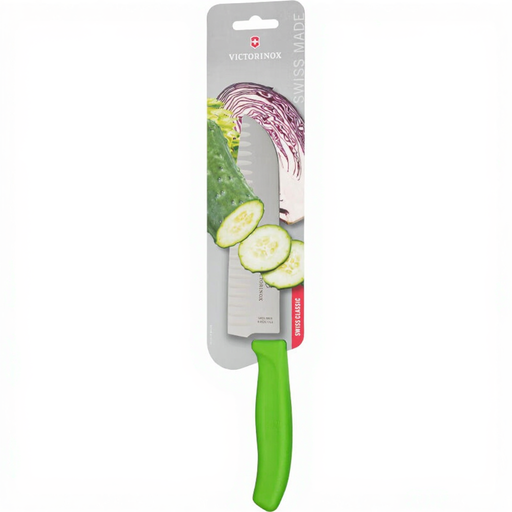
Why this product suits this profile: This Victorinox santoku knife has a 17 cm blade designed for slicing, chopping and preparing ingredients, making it a versatile standalone knife.
The product data specifies the knife type, 17 cm blade length and Granton edge. This allows you to choose based on specific features rather than general marketing claims.
Stainless steel blade, thermoplastic elastomer handle, weight of 103 g and listed dishwasher suitability.
We have put together a complete, regularly updated list of products that fully meet these strict selection criteria and the safety regulations applicable in the EU.
Even dishwasher-safe knives should not be left loose in a drawer with other cutlery. Suitable options include a knife block, magnetic strip, drawer insert or blade guard. Chopping boards made from stone, ceramic or glass can put additional strain on the edge; softer materials are generally more practical for kitchen knives.
After cutting acidic foods, the blade should be cleaned promptly. Avoid harsh or abrasive cleaning products. When transporting knives, for example to a catering job, knife bags, knife cases or individual blade guards are suitable options. Sharp blades should always be stored out of children’s reach.
Several of the models mentioned in this guide are listed as suitable for use in the dishwasher. Nevertheless, for gentler care and to help preserve the edge, we recommend washing by hand with mild detergent and drying immediately. Wooden handles should not be put in the dishwasher.
A Victorinox chef’s knife with a straight edge or a Victorinox santoku knife with a blade length of around 17 to 20 cm will cover many cutting tasks. The right choice depends on whether you prefer classic rocking cuts or more compact chopping and slicing movements.
Edge retention depends on the cutting surface, frequency of use, food being prepared and care. Stone and ceramic boards, as well as loose storage, can put additional strain on the edge. A suitable honing steel or sharpening system can help you maintain the cutting edge regularly.