
Lieferung heute & morgen

Qualitätsgarantie

Willkommens-Angebote freischalten: KOSTENLOSE Lieferung | Bis zu 80 % RABATT | Kostenlose 30-Tage-JoyPlus-Testphase
App herunterladen
A Victorinox serrated vegetable knife is useful for many kitchen tasks: its serrated blade cuts through soft foods and tougher skins without requiring much pressure. However, the wide choice of colours, blade lengths and product variants can easily lead to the wrong purchase.
Before buying, home cooks, households and professional kitchen users should therefore look beyond the brand name. The key factors are the blade length, the shape of the tip, the handle and the cleaning instructions.
A serrated edge is particularly suitable for foods with a soft surface and partly tougher skin. These include tomatoes, figs, avocados and certain types of fruit. However, a small serrated vegetable knife is not designed for bones, frozen food or heavy-duty cutting.
A serrated blade works differently from a smooth edge: it grips the surface and draws through the food. This can be helpful when cutting a tomato, but it does not replace a paring knife or a sturdy chef’s knife.
An 8 cm vegetable knife is compact and suitable for small cutting surfaces, peeling tasks and precise movements. A 10 cm vegetable knife offers slightly more reach and is more practical for larger tomatoes, peppers or pieces of fruit.
A longer blade is not automatically the better choice. If you mainly prepare small ingredients or have limited space on the chopping board, 8 cm may suit you better. For versatile everyday kitchen tasks, however, 10 cm can provide greater freedom of movement.
The Victorinox Swiss Classic vegetable knives featured here are listed as suitable for dishwashers. Even so, long wash cycles, harsh detergents and leaving the knife in a damp cutlery basket afterwards can put greater strain on the surface and cutting performance.
The following therefore applies to a dishwasher-safe vegetable knife: remove it as soon as possible after the cycle and dry it. Hand washing is a sensible option if you want to treat the blade and handle as gently as possible.
The blade length should match the food you usually cut:
The product details should clearly state whether the tip is centred or shaped as a pronounced point. Several variants in the Swiss Classic range differ in blade length and model number, while the basic principle of the serrated stainless-steel blade remains similar.
The models listed feature a stainless-steel blade and a handle made from polypropylene (PP). Depending on the version, the low weight is approximately 20 g for the 8 cm models and 27 g for the 10 cm variants. This makes the knife comparatively easy to handle during longer preparation tasks.
An ergonomic handle should sit securely in your hand and provide sufficient control. The coloured PP handles in red, blue, black, orange, green, yellow or violet also make it easier to identify knives in households and kitchens where several are in use.
“Dishwasher-safe” describes how the knife can be cleaned, not how it should be stored safely. The blade remains sharp and can cause cuts. The knife should therefore be kept out of children’s reach and stored safely after use in a drawer, knife block or suitable holder.
In Germany, carrying and possessing knives in public is subject to specific legal regulations. A small kitchen knife is intended for food preparation and should not be carried in public without a specific, legally permitted reason.
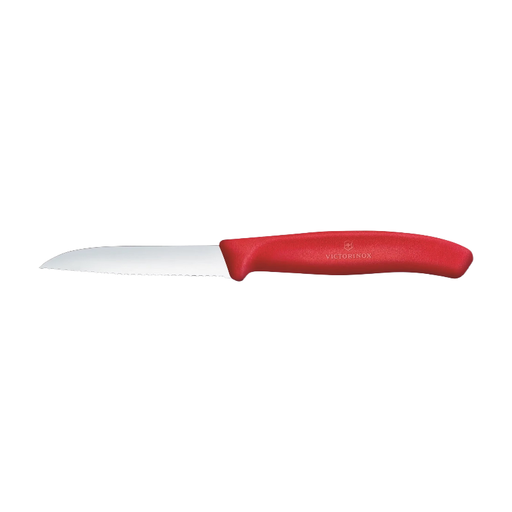
Why this product suits this profile: The 8 cm blade and stated weight of 20 g provide a compact solution for everyday cutting tasks involving fruit and vegetables.
The stated blade length helps prevent you from buying a knife that is too large for small ingredients. According to the product information, it can be cleaned in the dishwasher.
Serrated stainless-steel blade, PP handle, 8 cm blade length and low weight.
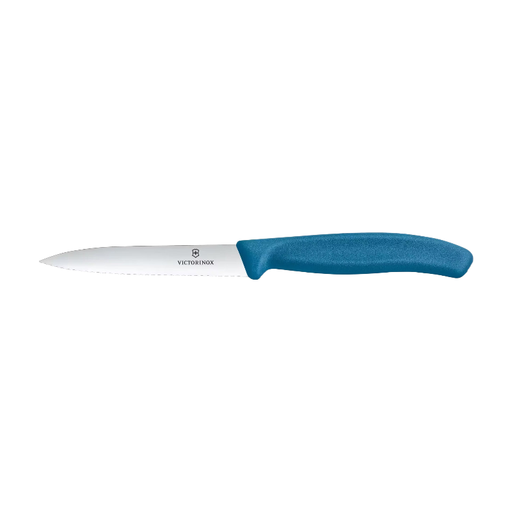
Why this product suits this profile: The 10 cm blade with pointed tip offers greater reach for regular preparation tasks while remaining comparatively light at 27 g.
The blade length, tip design and material are clearly specified. This makes it possible to compare the variant objectively with 8 cm models, rather than choosing based solely on the handle colour.
Swiss-made, serrated stainless-steel blade, 10 cm length, pointed blade shape and PP handle.
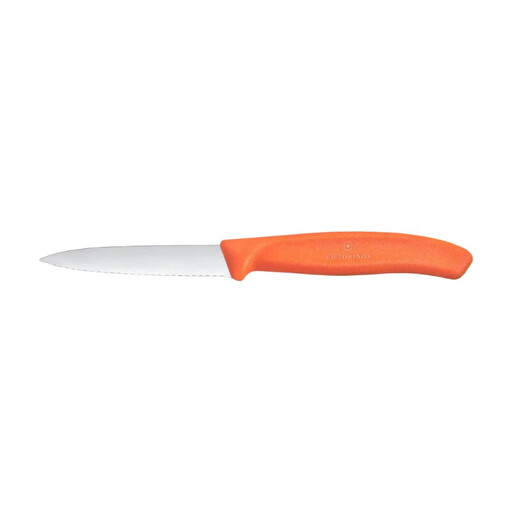
Why this product suits this profile: The compact design is suitable for frequent small cutting tasks, such as preparing tomatoes, soft fruit and vegetables. The distinctive handle colour makes it easier to identify in a busy kitchen.
The product details specify a serrated edge, tip, stainless steel and dishwasher suitability. This reduces the risk of choosing a decorative model without the right technical specifications.
8 cm serrated stainless-steel blade with pointed tip, PP handle, Swiss manufacture and stated dishwasher suitability.
We have put together a complete, regularly updated list of products that fully meet these strict selection criteria and the safety regulations applicable in the EU.
For most households, three questions are enough to narrow down the right variant:
A Victorinox Swiss Classic vegetable knife can be used in a private kitchen as well as for regular preparation work in a professional catering environment. However, its suitability depends on the food being cut, your working method and the blade length you require.
Yes, according to the product description, the serrated stainless-steel blade is designed for soft fruit such as tomatoes, avocados and figs. For safe handling, the chopping board should be non-slip and your fingers should be kept away from the blade.
The variants mentioned are listed as suitable for dishwashers. Removing and drying the knife promptly after the cycle, along with occasional hand washing, can help protect the blade and handle. The individual product information remains decisive.
8 cm is suitable for small, precise tasks and for users who prefer a particularly compact knife. 10 cm provides a larger cutting surface and is suitable for larger tomatoes, pieces of fruit and a wide range of preparation tasks. Your decision should be based on the food you typically cut and the space available.