Joybuy Insights

Video Baby Monitors: A Technical Buying Guide for 2026

Selecting the right video baby monitor involves a careful evaluation of specific technical parameters to ensure dependable surveillance. Your final choice will hinge on factors such as transmission technology, image quality, power source, and the overall feature set. This guide breaks down the key criteria to consider when choosing a device for 2026.

Buying Guide: What to Look for in a Video Baby Monitor

The performance of a modern baby monitor is defined by a range of technical specifications. Making an informed choice depends on a clear understanding of these core features.

Transmission Technology: Wi-Fi vs. Dedicated Radio Connection (FHSS)

The method of signal transmission is a fundamental differentiator.

  • Dedicated Radio Connection (FHSS): FHSS (Frequency-Hopping Spread Spectrum) is an interference- and eavesdrop-resistant radio technology that establishes a direct connection between the camera and parent units. These systems do not require an internet connection and are typically ready to use right out of the box (plug-and-play). The range is limited by the device's specifications, usually up to 300 metres in an open field.
  • Wi-Fi Baby Monitor: Wi-Fi-based models connect the camera to your home wireless network. Access is provided via a smartphone app, allowing for a potentially unlimited range. This enables monitoring from any location with an internet connection. Stability and security depend on the quality of your home network and the manufacturer's encryption standards. Some models offer a hybrid mode that supports both a direct connection and app control.

Image and Video Quality: Resolution and Night Vision

Visual monitoring is the core function of a video baby monitor.

  • Resolution: Image resolution, measured in pixels, determines the level of detail. Common standards are 720p (HD), 1080p (Full HD), or higher. A higher resolution provides a clearer picture, which is especially beneficial when using digital zoom.
  • Night Vision: An infrared night vision function is essential for monitoring in the dark. Automatically activated infrared LEDs invisibly illuminate the room for the camera sensor, delivering a clear black-and-white image.

Power Supply: Battery vs. Mains Power

The system's mobility is determined by its power source.

  • Parent Unit: Most monitors have a built-in battery, allowing for portable use around the house. Battery life is a key parameter and varies depending on the model and usage intensity.
  • Camera Unit: Cameras are often powered by a mains adapter to ensure continuous operation. Models with a built-in battery in the camera unit offer additional flexibility during power outages or for temporary use in locations without a power socket.

Additional Features: Two-Way Talk, Sensors, and App Control

Modern devices often offer more than just video transmission.

  • Two-Way Talk Function: A built-in microphone and speaker enable two-way communication, allowing you to soothe your child with your voice.
  • Sensors: Temperature and sound sensors (VOX mode) can automatically activate the parent unit when predefined thresholds (e.g., a specific room temperature or sound level) are exceeded.
  • App Control: A baby monitor with an app and monitor offers advanced features like saving recordings, sharing access with family members, or controlling pan-tilt cameras.

Our Top Picks for 2026

Based on the technical criteria above, we present three models with different specialisations.
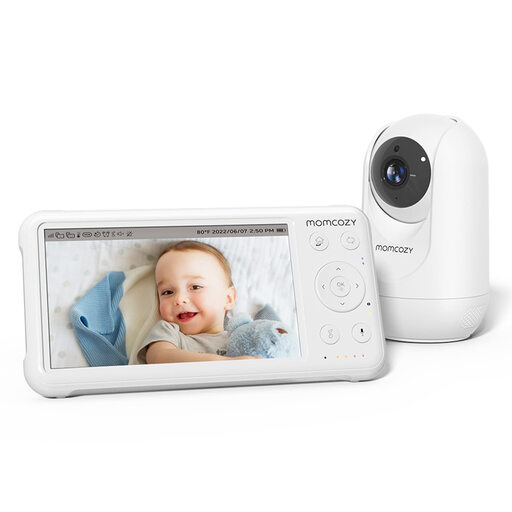
1. Momcozy BM01 Video Baby Monitor

Momcozy BM01 Video Baby Monitor

  • Why we recommend this product: The Momcozy BM01 is a classic video baby monitor that relies on a dedicated, secure radio connection without Wi-Fi. Configuration is minimal (plug-and-play), ensuring high operational reliability and ease of use. It focuses on core functions: clear video transmission and a stable connection.

  • Pros:

    • Image Quality: 1080p HD camera with a large 5-inch display.
    • Power Supply: Powerful 5000mAh battery in the parent unit for up to 11.5 hours of operation (according to the manufacturer).
    • Features: Infrared night vision, two-way talk, temperature sensor, and VOX mode for smart sound activation.
    • Security: Closed system with no internet connection to minimise external access risks.
  • Who it's for: Users who prefer a reliable, easy-to-use solution without app integration or Wi-Fi dependency. Ideal for parents who prioritise data privacy and a stable, direct connection.
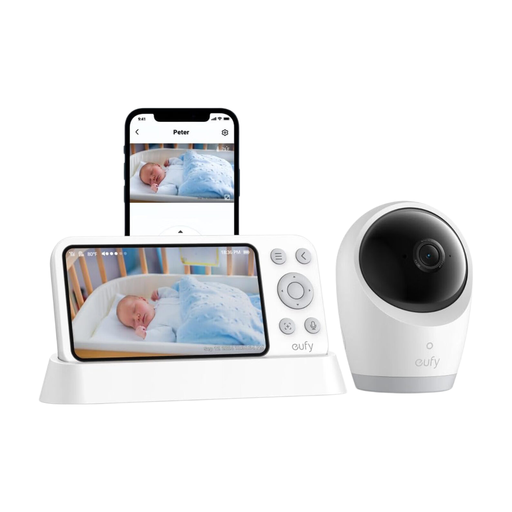
2. eufy Baby Monitor E21

eufy Baby Monitor E21

  • Why we recommend this product: The eufy E21 offers a hybrid system that combines the benefits of a local monitor connection with a Wi-Fi baby monitor app. The sensor's 4K UHD resolution and motorised pan-tilt function allow for comprehensive and detailed room surveillance.

  • Pros:

    • Hybrid Mode: Can be used with either the included 5-inch monitor (720p) or worldwide via the app. A physical switch can disable the Wi-Fi function for a purely local connection.
    • Image Quality: 4K UHD sensor for high detail, especially with the 8x zoom.
    • Flexibility: The camera has its own 5,000 mAh battery, making it portable. The pan (330°) and tilt (60°) functions cover the entire room.
    • Smart Features: Active noise reduction, notifications for crying or loud noises, and the ability to share access with up to 5 family members.
  • Who it's for: Tech-savvy parents who want maximum flexibility. This device is suitable for users who value both reliable local monitoring and remote smartphone access, and who prioritise high image resolution.
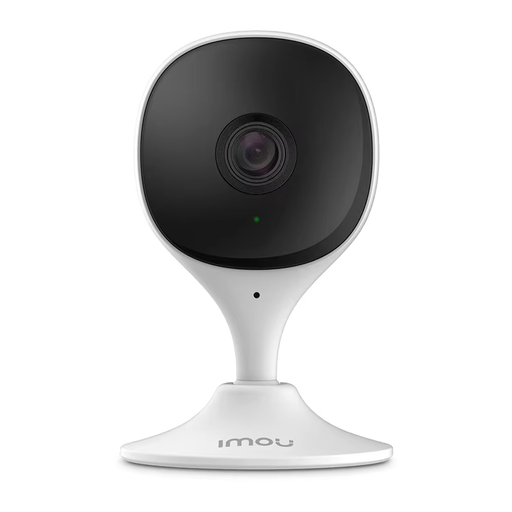
3. IMOU Cue 2E 3MP Wifi Security Camera

IMOU Cue 2E 3MP Wifi Security Camera

  • Why we recommend this product: The IMOU Cue 2E is primarily a security camera for baby monitoring, distinguished by its smart detection features and app-only control. It represents a cost-effective solution for parents who already use a smartphone as their primary display and want advanced security features.

  • Pros:

    • Smart Detection: AI-based human detection to reduce false alarms, as well as abnormal sound detection that reacts to a baby crying or loud noises and sends a notification.
    • Image Quality: 3MP (2304 x 1296) QHD resolution delivers sharper images than conventional 1080p.
    • Connectivity: Supports Wi-Fi 6 for a more stable and faster network connection.
    • Installation: A magnetic mount allows for easy and flexible installation on metallic surfaces.
  • Who it's for: Users looking for a purely app-based solution who want to use their smartphone as the monitor. It is especially suitable for budget-conscious buyers who want a multifunctional camera for both baby monitoring and general home security.

Discover More Models and Alternatives

The market for baby monitoring systems is diverse, offering solutions for various needs and budgets. In addition to the models presented here, numerous other devices with specific features are available. You can find a wider selection of devices in our main category.

Discover more products in the category: Baby Monitors

Frequently Asked Questions (FAQ)

1. How secure is a Wi-Fi baby monitor? The security of a Wi-Fi baby monitor depends on the manufacturer's implemented encryption standards. Models that use modern protocols like AES-128 or RSA-1024 and offer a secure app infrastructure are considered well-protected. Additional security is achieved by using a strong, unique Wi-Fi password and regularly installing firmware updates. Hybrid models also offer the option to completely disable the Wi-Fi function if needed.

2. Do I need a baby monitor with both an app and a separate monitor? The decision depends on your personal usage habits. A separate monitor (parent unit) is advantageous because it is a dedicated device that won't be interrupted by calls or other smartphone notifications, and its battery isn't drained by other apps. An app, on the other hand, offers the benefit of unlimited range and the ability to access the camera from anywhere. Hybrid systems that offer both provide a flexible compromise.

3. What does VOX mode mean on a baby monitor? VOX stands for "Voice Operated Exchange." In this mode, the parent unit's screen and/or audio transmission goes into standby as long as it is quiet in the child's room. As soon as the camera unit registers a predefined sound level (e.g., crying), the transmission is automatically activated. This significantly reduces the parent unit's power consumption and extends its battery life.


Written by: Joybuy Product Recommendation Officer