Which monitor is right for you?

Editing with long timelines

If you're reviewing a large amount of raw footage for a training demo, it can be useful to have several tracks and source clips side by side. Adobe Creative Cloud describes the timeline as a display of video clips and their order. A wide display is one option if you want more horizontal space for this.

4K and colour checks

When checking details, overlays and the colour in your videos, look at the native resolution and colour modes that suit your output format. ASUS, BenQ and EIZO each list a resolution of 3840 × 2160 pixels for the models described here. This alone does not establish independently measured colour accuracy.

Long editing sessions

If you spend a long time working in one place, the monitor's adjustment options matter, as do your seating position, lighting and potential reflections. The German Social Accident Insurance (DGUV) lists poor lighting, glare and a non-ergonomic workstation setup as possible causes of discomfort.

What should you look for when buying?

Ultrawide for your timeline

A good fit if: You prefer to view long source recordings and several editing tracks side by side, and have enough desk space. Dell lists the U3425WE as having a 34.1-inch screen and 3440 × 1440 pixels. This gives you a wide workspace, but does not represent a measured time saving.

Trade-off: Its 1440-pixel image height is lower than the 2160 pixels offered by the 4K UHD models considered here.

27-inch 4K for image details

A good fit if: You want to check 4K footage, small captions or fine image details particularly carefully. ASUS lists the PA279CRV and BenQ the PD2706U as having 27-inch screens with a resolution of 3840 × 2160 pixels.

Trade-off: The 16:9 format gives you less horizontal space than a 21:9 display. Also check whether the user interface is comfortably legible at your preferred scaling.

Priority What to check before buying Who is this most important to?
Keeping track of long timelines Aspect ratio, native resolution and available desk width. When I organise long source recordings, I need room for the timeline and tracks. Around 36% of consumers put this overview first.
Image details and colour Native resolution and a colour mode suited to your output format. With 4K footage, I want to check details and overlays and match the display to my output project. Around 29% of consumers prioritise image and colour checks.
Comfort during long sessions Height and tilt adjustment, as well as reflections in your workspace. When I work at my editing setup for a long time, I want to position the screen to suit my seating position and minimise distracting glare. Around 21% of consumers prioritise these ergonomic factors.
Laptop connection and power Video output through the laptop connection and suitable USB-C power delivery. With an editing laptop, I want to connect video and power in a way that suits my device. For around 14% of consumers, these connection requirements are the main priority.

Common buying mistakes

  • Assuming ultrawide automatically means “better for video editing”

    A wide format gives you more horizontal workspace, but at 3440 × 1440 pixels it has fewer vertical pixels than the 3840 × 2160 pixels of the 4K models considered here.

    First decide whether timeline width or checking 4K image details matters more for your editing setup.

  • Taking a claimed colour gamut as a guarantee of accurate final colours

    Manufacturer information about colour gamuts and modes alone does not tell you whether your project settings will match the final output. BenQ, ASUS and EIZO list different features for their respective models.

    Match the colour mode and editing workflow to your intended output format. If you need dependable colour checks, plan a calibration workflow.

  • Assuming any USB-C port provides enough power

    Manufacturers list a maximum of 60 W for the EIZO CS2740, 90 W for the BenQ PD2706U and 96 W USB-C Power Delivery for the ASUS PA279CRV. The right level of power depends on the laptop you use.

    Check your laptop's power requirements and video output through the relevant port, then compare both with the monitor's specifications.

    If your laptop needs more power, you may still need to use its existing power adapter.

Key brands at a glance

ASUS

The ProArt PA279CRV is a documented 27-inch 4K option for image checks and a USB-C editing setup.

  • ASUS Germany lists a resolution of 3840 × 2160 pixels, colour modes including Rec.709, 96 W USB-C Power Delivery and height adjustment of up to 130 mm.
  • These are manufacturer specifications for this model, not independently measured colour accuracy or a statement about every ProArt monitor.

BenQ

The DesignVue PD2706U is a 27-inch 4K option with documented colour modes and connectivity features.

  • For this model, BenQ lists 100% Rec.709, 95% DCI-P3, USB-C with 90 W Power Delivery and 110 mm of height adjustment.
  • Colour gamut coverage is a manufacturer specification. Check that the colour workflow and laptop connection suit your editing setup.

Dell

The UltraSharp U3425WE is a wide 34.1-inch option if you want plenty of horizontal space for your timeline.

  • Dell lists a resolution of 3440 × 1440 pixels, a 21:9 format and a height-adjustable stand for this model.
  • Its resolution provides fewer vertical pixels than the 4K UHD models considered here. The larger timeline view is inferred from the format and resolution; it is not based on an independent productivity test.

EIZO

The ColorEdge CS2740 is a 27-inch 4K option if you plan to use a calibration workflow.

  • EIZO lists hardware calibration, 3840 × 2160 pixels and 100% Rec.709 as features of this model.
  • According to the specifications, USB-C power delivery is limited to 60 W. Check this figure if your laptop needs more power; it does not indicate independently measured superiority.

Joybuy products for your editing setup

The Joybuy products below include wide ultrawide formats for timelines and 4K models for previews and image details. The right option for you depends on whether workspace, vertical resolution or laptop connectivity is the priority for your editing setup.

INNOCN 40C1U 40-inch 5K ultrawide monitor

INNOCN 40C1U 40-inch 5K ultrawide monitor

For long timelines, the 40-inch 21:9 format combines a wide workspace with a resolution of 5120 × 2160 pixels.

Specifications include an IPS panel, 100 Hz, a matte finish and a height-adjustable stand with a 120 mm adjustment range.

USB-C Power Delivery: 65 W. Check that this is enough for your laptop.

View at Joybuy

CRUA 49-inch DQHD curved monitor, 32:9

CRUA 49-inch DQHD curved monitor, 32:9

The 32:9 format and 5120 × 1440 pixels make this an option if you need plenty of horizontal space for timelines.

Specifications include 1500R curvature, HDMI 2.1 and DisplayPort 1.4; the title also lists a height-adjustable stand.

The vertical resolution is 1440 pixels, below the 2160 pixels of a 4K UHD screen.

View at Joybuy

INNOCN E34A1R 34-inch curved ultrawide monitor

INNOCN E34A1R 34-inch curved ultrawide monitor

The 21:9 format and 3440 × 1440 pixels provide a wide workspace for editing timelines.

The title lists a VA panel, 200 Hz and a height-adjustable stand.

The vertical resolution is 1440 pixels. Bear in mind the difference from 2160 pixels when checking 4K image details.

View at Joybuy

INNOCN CB27U1 27-inch 4K UHD monitor

INNOCN CB27U1 27-inch 4K UHD monitor

The listed specifications of 27 inches and 3840 × 2160 pixels make this suitable for previewing 4K footage and checking image details.

An IPS panel, 120 Hz and USB-C Power Delivery of 90 W are listed. Check that the USB-C power output is right for your laptop.

The 16:9 format gives you less horizontal space than a 21:9 ultrawide if timeline width is your priority.

View at Joybuy
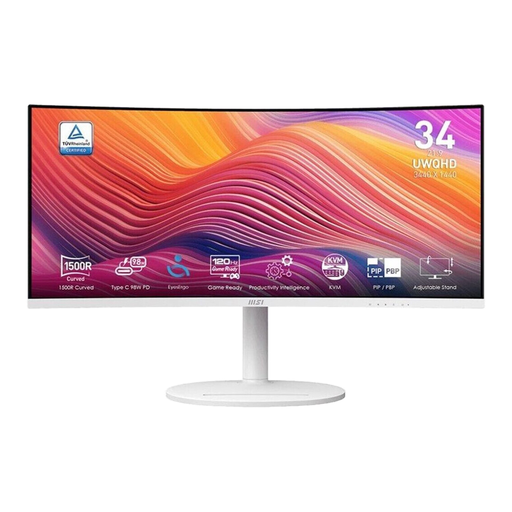
MSI Modern MD342CQPWDE 34-inch UWQHD monitor

MSI Modern MD342CQPWDE 34-inch UWQHD monitor

The 21:9 format and 3440 × 1440 pixels make this an option if you prioritise timeline width at your editing setup.

Specifications include a QLED VA panel, 120 Hz, HDMI, DisplayPort and two USB 3.0 ports. The description lists a tilt-adjustable stand.

The vertical resolution is 1440 pixels, below the 2160 pixels of a 4K UHD screen.

View at Joybuy

Frequently asked questions

Which format is best if I mainly sort through long raw recordings?

If your timeline is the main bottleneck, consider a 21:9 display such as the 34.1-inch Dell U3425WE, with a resolution of 3440 × 1440 pixels. If you prioritise 4K image details instead, compare it with a 27-inch 4K model. The best window layout also depends on your editing software.

Is one USB-C cable between the monitor and editing laptop enough?

Only if the laptop can output the required video signal through that connection and the monitor's power delivery meets its needs. Depending on the model, manufacturers list 96 W for the ASUS PA279CRV, 90 W for the BenQ PD2706U and a maximum of 60 W for the EIZO CS2740. Before buying, check the cable and your laptop's specifications too.

How should I set up my monitor for longer sessions?

Adjust the height and tilt to suit your workspace, and pay attention to lighting and glare. The German Social Accident Insurance (DGUV) lists poor lighting, glare and a non-ergonomic workstation setup as possible causes of discomfort. A single monitor feature will not automatically resolve these factors.

Are there specific requirements for an editing setup used for training?

If the setup is a workplace screen station or a teleworking station covered by the relevant rules, the Workplace Ordinance and the accompanying ASR A6 are relevant to the employer. The Federal Institute for Occupational Safety and Health defines the scope of ASR A6 accordingly; the term “training demo” does not imply one standard minimum monitor size for all buyers.

What are my rights when buying online or if something is faulty?

In Germany, consumer contracts made online generally come with a 14-day right to cancel, which must be communicated to you. If newly purchased goods are faulty, you generally have statutory rights against the seller for two years. The Consumer Advice Centre distinguishes these rights for faulty goods from the right to cancel an online purchase.