If you’re filming yourself and a demonstration area from a fixed spot, an adjustable panel or a two-light kit can be a sensible starting point. For setups that change from lesson to lesson, a COB light with a separately chosen modifier gives you more creative options. The key factors are your framing, available space, what’s included and how the lighting works with the room and your camera’s white balance—not just a lux figure. Record a short test clip to check for flicker and possible fan noise. Manufacturer illuminance figures apply only under the specific measurement conditions stated.
Who needs what kind of lighting?
Teachers with a demonstration area
If you show explanations and practical demonstrations in the same shot, assess the lighting on your face and work surface together. Canon Europe explains how to use key and fill lights; a two-light kit can give you separate positions, provided there’s room for the stands.
Teachers using colour-critical examples
If you’re demonstrating light colours or photographic subjects, it’s important to balance the room lighting with your camera’s white balance. Canon Europe highlights the importance of white balance in challenging lighting conditions; a panel’s colour temperature is only one part of the setup.
Teachers recording their own audio
If you speak while demonstrating, test the lighting and sound together with your microphone. Sony Deutschland describes shutter speed as one possible adjustment for visible flicker. With a COB light, you should also consider the cooling system in your actual recording setup.
What should you look for when buying?
Single bi-colour panel
A good fit if: you’re filming mainly your face or a modest work surface from a fixed spot, and can position the panel to one side.
Things to consider: The size, mount and distance need to work for the whole frame. Batteries for optional battery operation of the Rollei LUMIS LED Panel Bi-Color are sold separately.
Two bi-colour panels as a kit
A good fit if: you want to light the teacher and demonstration area separately, and have room for two stands.
Things to consider: Two stands need floor space. The NL660 kit described by NEEWER includes diffusers, but not NP-F batteries.
COB light with a modifier
A good fit if: you switch between explanations, portraits and subject demonstrations, and want to adapt the modifier to each scene. The Godox SL60IIBi and amaran 100x S are documented bi-colour examples with Bowens mounts.
Things to consider: Choose a modifier and stand to suit your setup, and make sure you have enough space. Lux figures measured with a reflector can’t be directly compared with results using a softbox.
Compact desk light
A good fit if: you mainly speak to camera while seated and would rather use a tabletop stand than a floor stand.
Things to consider: Check in a wide shot whether the desk light reaches the demonstration area as well as your face.
| What you need |
What to check |
Who is it important for? |
| Face and demonstration area |
Set your camera framing and test the lights in place to check that both areas are clearly lit. |
If I want to show my face and work surface in the same lesson, I need to assess both in the camera frame; around 36% of consumers prioritise lighting both together. |
| Subject colours |
Check the colour temperature range of the specific model, along with the room lighting and camera white balance, using a test clip. |
If I want to show colours in photographic examples clearly, I need to balance the lighting and white balance; around 29% of consumers put subject colours first. |
| Flicker and sound |
Record a short video and audio test using your planned frame rate, shutter speed, dimming level and microphone position. |
If I speak while demonstrating lighting, I want to avoid visible flicker and distracting noise in the finished clip; around 21% of consumers prioritise clear video and audio recording. |
| Setup and power |
Check the contents of the exact variant against the stand, power supply, modifier and any batteries you need. |
If I want the setup to be ready for a lesson without any missing parts, I check what’s included, the power supply and the space needed in advance; around 14% of consumers focus above all on getting a complete setup that suits their needs. |
Which buying mistakes should you avoid?
-
Comparing lux figures from different setups directly
A lux figure applies only to the stated measurement conditions. amaran specifies up to 30,500 lux for the 100x S at 1 m, 5,600 K and with the Hyper Reflector. Changing the distance or using a softbox means you’re no longer comparing like with like.
Compare figures only when the conditions match, and test your planned modifier with your own framing.
-
Assuming a light or kit comes fully equipped
What’s included varies by model and version. Optional battery operation doesn’t automatically mean batteries are included.
Before buying, check the parts list for the exact offer against everything you need for your setup.
-
Assuming bi-colour or colour-rendering specifications guarantee accurate subject colours
Room lighting and camera white balance also affect how colours appear in your video.
Balance your lighting and check your actual subjects with a test clip and a set white balance.
A guide to key brands
NEEWER
Bi-colour panels, including a two-panel NL660 kit for lighting that can be positioned separately.
- According to NEEWER, the kit version described includes two panels, diffusers, stands and power supplies.
- NP-F batteries aren’t included, and these details don’t necessarily apply to other NL660 offers.
Rollei
The LUMIS LED Panel Bi-Color for a positionable panel, and the LUMIS Key Light Pro for a desk setup.
- Rollei specifies an adjustable range of 3,200 to 5,600 K for the LUMIS LED Panel Bi-Color; the Key Light Pro is described as coming with a tabletop stand.
- Batteries for optional battery operation of the panel are sold separately. Whether the desk light reaches a demonstration area depends on your framing.
Godox
The SL60IIBi is a bi-colour COB light with a Bowens mount for a separately selected modifier.
- Godox specifies a colour temperature range of 2,800 to 6,500 K and a Bowens mount for this model.
- The maximum lux figure refers to the standard reflector at 1 m, not automatically to a softbox setup.
amaran
The 100x S is a bi-colour COB light with a Bowens mount for interchangeable modifiers.
- amaran specifies 2,700 to 6,500 K and lists a reflector and mains power supply among the items included.
- A softbox isn’t listed. The stated illuminance is with the Hyper Reflector at 1 m and 5,600 K; the light has active cooling.
SmallRig
The RC 120B is another documented bi-colour COB light with a Bowens mount.
- For the model version described, SmallRig specifies 2,700 to 6,500 K and mains or compatible V-mount power.
- SmallRig describes this particular version as an Australian standard model. Check the version intended for Germany separately, and don’t assume the power and included-items details apply without checking.
Video lights at Joybuy
This selection at Joybuy includes COB video lights for adaptable lighting setups, as well as a compact LED camera light for smaller subjects.
 No image available
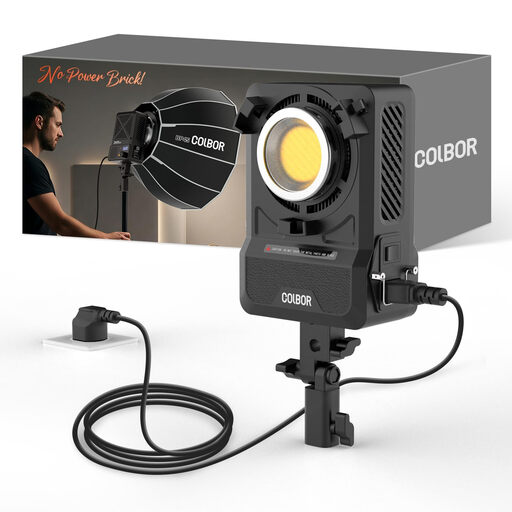
COLBOR 200W bi-colour COB video light with Bowens mount
For an adaptable lighting setup where you can choose a modifier to suit the scene.
200 W; 2,700–7,000 K; COB; Bowens mount; integrated power supply design.
View at Joybuy
 No image available
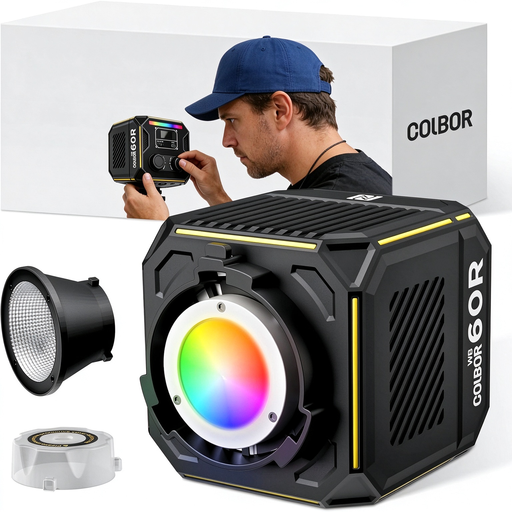
COLBOR 60W RGBCW COB video light with built-in 59 Wh battery
If you want to position your lighting flexibly, the portable design and built-in battery stated in the product name may be useful.
60 W; RGBCW; bi-colour 2,700–6,500 K; built-in 59 Wh battery.
View at Joybuy
 No image available
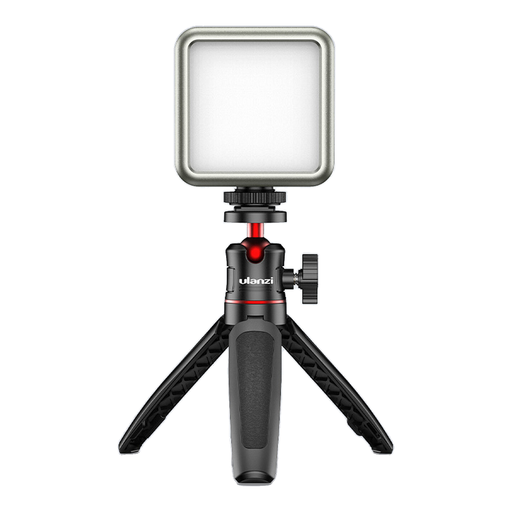
ULANZI VL49 RGB LED camera light
For compact setups and smaller subjects, if a small camera light suits your framing.
RGB; dimmable; colour temperature 2,500–9,500 K; 2,000 mAh battery.
View at Joybuy
Frequently asked questions
How should I start lighting a lesson that combines explanations and demonstrations?
First, set your final framing and check your face and demonstration area together in the camera view. Canon Europe describes a key light as the main light source, with a weaker fill light as one way to soften shadows from the other side. Three-point lighting isn’t essential equipment.
What can I do if artificial light flickers on video?
Record a test clip with the lights and camera settings you plan to use. Sony Deutschland describes adjusting the shutter speed as one possible solution; the features available depend on your camera model.
How can I check that colours look right in my lesson video?
Balance the light with the room lighting, then check the subjects you’re using in a test clip with your camera’s white balance set. An adjustable colour temperature doesn’t replace this check.
Which accessories should I check before buying?
Compare what’s included with the specific version against the needs of your setup. The NL660 two-panel kit described by NEEWER lists stands and power supplies, but no NP-F batteries. The amaran 100x S lists a reflector and mains power supply, but no softbox.
How can I check whether the cooling system will affect a voice recording?
Record a short sound test with the microphone and position you plan to use. Cooling specifications alone don’t tell you how loud a light will sound from your actual recording distance.


