Collectors with shiny cameras
If you photograph chrome bodies, lenses or viewfinders, you need room to shift or soften reflections without obscuring important details.


Choose a panel first by how easily you can shape its reflections on glass and metal: adjustable positioning and suitable diffusion matter more than a high wattage alone. For consistent product shots, keep the lighting and white balance constant too. A second panel is only worth considering if a single light or reflector cannot illuminate the subject and white background as needed.
If you photograph chrome bodies, lenses or viewfinders, you need room to shift or soften reflections without obscuring important details.
When photographing several cameras against the same white background, a repeatable lighting setup and consistent white balance help keep your images looking uniform.
With limited space, the panel, camera, background and mounts all need to fit together. Check whether the specific listing includes the accessories you need.
For vintage cameras against a white background, the key factors are controlling reflections, keeping colours consistent, lighting the subject and background, and checking the space needed and what’s included.
| Criteria | What to check before buying | Who it matters most to |
|---|---|---|
| Reflections on glass and metal | Check whether you can position the panel and diffuser to suit your setup; test the light from the camera angle you’ll use. | If I’m photographing lens glass, a viewfinder or chrome edges, I want to move reflections or soften them without losing detail. Around 36% of consumers put reflection control first. |
| Consistent colours | Check the adjustable colour temperature of the specific model, and keep the light position and white balance constant throughout a series of shots. | For a series, I want the white background and camera body to look similar from one image to the next. Around 29% of consumers prioritise repeatable colour. |
| Lighting the subject and background | First try repositioning one panel or using a reflector; then check whether you really need a second light source. | If the camera needs to stand out clearly against white, I need to be able to position the light for both the subject and the background. Around 21% of consumers have this as their main concern. |
| Space, power and accessories | Check the dimensions, mount, power supply, stands and whether batteries are explicitly included or excluded against your setup. | At a small table, I want to know in advance whether the light and mounts will fit and what power sources are available. Around 14% of consumers are primarily concerned about space or missing accessories. |
Reflections also depend on the angle and position of the light source. A documented report of visible LED points relates to an older panel and cannot be applied to other models across the board.
Test the specific panel with your subject from the camera angle you plan to use. If individual points of light are distracting, adjust the angle or try additional diffusion.
Depending on your setup, you may need an additional, suitable light modifier.
Illuminance depends, among other things, on the stated measurement conditions. Without comparable conditions, a direct comparison of figures won’t give you a reliable ranking.
Only compare readings taken under similar conditions, and consider the light’s surface area, position and diffusion for your camera setup too.
The contents can vary when it comes to stands, light modifiers and batteries. A panel on its own doesn’t tell you whether you have everything you need for your shooting space.
Check the contents for the exact variant and make sure they match your mounts and power sources.
Depending on what’s included, you may need to buy suitable stands or batteries separately.
The P260C Pro is a bi-colour panel for a setup with a separately positioned light.
The single LUMIS LED Panel Bi-Color and the two-panel kit are different options for tabletop setups.
The RGB660 PRO II two-panel kit is designed for a setup with two separate lights and stands.
The P60x is a single bi-colour panel that’s supplied with a light modifier.
This selection includes a foldable photo light for small tabletop subjects, as well as a compact, adjustable LED light for photography and video.
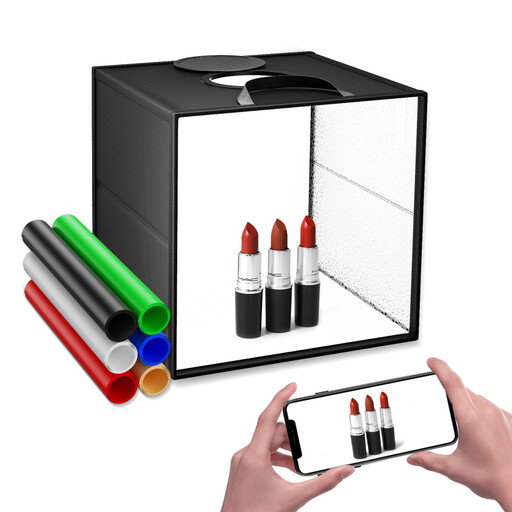 No image available
Ideal for small tabletop subjects if you’re looking for a foldable lighting solution with white background paper.
Includes six background papers, including white, as well as three colour temperatures and nine brightness settings.
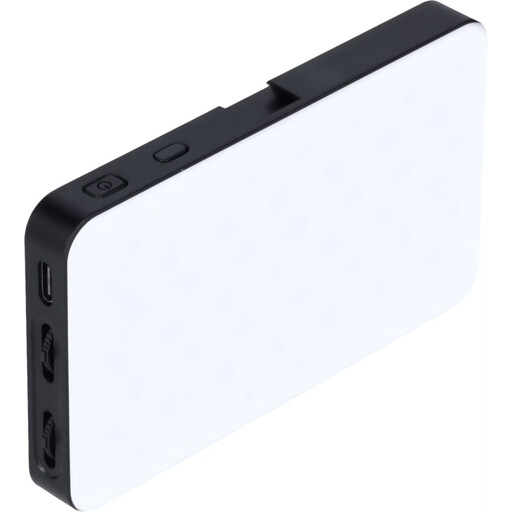 No image available
Suitable for a compact tabletop or camera setup if you want to adjust the colour temperature and brightness on the light itself.
Specifications include 91 LEDs, 2,500–9,000 K, 8 W and brightness adjustment in 1% increments. It measures 11.5 × 6.8 × 1.6 cm, with Cold Shoe and 1/4-inch connections.
A run time of around 80 minutes is stated at 100% power, so bear this in mind for longer photo sessions.
First, adjust the angle and position of the light and check the result from the camera angle you’ll actually use. If individual points of light are still visible, try adding diffusion. One documented example relates to the older Rollei Lumen Panel 900 Bi-Color, not every panel.
Keep your lighting setup and camera settings as consistent as possible, and set the white balance to suit the lighting you’re using. Adobe explains that white balance affects the colour reproduction of a photo, so white material may look different when the lighting changes.
No, what’s included depends on the model and specific variant. The amaran P60x doesn’t list a stand in its packaging; batteries are optional for the single Rollei LUMIS panel, and the NEEWER RGB660 PRO II two-panel kit includes stands but no NP-F batteries.
For online purchases by consumers, there is generally a 14-day right to cancel; the Verbraucherzentrale also explains the conditions and exceptions. Your Europe explains that the CE marking represents the manufacturer’s declaration of conformity and is not a general, independent quality mark. According to stiftung elektro-altgeräte register, retailers with at least 400 m² of sales area for electrical and electronic equipment must take back electrical appliances; the specific obligation depends on the conditions in force at the time.