Which buying criteria matter?
First decide whether separate tracks, a shared stereo image or a simple mono track is your priority. Then check the microphone inputs and your monitoring needs.
When choosing an interface for a duo recording at a shared desk, the right option depends on what matters most to you.
| Priority |
What to check before buying |
Who is it most important for? |
| Separate violin tracks |
Two microphone preamps that can be used simultaneously and the channel assignments in your recording software; for condenser microphones, check the power supply they require too. |
If I want to edit each violin separately later, I need two separate input signals. Around 36% of consumers prioritise separate tracks. |
| A spacious sound for the duo |
For a stereo pair, two suitable microphone inputs and the left-right monitoring you want; try different microphone positions before recording. |
If a shared, spacious sound matters more to me than separate editing, I’ll want to take care with microphone placement. Around 29% of consumers prioritise a shared stereo sound. |
| Monitoring together |
Check the headphone sockets, volume controls and any CUE mixes individually; two sockets don’t automatically mean two independent mixes. |
If we both want to listen while recording, the connections and routing need to suit our monitoring needs. Around 21% of consumers prioritise two monitoring positions. |
| A simple mono track |
One suitable microphone input, the power supply required by your specific microphone and a connection to your recording computer. |
If a shared mono track is enough, I want to keep the setup simple and adjust the balance before recording. Around 14% of consumers prefer this straightforward approach. |
Joybuy product selection
This selection includes an audio interface and sound card kit for recording on a computer. Before buying, check that the connections and microphones are right for your violin setup.
 No image available
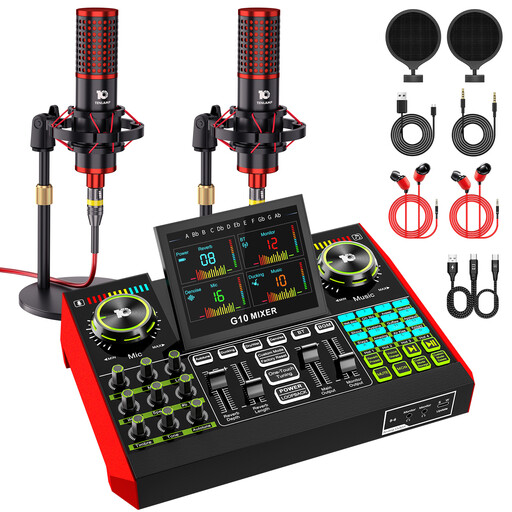
Yinkaer G10-P17-P17 podcast kit with two microphones
The kit is described as being suitable for computer recording and includes two microphones according to the product details. Check that the connections and routing will work for the violin recording you have in mind.
The product name mentions two 3.5 mm condenser microphones and stands.
The description lists support for 3.5 mm and 6.35 mm connections, along with 48 V phantom power and effects.
View at Joybuy
Frequently asked questions about recording a violin duo
Do two jack sockets and two XLR sockets on the Scarlett 2i2 4th Gen give you four simultaneous inputs?
No. Focusrite describes two analogue inputs that can be used at the same time; using a front jack socket disables its corresponding XLR input. The loopback channels shown in the software aren’t additional analogue microphone inputs.
When should I switch on 48 V phantom power?
Switch it on if the manual for your microphone says it’s required. On the Scarlett 2i2 4th Gen, power is supplied to both XLR inputs when switched on. Check the manufacturer’s guidance carefully, especially when using a ribbon microphone, and switch phantom power off before plugging in or unplugging the microphone.
How can I avoid too much room sound when recording at a desk?
Try recording with the microphones in different positions and at different distances, then listen back to the results. If room acoustics are causing problems, Shure recommends trying a closer position or improving the separation between sound sources. The right position will depend on your duo and the room.
Do two headphone sockets automatically provide two independent monitoring mixes?
No. Check the number of sockets and the signal routing separately. For the iD14 MKII, Audient describes assigning a headphone output to CUE mixes and warns that DAW thru bypasses its volume control.
What are my rights if I buy an interface online in Germany and it’s faulty or I change my mind?
When consumers buy online from a business in the EU, they generally have a 14-day right to cancel, starting from the date of delivery. Exceptions may apply, and you may have to pay the return costs. If an item is faulty, you have a legal guarantee from the seller of at least two years from the date you receive it. The European Union’s Your Europe website distinguishes these rights from a voluntary manufacturer’s guarantee.


