A duo recording separate tracks
You want to record each violin with its own microphone and balance the tracks separately later. Look for two microphone inputs that can be used at the same time; Focusrite and PreSonus list models with this feature.


One shared microphone is enough if you want to record both violins on a single track. To use one microphone per violin, or a two-channel stereo pair, you’ll need two microphone inputs that can be used at the same time. Shure and Neumann highlight microphone positioning and the room as factors that affect your recording. A more expensive interface alone won’t eliminate unwanted reflections.
You want to record each violin with its own microphone and balance the tracks separately later. Look for two microphone inputs that can be used at the same time; Focusrite and PreSonus list models with this feature.
If reflections or background noise are an issue, microphone distance and positioning are important things you can adjust. Shure and Neumann explain how microphone placement and the room affect a recording.
You want to hear yourselves as you play, so you’ll need to work out whether a single headphone output will be enough. MOTU and Audient list monitoring features or multiple headphone outputs on some of their models.
A good fit if: one shared recording is all you need and you don’t have to edit separate violin tracks.
The trade-off: The balance between the violins is mainly determined by how you position them. You won’t be able to adjust each violin’s level independently on a separate track afterwards.
A good fit if: you want to record each violin separately or use a two-channel stereo pair.
The trade-off: A more spacious stereo setup can capture more of the room sound. Placing the microphones closer can reduce the room sound, but it will also change the balance of the recording.
A good fit if: you want to connect two pairs of headphones directly to the interface or add more channels later using extra hardware.
The trade-off: Extra outputs or ADAT expansion aren’t essential for a simple duo setup. ADAT requires compatible external hardware.
First, decide whether you want one shared recording or separate microphone signals. The four buying priorities below reflect what matters most to your duo.
| Buying priority | What to look for | Who is it important to? |
|---|---|---|
| Separate tracks | If you’re using two microphones, check that the interface has two microphone preamps that can be used at the same time, rather than just looking at the total number of inputs. Make sure the phantom power is suitable for your microphones. | If we want to edit each violin separately, we need two separate microphone signals. Roughly 36% of consumers prioritise separate tracks. |
| Room sound | Before buying an interface, try changing the microphone distance and positioning and make test recordings. A stereo setup can capture more of the room sound. | If you mainly want to control reflections in an untreated room, experiment with positioning and distance first. This is a priority for roughly 29% of consumers. |
| Direct monitoring | Check the direct monitoring feature and number of headphone outputs on the specific model. If there’s only one output, work out in advance how both players will monitor the recording. | If we want to hear ourselves while playing without distracting latency, we need a suitable monitoring setup. Roughly 21% of consumers put this first. |
| Expansion and setup | Tell the difference between built-in microphone preamps and channels that can be added later via ADAT. Also factor in microphones, cables, stands and monitoring. | Consumers weighing up a streamlined duo setup against future expansion should consider all the connections they’ll need. Roughly 14% prioritise room to expand or a simple setup. |
To record two separate violin tracks, check whether the interface has two microphone preamps that can be used at the same time. Other inputs may be intended for different types of signals.
Check the number of microphone inputs and their connection type on the specific model.
The microphone will also pick up reflections from the room, so choosing an interface won’t replace finding the right microphone position.
Start by making test recordings with different microphone positions and distances. Shure describes moving a microphone closer as one way to reduce unwanted room sound.
The Audient iD14 MKII is listed as having two built-in microphone preamps. Additional channels via ADAT require compatible external hardware.
Count built-in microphone preamps and digital expansion options separately.
The Scarlett Solo has one microphone channel; the Scarlett 2i2 has two microphone inputs.
The Studio 24c is a two-channel option for two microphones.
The Rubix22 has two microphone preamps and MIDI connections.
The M2 is an option if you want to control certain features separately for each input.
The iD14 MKII combines two built-in microphone preamps with two headphone outputs and an ADAT option.
The UR22C has two microphone preamps and monitoring via dspMixFx.
The following products are microphone sets with an audio mixer. Before buying, check whether you can record both microphones at the same time on separate tracks.
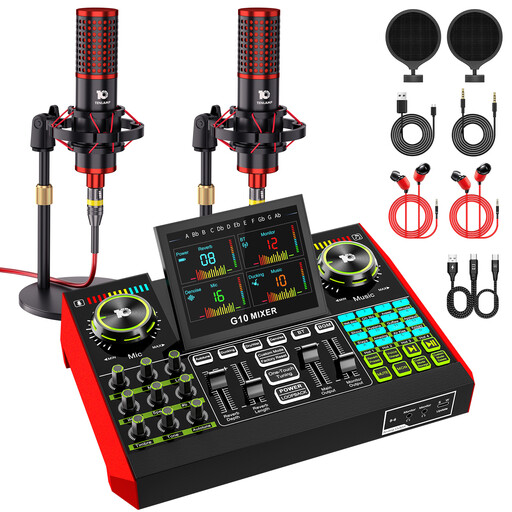 Image unavailable
Could suit you if you’re looking for a set with two microphones and an audio mixer. Check whether you can record the microphones separately.
The product name specifies two 3.5 mm condenser microphones and microphone stands.
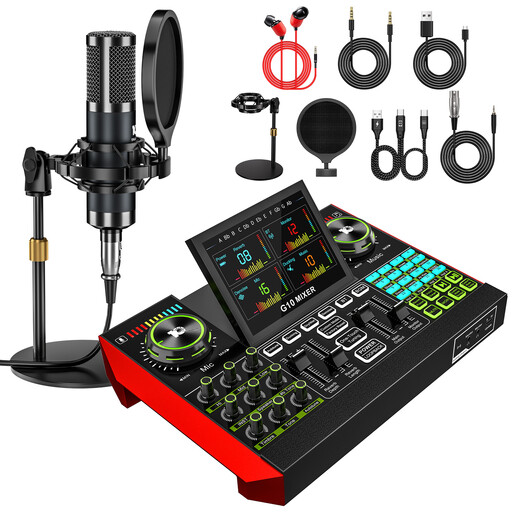 Image unavailable
Could suit you if you’re looking for a set with one microphone and an audio mixer. Check whether it meets your needs for recording two violins.
The product name specifies a 3.5 mm condenser microphone and an audio mixer.
No, not if one shared microphone is recording both violins on a single track. To use one microphone per violin, or a two-channel stereo pair, you’ll need two microphone channels that can be used at the same time.
Try different setups, distances and microphone positions. Shure describes placing a microphone closer as one way to reduce unwanted room sound, while Neumann explains how room acoustics affect a recording.
Only if it’s suitable for the connected microphones and their instructions say to use it. If you’re using different types of microphone, also check whether the interface switches phantom power per channel or for all channels together.
For a consumer purchase in Germany, statutory rights against the seller are separate from any voluntary guarantee. Online purchases also generally come with a 14-day right to cancel. Conditions and exceptions apply, as explained by the Verbraucherzentrale.
Check the EU requirements that apply to the specific product. The Bundesnetzagentur lists CE marking, product identification and correct manufacturer details among the points it checks when monitoring the market. The CE mark isn’t an award for recording quality.