What to look for in a single monitor
First, decide how much screen space you can fit in your training area and whether a wider view matters to you. Then check that the resolution, connections and potential frame rate work with your connected device and training software.
When choosing a single monitor for virtual climbs, readability, panoramic views, setup, power consumption and panel care can all influence your decision.
| Priority |
What to look for when buying |
Who it's most important to |
| Readability and graphics demands |
Compare your viewing distance and the monitor’s native resolution with the performance of your connected device. Zwift Support names the GPU as a factor affecting picture quality and frame rate; the monitor’s refresh rate does not guarantee the frame rate you’ll actually achieve. |
If I want to read the route and training metrics on one screen while riding, the resolution needs to suit my PC. Around 40% of consumers put readability first while keeping graphics demands manageable. |
| Wider view of the route |
Check that your training software can output 21:9 on the device you plan to use, and see where it places the on-screen data. To display 3440 × 1440, the output device must also support the required resolution. |
If I want to see more of the route to either side on a single screen, the format needs to display properly in my application. Around 30% of consumers prioritise a panoramic view. |
| Connections and setup |
Measure the available width and height, and check the viewing line. Compare inputs, refresh rate for each connection, VESA dimensions and height adjustment on the specific model; ASUS, for example, lists VESA 100 × 100 mm for the VG34VQ3B, but no height adjustment. |
If I set the screen up permanently in front of my bike, I want to know it will fit the space and work with my connected device. Around 20% of consumers put connections and setup first. |
| Power consumption and panel care |
Compare the EU energy label for the specific model, including its HDR performance. If you choose OLED, check its protective features and the terms of the specific warranty; manufacturer claims are not an independent long-term test. |
If I ride for long periods with fixed training data on screen, I want to consider power consumption and panel care. Around 10% of consumers prioritise power use and care requirements. |
Monitor brands worth considering
The examples below refer to specific model ranges and illustrate different screen sizes, formats and panel types. They are not a general assessment of the brands themselves.
LG
The LG UltraGear models considered here include both compact 27-inch screens and wider 34-inch options.
- LG lists the 27GS75QX-B as a 27-inch QHD IPS display with 180 Hz, and the 34GX90SA-W as a 34-inch OLED display with 3440 × 1440 resolution.
- LG’s German website marks the 27GS75QX-B as no longer available. The specifications of an OLED model do not tell you how fixed training data will look during extended use.
Dell
The G2725D is a specific 27-inch QHD Fast IPS example for a space-conscious 16:9 setup.
- Dell lists QHD resolution of 2560 × 1440 for the G2725D, with different maximum refresh rates over DisplayPort and HDMI.
- Dell’s German product page marks this model as unavailable. Check the connection specifications for the exact model rather than assuming they apply to other monitors.
ASUS
The TUF Gaming VG34VQ3B is an example of a 34-inch VA ultrawide with a 21:9 aspect ratio.
- ASUS Germany lists a resolution of 3440 × 1440 and VESA 100 × 100 mm for this model.
- According to ASUS, it supports up to 180 Hz over DisplayPort and up to 144 Hz over HDMI, but has no height adjustment. Its specifications do not prove compatibility with every piece of training software.
Samsung
The Odyssey OLED G81SF S27FG814SU is a specific example of a 27-inch 4K QD-OLED monitor.
- Samsung’s German specification sheet lists a resolution of 3840 × 2160 and 240 Hz for this model.
- The model number matters: a similarly named G81SF product page for a 32-inch screen refers to a different model, not this 27-inch one.
MSI
The MAG 341CQP QD-OLED illustrates a 34-inch OLED ultrawide for buyers who care about panel type and picture quality.
- MSI describes OLED Care 2.0 and promotes a burn-in warranty for this model range.
- Manufacturer claims are not independent long-term tests. Check the exact warranty cover and terms for your specific purchase in Germany.
Joybuy monitors for virtual climbs
This selection includes compact 27-inch WQHD models, a 27-inch 4K monitor and a 34-inch ultrawide to suit different training spaces and picture priorities.
 No image available
Z-Edge AGEX 27-inch QHD gaming monitor
The 27-inch WQHD format is a good fit if you want to view the route and training data on a single screen.
The product title lists 2560 × 1440, Fast IPS, 144 Hz, FreeSync, a height-adjustable stand, DisplayPort and HDMI.
Joybuy
 No image available
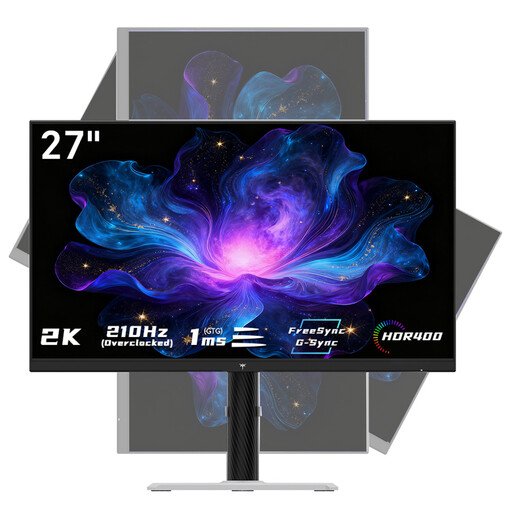
KTC H27T6 flat Fast IPS QHD monitor
This 27-inch QHD model is worth considering if you’re looking for a single 16:9 screen for the route and training data.
The product title lists 2560 × 1440, Fast IPS, 200 Hz and overclocking to 210 Hz.
Joybuy
 No image available
INNOCN 2751S PLUS 27-inch QHD Mini LED monitor
A 27-inch QHD monitor could suit you if you prefer a compact format for a single training screen.
The product title lists Mini LED with 1152 zones, QHD, Fast IPS and up to 275 Hz.
Joybuy
 No image available
KTC M27P6 27-inch 4K Mini LED monitor
This model is worth considering if you prefer 4K on a single 27-inch monitor and your connected device can handle the output you want.
The product title lists Mini LED, Fast IPS, 4K at 160 Hz and an FHD dual mode at 320 Hz. Zwift Support notes that the GPU affects picture quality and frame rate.
Joybuy
 No image available
ASUS TUF Gaming VG34VQ3B 34-inch ultrawide monitor
The 21:9 format is a good fit if you want to see more of the route to either side on one screen and your training software supports the display you want.
ASUS Germany lists a resolution of 3440 × 1440 for this VA model, with up to 180 Hz over DisplayPort and up to 144 Hz over HDMI. ASUS specifies VESA 100 × 100 mm but no height adjustment, so check the space and mounting options at your training location.
Joybuy
Frequently asked questions about monitors for indoor cycling
Does a monitor make the virtual climb steeper on a smart trainer?
No. In Zwift, resistance and simulated gradients depend on suitable trainer hardware and its connection or settings, not on the monitor’s specifications. As Zwift Support explains, compatible trainer hardware needs to be connected for simulated changes in resistance.
What frame rate will I get once it’s connected?
That depends on the monitor, the input you use, the cable, your connected device and the frames it can actually render. For the VG34VQ3B at 3440 × 1440, ASUS lists up to 180 Hz over DisplayPort and up to 144 Hz over HDMI; the monitor’s specification does not guarantee the same frame rate in your training software.
Will an ultrawide monitor work with all training software?
Check the specific application and connected device you plan to use. Individual posts from Zwift Forum users show ultrawide setups in use, but they do not guarantee compatibility with every software and device combination. Also check whether the training data is positioned sensibly on a 21:9 screen.
What should I check when setting up a monitor by my bike?
Measure the available width and viewing distance before choosing a screen size. Check the stand, height adjustment or VESA mount for the specific model: ASUS, for example, lists VESA 100 × 100 mm for the VG34VQ3B, but no height adjustment.
How should I compare energy use and warranties when buying a monitor?
Compare the EU energy label for the specific monitor and take its HDR performance into account; the European Commission classifies monitors as electronic displays that carry an energy label. The Verbraucherzentrale points out that statutory consumer rights are different from a voluntary warranty. If you choose OLED, also check the protection and warranty terms for the exact model.


