What should you look for when choosing one?
First decide whether you value a wide screen for your layout and tools, or more vertical space for fine detail. Then check the software, PC and available desk space for the specific model.
| What matters |
What to look for when buying |
Who is it important to? |
| A clear view of the layout and tools |
Compare the aspect ratio and native resolution; if possible, try your software in the format you want to use. |
If I want to keep my track plan and tools in view at the same time, how the software uses the wider screen matters. Around 33% of consumers put having a clear overview first. |
| Clear, readable track details |
Consider the resolution, screen size and software scaling together. |
If small objects and labels need to remain easy to see, extra vertical screen space matters more than maximum width. Around 27% of consumers prioritise detail. |
| Compatibility with your PC and railway software |
Check the graphics output, monitor input and supported modes; test the resolution you want in your software. |
If I want to keep using my existing graphics hardware and software, the connection and display need to work well together. Around 20% of consumers put compatibility first. |
| Space and positioning |
Compare the dimensions including the stand with the space available, rather than looking only at the screen size. |
If the monitor needs to fit on my desk with its stand, I’ll check its width, depth and height before buying. Around 13% of consumers prioritise the space it takes up. |
| Panel care and day-to-day use |
Read the care guidance and warranty terms for the exact variant; compare the energy labels of the specific models to check power consumption. |
If on-screen controls are visible for long periods, I want to consider panel care and warranty terms in advance. Around 7% of consumers focus on durability and running costs. |
At the specific resolutions of 3840 × 2160 and 3440 × 1440, 4K offers more vertical pixels, while 21:9 gives you more horizontal screen space. Whether that makes menus easier to read or keeps them better organised also depends on the scaling and the software you use.
Monitors available at Joybuy
This selection includes 32-inch 4K monitors for fine detail, as well as wide 34-inch monitors that give you more horizontal space for your layout and tools.
 No image available
TCL 32x3A 32-inch OLED monitor
A 32-inch 4K model is worth considering if you want to show fine detail on a large single screen.
OLED; 4K UHD at 3840 × 2160; 240 Hz; 480 Hz in FHD mode.
Joybuy
 No image available
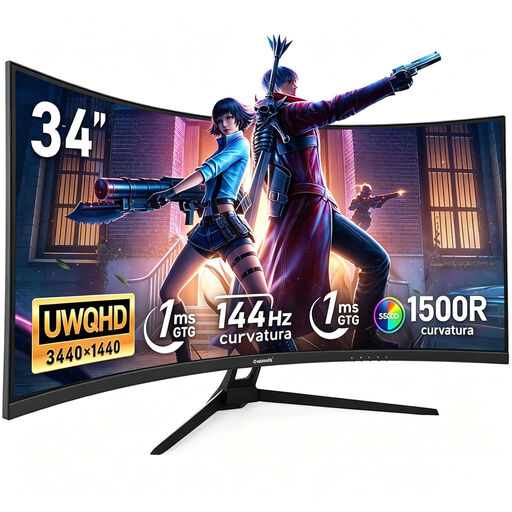
Gawfolk 34-inch curved gaming monitor
The wide 34-inch screen could be a good fit if you want to show your layout and controls side by side.
UWQHD at 3440 × 1440; 144 Hz; 1500R curvature; VA panel; no speakers.
Joybuy
 No image available
Gawfolk GF340C-H 34-inch curved gaming monitor
The wide single-screen view is an option if you want more horizontal space for your track plan.
UWQHD at 3440 × 1440; 165 Hz; 1500R curvature; VA panel; DisplayPort; VESA 75 × 75 mm.
Joybuy
 No image available
CRUA CR340QA-H 34-inch WQHD gaming monitor
If you’re looking for a wide single-screen view of your layout and tools, check that the aspect ratio and resolution work well with your software.
21:9; 3440 × 1440; 165 Hz; 1500R curvature; 1 ms MPRT; VESA 75 × 75 mm.
Joybuy
 No image available
CRUA CR320QB 32-inch curved 4K monitor
A 32-inch 4K display could be a good choice if fine detail and vertical screen space matter more to you than an especially wide format.
3840 × 2160; VA display; 3000R curvature; HDR10; Adaptive Sync.
Joybuy
Frequently asked questions
Should I use multiple monitors for Train Sim World instead of one large display?
It’s worth being cautious about using multiple monitors with Train Sim World: according to Dovetail Games, the game doesn’t natively support multiple monitors, and manually stretching the image can cause interface problems. This applies to Train Sim World and doesn’t show that other railway programmes have the same limitation.
Why choose 34-inch ultrawide or 32-inch 4K for building a virtual railway?
A 34-inch screen in 21:9 gives you more horizontal space, while a 32-inch 4K screen has more vertical pixels at the resolutions listed here. Which works better for your track plan and menus also depends on the software and its scaling.
What should I check before setting up and connecting the monitor?
Measure the space available for the monitor and stand, and check that the connections are compatible with your PC. Xiaomi lists the G34WQi’s dimensions including the stand, as well as its HDMI and DisplayPort inputs; other models have their own specifications.
What should I bear in mind with OLED if control panels stay on screen for a long time?
Check the care guidance and warranty terms for the specific device. MSI describes OLED Care 2.0 on the MPG 341CQPX as a way to reduce the risk of burn-in, not eliminate it.
How do I compare the power consumption of different monitors?
Compare the EU energy labels for the specific monitors rather than assuming OLED or LCD is always more energy-efficient. The European Commission classifies computer monitors as electronic displays with an efficiency scale from A to G.


