
Lieferung heute & morgen

Qualitätsgarantie
App herunterladen
Kategorien
Upgrading a vehicle's lighting from traditional halogen lamps to modern LED technology is a common step in vehicle modernisation. Bulbs with a W5W base (also known as T10 or 194) are particularly widespread, used in applications such as parking lights, license plate lighting, and interior lighting. Switching to LEDs promises higher light output, a longer lifespan, and lower power consumption. A key technical challenge in this process is ensuring compatibility with the vehicle's Canbus system to prevent error messages on the on-board computer. This article analyses the technical parameters to consider when selecting W5W LED Canbus bulbs.
Selecting the right LED bulb depends on objective technical specifications. An informed decision prevents compatibility issues and ensures the desired performance.
The designations W5W, T10, and 194 all refer to the same wedge-type glass base, which has a width of approximately 9.5 mm. These terms are often used interchangeably. Before purchasing, it is still advisable to check your vehicle's owner's manual to confirm the exact fitment for the specific application (e.g., LED parking light or LED license plate light). The physical dimensions of the LED bulb itself (length and diameter) are also crucial, as space within the lamp housing can be limited.
Modern vehicles use a Controller Area Network (Canbus) to monitor electrical components, including the lighting system. The system checks the electrical resistance of the connected bulbs. Since LEDs have significantly lower power consumption (and thus a higher resistance) than halogen lamps, the on-board computer incorrectly interprets this as a fault and generates an error message.
LEDs advertised as Canbus error-free integrate a load resistor that simulates a power draw similar to that of a halogen lamp. This prevents error messages. The effectiveness of this integration can vary depending on the vehicle model and the sensitivity of its specific Canbus system.
Two key metrics define the light characteristics of an LED:
The standard voltage in passenger cars is 12V. Most W5W LEDs are designed for this range. Some models offer a wider voltage range (e.g., 12V-24V), which can indicate more robust electronics.
The construction of the bulb's body, particularly the material, affects heat dissipation and, consequently, its lifespan. Housings made of aluminium dissipate heat more effectively than those made of plastic, which can contribute to more stable performance and greater durability.
The following products have been selected based on their technical specifications and intended applications.
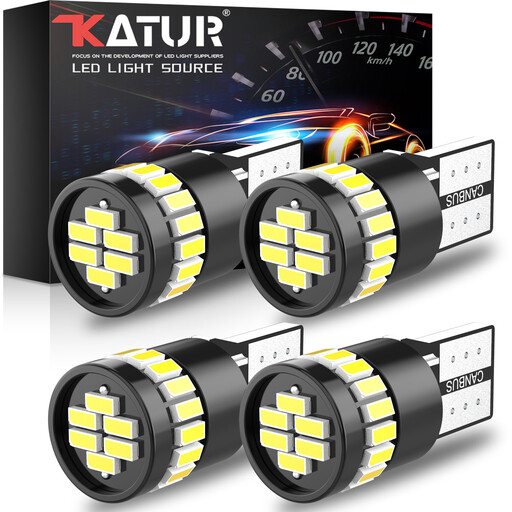
Why we recommend this product This bulb from KATUR uses 24 individual 3014-SMD chips designed for 360-degree illumination. This design prevents the dark spots (hotspots) that can occur with simpler LEDs. At 280 lumens per bulb, it offers a significant brightness increase over standard halogen lamps. The specified 6000K colour temperature provides a modern, crisp white light. Its plug-and-play installation requires no modifications, making it accessible for DIY enthusiasts.
Pros
Who it's for This model is ideal for vehicle owners seeking a reliable and balanced LED solution for various applications, such as license plate lighting, car interior lighting, or as LED parking lights, who value a straightforward, error-free installation.
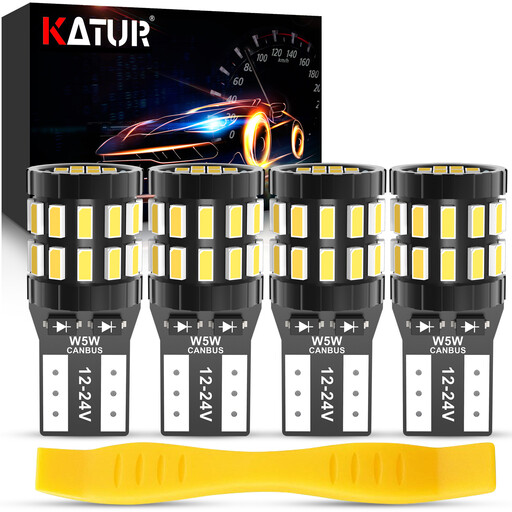
Why we recommend this product Featuring 30 integrated 3014-LED chips and a light output of 450 lumens per bulb, this model is engineered for high brightness. According to the manufacturer, the body is constructed from 6063 aviation-grade aluminium, which promotes efficient heat dissipation and contributes to longevity. Compatibility with a voltage range of 12V to 24V suggests flexible and robust driver electronics.
Pros
Who it's for This bulb is an excellent option for users who require maximum light output, for instance, in reverse lights, large boot/trunk spaces, or as exceptionally bright parking lights. Its robust construction will appeal to users who prioritise durability.
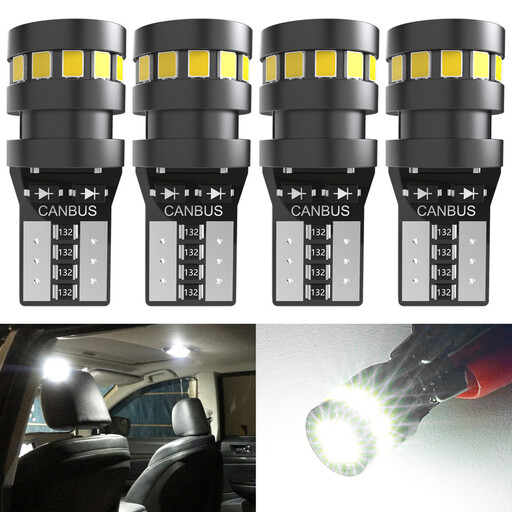
Why we recommend this product The OUSHI model positions itself in the cooler spectrum of white light with a colour temperature of 6500K. The manufacturer claims it is 300% brighter than a halogen lamp, a feat achieved with 18 integrated 2015 chipsets. An interesting feature is the built-in intelligent IC driver, designed to protect the LED from short circuits and stabilise its operation. The full aluminium body also serves to dissipate heat.
Pros
Who it's for This product is aimed at drivers who prefer a particularly cool, xenon-like light colour and place extra value on the electronic stability and protection offered by a dedicated IC driver. It is a great choice for visible exterior lighting, such as parking lights.
The products featured here cover common requirements. However, if you are looking for more specific solutions, different light colours, or bulbs for other base types, you can find a wider selection in our main category for LED Signal Lamps.
1. What exactly does "Canbus error-free" mean for W5W LEDs? "Canbus error-free" means the LED bulb has an integrated load resistor. This resistor simulates a higher current draw for the vehicle's diagnostic system (Canbus), similar to that of a conventional halogen lamp. This prevents the on-board computer from incorrectly identifying the energy-efficient LED as a faulty bulb and displaying a warning message on the dashboard.
2. Can I use a T10 LED to replace a W5W halogen lamp? Yes, in the vast majority of cases, the T10 and W5W base types are mechanically and electrically identical and therefore interchangeable. Both designations describe a wedge base with a 9.5 mm width. It is still recommended, however, to compare the physical dimensions of the new LED bulb (especially its length and diameter) with the available space in the vehicle's lamp housing.
3. Why is my new LED bulb flickering or glowing dimly after being turned off? Flickering can be caused by an incompatibility with the Pulse Width Modulation (PWM) signal used for brightness control in some vehicles. A dim glow is often caused by residual currents in the vehicle's electrical system, which are too low to make a halogen lamp glow but are sufficient for a highly efficient LED. In both cases, a high-quality Canbus module or an additional load resistor can resolve the issue by stabilising the electrical load.