
Lieferung heute & morgen

Qualitätsgarantie

Willkommens-Angebote freischalten: KOSTENLOSE Lieferung | Bis zu 80 % RABATT | Kostenlose 30-Tage-JoyPlus-Testphase
App herunterladen
By the Joybuy Product Recommendation OfficerLast updated: July 28, 2026
A walking pad promises to add more movement to your daily routine, especially in a home office or small apartment. Models with an incline feature take your workout to the next level by increasing calorie burn and engaging your leg muscles more intensely. However, the market is flooded with devices whose marketing promises often don't hold up in practice. Before you make a decision, it's crucial to understand the common pitfalls that can lead to a bad purchase.
This guide will help you identify the critical features and make an informed choice.
Many buyers focus on heavily advertised features that later turn out to be irrelevant or misleading. Pay close attention to these three points:
To avoid buyer's remorse, you should focus on the technical specifications that determine actual user comfort and longevity.
The motor is the most critical component. A brushless motor is the preferred choice here. It not only operates more efficiently and with less wear but is also significantly quieter than conventional motors. For a quiet treadmill for an apartment and office, the operating noise level should be under 50 decibels (dB). This is roughly equivalent to a quiet conversation and ensures that neither your concentration at work nor your neighbours are disturbed.
A high maximum weight capacity is a direct indicator of the frame's stability. Even if you are well below the limit, a sturdy construction ensures a secure footing and prevents the device from warping over time.
An effective cushioning system is just as important. A multi-layer running surface (e.g., a 7-layer running belt) combined with silicone shock absorbers significantly reduces the impact on your knees and joints. This allows for longer, more comfortable workout sessions without the risks associated with running on hard surfaces.
The incline function is the feature that distinguishes a simple walking pad from an effective training device. Even a slight, manually adjustable incline of 5-10% simulates walking uphill, which can increase calorie burn by up to 30% and target the glute and calf muscles more specifically.
For added safety, especially for beginners, seniors, or when using higher speeds, an under-desk treadmill with a handrail is a sensible feature. A height-adjustable or foldable handle provides stability without compromising the device's compactness for storage.
Based on the criteria above, we have identified a model that is well-suited for a specific user group.
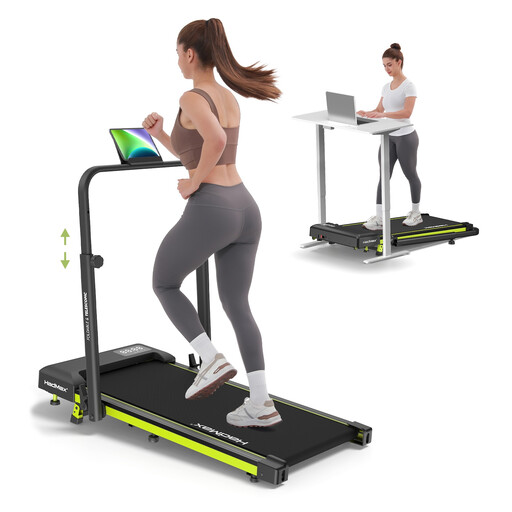
Why This Fits Their Persona: This model is designed for professionals who want to seamlessly integrate movement into their workday. It combines a quiet motor with an incline function for an efficient workout without disrupting workflow or online meetings. Its compact dimensions make it ideal for small apartments.
According to the manufacturer, the 3.0 HP brushless motor operates at a quiet 45 dB (avoids the noise trap). The weight capacity of up to 300 lbs (approx. 136 kg) indicates a robust construction (avoids the stability trap). The flat design and transport wheels make it easy to store (avoids the compact trap).
The manual 10% incline feature significantly intensifies the workout. The 7-layer cushioning system protects joints and allows for comfortable sessions.
We have compiled a complete, real-time list of products that fully satisfy these strict selection criteria and UK safety regulations.
1. How loud is a walking pad really, and will it bother the neighbours? The noise level depends heavily on the motor. Models with a high-quality, brushless motor and solid construction often operate at under 50 dB, which is quieter than a standard refrigerator. To be safe, check the manufacturer's decibel rating and consider placing an additional cushioning mat under the device to minimise vibrations transferred to the floor.
2. Is a walking pad with a handrail safer? Yes, a handrail provides extra stability and is especially recommended for fitness beginners, seniors, or if you plan to walk near the device's maximum speed. Many modern models offer foldable or detachable handles, so they don't compromise the device's compactness when not needed.
3. How much maintenance does a walking pad require? Maintenance is generally straightforward. It involves regularly cleaning the surface, checking the belt tension and alignment, and occasionally lubricating the running belt according to the manufacturer's instructions (often every few months, depending on use). These simple steps take only a few minutes and significantly contribute to the device's longevity.