
Lieferung heute & morgen

Qualitätsgarantie

Willkommens-Angebote freischalten: KOSTENLOSE Lieferung | Bis zu 80 % RABATT | Kostenlose 30-Tage-JoyPlus-Testphase
App herunterladen
By the Joybuy Product Recommendation Officer, August 29, 2026
A cluttered desk is a common problem in both home and corporate offices. Invoices, important documents, and loose papers pile up, consuming valuable workspace. A wall-mounted file holder is an effective solution for utilising vertical space and creating order. However, not every model lives up to its promises. Many buyers invest in products that quickly prove to be impractical or unstable.
This guide highlights the crucial criteria for selecting a functional wall organiser and helps you avoid common purchasing pitfalls.
Before making a purchase, you should be aware of the three most common flaws found in low-quality products:
To avoid these issues, you should check three core technical parameters. These determine the durability and functionality of your document holder.
The material is the most critical factor for load-bearing capacity. A metal wall file holder is often the more robust choice compared to plastic. However, pay attention to the specifications:
A solid office wall organiser should be made from a sufficiently thick metal mesh or sheet that does not deform under load.
The functionality of a wall-mounted letter tray depends directly on its layout. Check the following dimensions:
A secure wall mount for hanging files (or any other wall rack) requires the right hardware. Check if screws and anchors are included. However, it's crucial to consider your wall material. For drywall (plasterboard), special hollow-wall anchors are necessary, which are not always included as standard.
Some models also offer dual-use functionality: they can be either mounted on the wall or placed freestanding on a desk. This provides maximum flexibility, especially in rental apartments where drilling is not always permitted.
Based on the criteria above, we have identified several models that are well-suited for specific use cases.
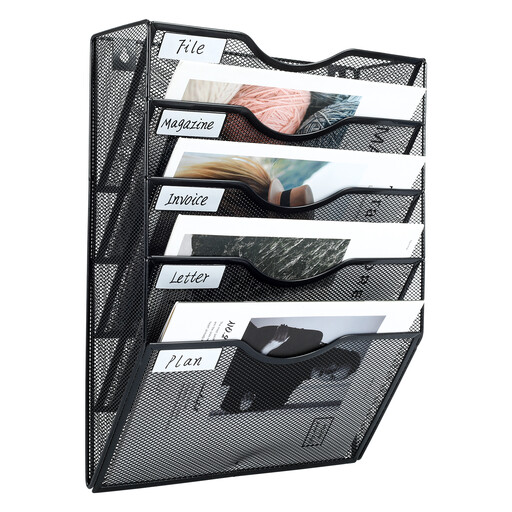
Why it's a good fit: This model's five compartments offer a balanced capacity for typical home office needs. It's large enough to separate ongoing projects, invoices, and mail without visually overwhelming the wall.
The powder-coated metal construction prevents bending. The compartments are explicitly designed for A4 documents, and mounting hardware is included.
Good balance between size and capacity. Includes label plates for clear categorisation.
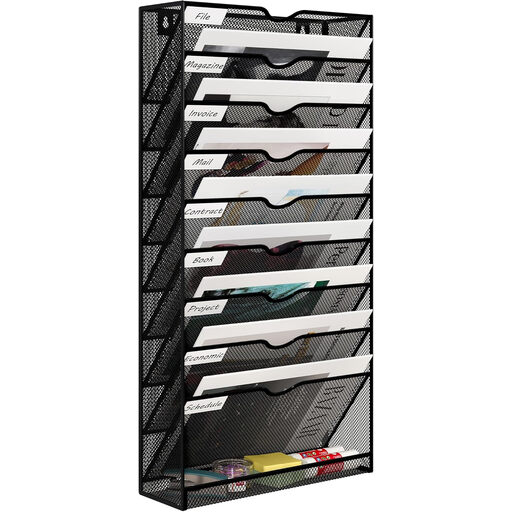
Why it's a good fit: With ten compartments, this organiser offers maximum vertical storage capacity. It is ideal for offices, families, or freelancers who need to sort a large volume of documents by project, person, or priority.
The robust metal construction is designed to remain stable even when fully loaded. All ten compartments are suitable for A4-sized documents, and its single-unit assembly is straightforward.
Maximum sorting options with 10 compartments. An additional tray at the bottom provides space for pens or small office supplies.
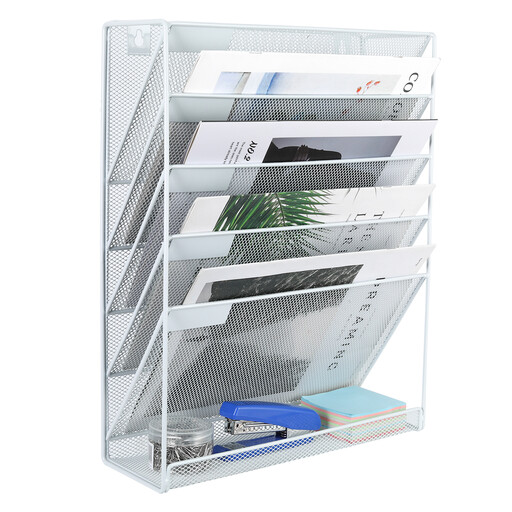
Why it's a good fit: This model is designed for students or residents of smaller apartments. It can be mounted on the wall to save space or, alternatively, placed directly on a desk if drilling is not an option.
Its dual-use capability bypasses the "mounting trap" for renters. The sturdy metal construction ensures a secure footing even when used freestanding.
Maximum flexibility with wall-mount or freestanding use. Six compartments and a bottom tray offer ample storage in a compact footprint.
We have compiled a complete, up-to-date list of products that fully meet these strict selection criteria and relevant safety standards.
The load capacity depends heavily on the organiser's material and, more importantly, the type of wall and mounting method. A sturdy metal file holder anchored into a solid brick or concrete wall with appropriate anchors can support several kilograms. For drywall installations, using special hollow-wall anchors is crucial. Always follow the manufacturer's specifications and distribute the weight evenly across the compartments.
For storing paper documents, metal is generally the more durable and stable choice. In particular, powder-coated metal is resistant to bending and rust. Plastic models can be lighter and less expensive, but they are more prone to sagging under the weight of document stacks or becoming brittle over time.
No, generally they do not. The wall racks featured here are designed as wall-mounted magazine holders or as trays for loose documents, letters, and thin folders. Standard hanging files require special rails, like those found in filing cabinets or dedicated hanging file systems. The compartments of a wall rack are not designed for this purpose.