
Lieferung heute & morgen

Qualitätsgarantie

Willkommens-Angebote freischalten: KOSTENLOSE Lieferung | Bis zu 80 % RABATT | Kostenlose 30-Tage-JoyPlus-Testphase
App herunterladen
A simple wall hook can be the difference between a cluttered hallway and an organized home. But the selection is vast, and not every product delivers on its promise. Many buyers invest in solutions that quickly prove to be impractical or unstable. Before you make a decision, it's crucial to understand the most common pitfalls.
Three problems often lead to disappointment:
To avoid these problems, you should base your selection on objective criteria.
The right choice depends on three central factors that determine functionality and longevity.
The material determines not only the appearance but also the durability and where it can be used.
The specified load capacity usually refers to a single hook and assumes proper installation on a suitable wall.
Consider what you want to hang and how much space you have.
Here are some product recommendations tailored to specific needs and living situations.
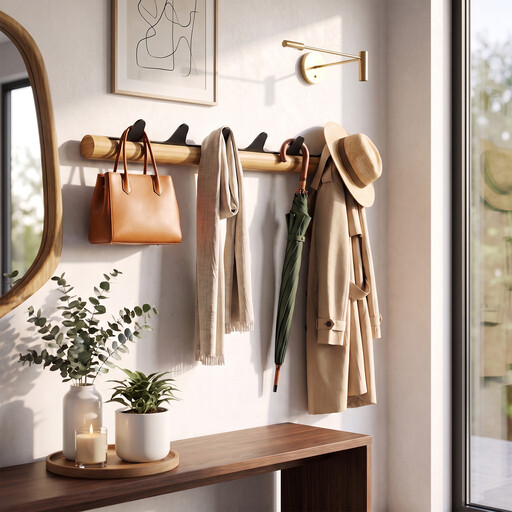
Why This Fits Their Persona: This coat rack combines a solid base of FSC-certified rubberwood with robust aluminum hooks. It is ideal for a statement entryway where both design and a high load capacity for heavy coats and bags are required. According to the manufacturer, the design has won the Muse Design Award and the French Design Award.
The use of solid, lacquered wood and aluminum hooks with rounded edges prevents the problem of inferior materials that damage clothing. The specified total load capacity of up to 30 kg is realistic for everyday use with proper wall mounting.
High load capacity (up to 30 kg); combination of FSC-certified wood and rust-resistant aluminum; clothing-safe, rounded hooks.

Why This Fits Their Persona: This set of eight individual double hooks offers maximum flexibility. Users can arrange the hooks freely—side-by-side as a coat rail, distributed throughout a room, or in different rooms. The modern, minimalist aluminum design complements many interior styles.
The modular nature bypasses the problem of a rigid, ill-fitting hook rail. According to the manufacturer, each hook features a rubber pad on the back that protects the wall and compensates for minor unevenness—a detail often missing from simpler mounting systems.
Modular set of 8 sturdy aluminum double hooks; flexible arrangement; each hook holds up to 5 kg (11 lbs); wall-protecting rubber pad.
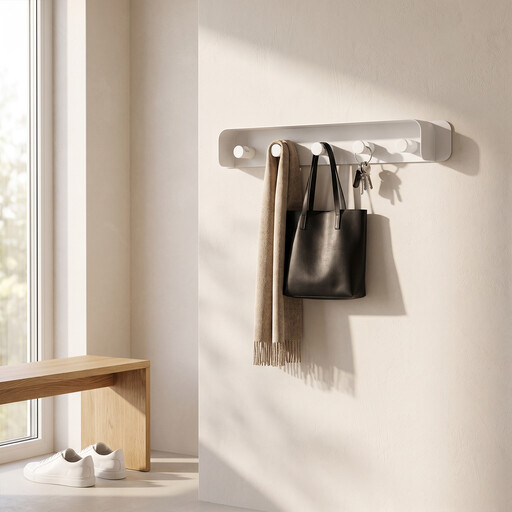
Why This Fits Their Persona: This hook rail with a shelf is an all-in-one solution for hallways, kitchens, or bathrooms. It not only provides five hooks for jackets or towels but also a shelf for keys, mail, spices, or small decorative items. The aluminum design is modern and easy to clean.
This product solves the problem of simple hooks often being insufficient. It offers an integrated, space-saving solution. The high specified load capacity of up to 25 kg and the robust material counteract the risk of an unstable construction.
Combination of 5 hooks and a shelf; high total load capacity (up to 25 kg); waterproof and rust-resistant aluminum.
We've compiled a complete, up-to-date list of products that fully meet these strict selection criteria and current regulations.
A common recommendation for the mounting height of a coat rack is about 1.70 meters (approx. 5'7") from the floor. This allows most adults to access it comfortably. If children will also be using the rack, a lower height or the addition of extra, lower-set individual hooks may be a good idea.
For heavy items like winter coats or full backpacks, hooks that are securely anchored into the wall are the safest choice. Look for products with an explicit load capacity per hook (e.g., 5 kg or more) and always use the appropriate anchors and screws for your wall type (e.g., concrete, brick, hollow wall).
Yes, but only under specific conditions. Suction cup hooks, like those from TAILI, adhere very well to completely smooth, clean, and non-porous surfaces such as tile, glass, or metal. They are unsuitable for painted walls, wallpaper, or wood. Adhesive hooks can be an alternative for lightweight items, but their holding power and residue-free removal depend heavily on the quality of the adhesive. For heavy loads, drilling remains the most reliable method.