
Lieferung heute & morgen

Qualitätsgarantie

Willkommens-Angebote freischalten: KOSTENLOSE Lieferung | Bis zu 80 % RABATT | Kostenlose 30-Tage-JoyPlus-Testphase
App herunterladen
Wall hooks help you keep things tidy without taking up floor space. Use them as coat hooks in the hallway, bathroom hooks for towels, kitchen hooks for utensils, or compact storage for keys and bags. The choice ranges from self-adhesive hooks and screw-mounted models to over-door hook racks.
However, not every space-saving solution automatically makes the right purchase. The key considerations are the surface, load capacity, dimensions and intended use. If you focus only on design or the number of hooks, you can easily overlook important details.
Self-adhesive hooks are particularly useful in rented homes because you do not need to drill. However, their grip depends heavily on the surface. Smooth, clean and dry surfaces such as glass, metal or smooth tiles are generally more suitable than woodchip wallpaper, wallpaper, porous walls or textured paint finishes.
You should also avoid confusing the stated load capacity with a general recommendation for all types of items. A hook for lightweight keys is not automatically suitable for a heavy bag or winter coat. With adhesive surfaces, it is advisable to allow a safety margin: wherever possible, hang less weight from the hook than the maximum specified by the manufacturer.
A rack with several coat hooks can be practical, but it requires sufficient wall width and secure mounting. If jackets, bags and scarves overlap, some of the additional storage space remains unusable. In small hallways, individual wall hooks or swivel hooks can be more space-efficient.
Over-door models can be fitted without drilling. Before buying, however, you should check the door thickness, the gap between the door leaf and frame, and the available clearance. A construction that is too tight can cause scratches or prevent the door from closing fully. Weight distribution is also important: heavy items should be spread evenly across several hooks.
In rented homes, self-adhesive hooks or door hooks are often a straightforward option. For a permanent wall-mounted coat rack, mechanical fixing is frequently the more reliable choice because the connection does not depend solely on an adhesive strip.
Steel and stainless steel are suitable for many indoor areas. In the kitchen and bathroom, you should also consider moisture resistance, rust resistance and an easy-to-clean surface. Wood or bamboo adds a natural look, but should be protected from prolonged contact with water.
A product designed for indoor use is not automatically suitable for balconies, cellars or outdoor areas. You should therefore pay attention to information such as “Indoor” and any guidance concerning moisture. For products bearing an FSC label, this refers to the relevant material or product certification provided by the manufacturer and should not be interpreted as a blanket statement about every component.
Check the following before buying:
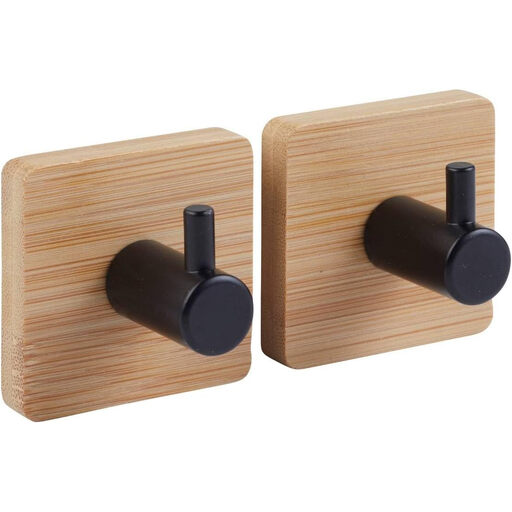
Why this product suits this profile: This set of two self-adhesive hooks is designed for lightweight items indoors and requires no drill.
The product details clearly state that it uses adhesive mounting, is intended for indoor use and has compact dimensions of 4.5 × 4.5 × 3.6 cm. This makes it easier to establish whether it is suitable before buying.
Bamboo and steel elements, two pieces per set and an FSC statement according to the product description.
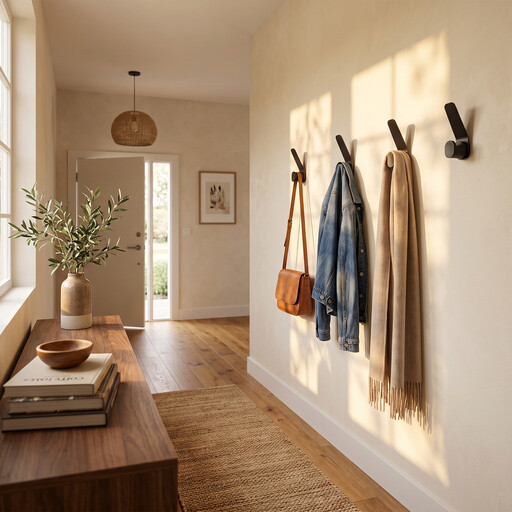
Why this product suits this profile: These screw-mounted double hooks are designed for households that want to organise several garments, towels or bags on the wall for the long term.
Mounting with screws and wall anchors reduces reliance on an adhesive surface. Suitable wall plugs must be selected for plasterboard or other surfaces.
Set of eight double hooks, aluminium construction and a stated load capacity of 11 lb per hook.

Why this product suits this profile: Ten hooks provide extra storage for families, bathrooms or bedrooms without the need to drill into the wall.
The rack hangs over the door and can therefore be removed without leaving marks. Before use, check the door thickness, secure fit and maximum load.
Ten hooks, stainless steel construction and dimensions of 19.5 × 12.5 × 41.7 cm.
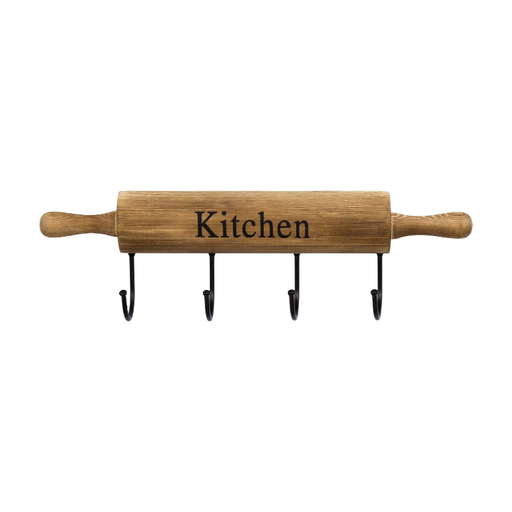
Why this product suits this profile: The combination of a kitchen rail and four hooks is designed for cooking utensils, mugs, tea towels or oven gloves.
The product description states that it has four metal hooks, wall mounting via keyhole brackets and a maximum load of 1 kg. This makes it easier to choose suitable kitchen items.
Four hooks, a wooden rail with decorative turned-wood styling and flat wall mounting; mounting hardware is not included according to the product details.
We have put together a complete, regularly updated list of products that fully meet these strict selection criteria and the safety regulations applicable in the EU.
For a screw-mounted wall coat rack, mark the drilling points first using a spirit level. Use wall plugs suitable for the surface and check that the screws are secure after installation. With tiles, avoid drilling into a grout line wherever possible, provided that the construction and surface allow this.
Self-adhesive hooks should be applied to a clean, dry surface. After pressing them into place, follow the waiting time specified by the manufacturer. Hook rails and door hooks should be checked regularly for loose connections, deformation or damage. Children should not pull on the hooks or use the construction as a support aid.
The load capacity depends on the product, mounting method and surface. The lowest load limit is decisive: even a sturdy hook can give way if it is used on an unsuitable adhesive surface or with the wrong wall plugs. Heavy jackets and bags should be hung on mechanically fixed models, provided that the wall and mounting method are suitable.
There is no universal answer. Textured wallpaper, woodchip wallpaper and delicate paint finishes can affect adhesion or become damaged when the hooks are removed. Check the manufacturer’s instructions and, if possible, test the surface first in an inconspicuous area.
Wall hooks are suitable for a fixed, long-term solution with a defined position. Door hooks are more flexible and, when used correctly, leave no drill holes. The right choice depends on the door thickness, required load capacity, available wall space and how often you need to move the hooks.