
Lieferung heute & morgen

Qualitätsgarantie

Willkommens-Angebote freischalten: KOSTENLOSE Lieferung | Bis zu 80 % RABATT | Kostenlose 30-Tage-JoyPlus-Testphase
App herunterladen
By the Joybuy Product Recommendation Officer editorial team
Wall hooks and coat hooks create storage space without the need for additional cupboards or shelves. For rented homes, no-drill hooks, self-adhesive hooks and over-door hooks are particularly useful. However, not every solution is suitable for every surface or load. A glossy product description says little about whether a hook will remain securely in place on a painted wall, cupboard door or room door over time.
Claims such as “strong” or “Heavy Duty” are difficult to assess without a specific kilogram figure. What matters is whether the load capacity refers to one individual hook, the entire hook set or a particular installation method. The actual load capacity may also depend on the surface, temperature, moisture and weight distribution.
Self-adhesive hooks generally adhere most reliably to clean, dry and smooth surfaces. Textured plaster, wallpaper, flaky paint, porous walls or damp bathroom areas can impair adhesion. A product that works on tiles is therefore not automatically suitable for every wall.
Over-door hooks and hook rails must match the door thickness and the gap between the door leaf and frame. If the gap is too small, the door will not close fully. If the hook is too deep, bags or towels may knock against the wall. Before buying, you should therefore check the door thickness, distance between hooks, hook depth and available wall space.
Pay attention to the stated maximum load and distinguish between static and practical use. An evenly distributed load is usually more suitable than a single heavy bag that is constantly swinging. For brooms, handles or cleaning equipment, dedicated broom holders with clips are often more practical than simple adhesive hooks.
With over-door hooks, the weight should be kept as close to the door as possible. Heavy items can put strain on the door leaf or cause the hook to slip. Children should not pull on hooks or use them to pull themselves up.
Stainless steel hooks and coated metal hooks are worth considering for kitchens and bathrooms, as they are easy to wipe clean. Even so, the product description should include specific material details. Steel with a chrome finish, stainless steel and plastic differ in appearance, care requirements and possible uses.
For damp areas, rust-resistant materials are a sensible choice. Where there is direct contact with water, high humidity or heat, you should also check whether the manufacturer approves the product for the intended area of use. Smaller hooks made from MDF, bamboo or plastic are often sufficient for decorative accessories. For coats and full bags, dimensions and load capacity are more important than colour.
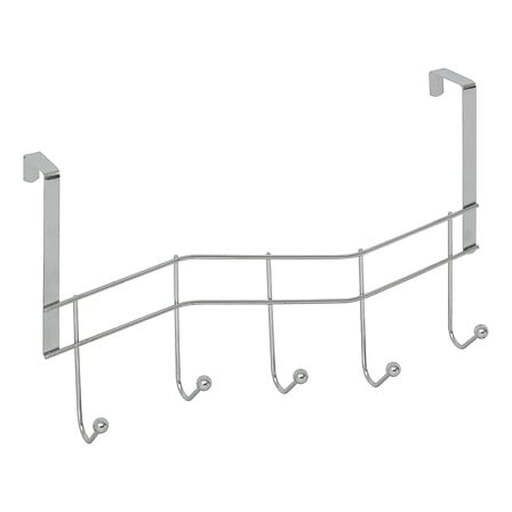
Why this product suits this profile: This over-door solution provides five hanging points for hallways, bedrooms or bathrooms, without requiring any tools. Its stated dimensions are 38,5 × 9,2 × 23,5 cm, with a maximum total load of 10 kg.
The specific details regarding the five hooks, hook depth and load limit make it easier to check the dimensions. The hook may only be used on suitable standard internal doors with sufficient clearance.
Steel construction with a chrome finish; five hooks and tool-free installation over the door.
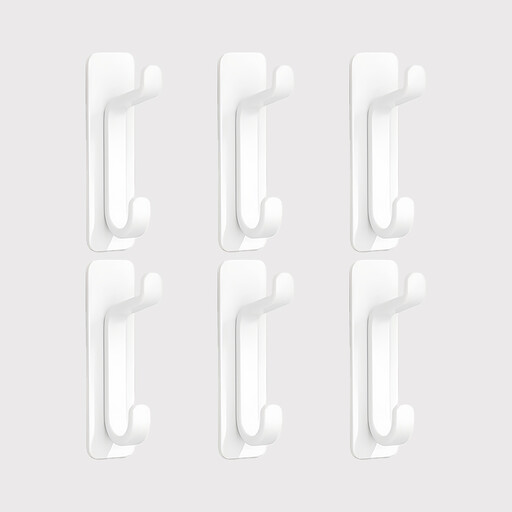
Why this product suits this profile: This set of six stainless steel hooks is designed for kitchens, bathrooms, bedrooms and hallways. Installation uses an adhesive pad rather than screws.
The product details explicitly identify unsuitable painted or delicate surfaces. Clean the surface, allow it to dry and avoid placing heavy loads on the hooks immediately after installation.
Stainless steel construction; six hanging points; designed for installation without drilling.
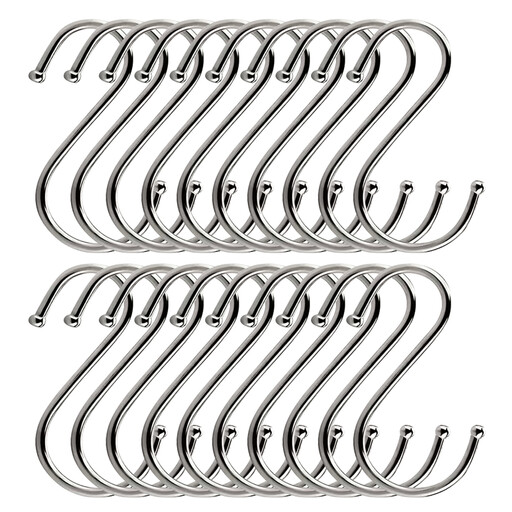
Why this product suits this profile: The 20 S-hooks are designed for flexible storage on poles, rails or edges. This makes them suitable as hooks for kitchens, bathrooms, garages, gardens or offices.
Use does not depend on an adhesive surface. Even so, you should consider the load capacity of the pole or rail being used and distribute each load appropriately.
20 pieces per set; S-shape for quick repositioning; metal construction with a rust-resistant finish according to the product information.
We have put together a complete, regularly updated list of products that fully meet these strict selection criteria and the safety regulations applicable in the EU.
For self-adhesive hooks, the surface should first be cleaned with a suitable, low-residue cleaning product. Dust, grease and moisture reduce adhesion. The hook should then be attached using even pressure. Heavy or fragile items should only be hung after the recommended setting time.
For a hook rail installed with screws, wall plugs and screws suitable for the wall material are required. In rented homes, you should check whether permission is needed before drilling. With over-door hooks, check that the door closes fully and that the hook sits securely over the top edge.
For bathroom towel hooks, wipe-clean materials such as stainless steel or coated metal are a practical choice. Self-adhesive models should only be attached to smooth, dry surfaces. Constant moisture, grout areas and textured tiles can affect adhesion.
No. Suitability depends on the surface and the adhesive area. Smooth tiles, glass, metal or suitable sealed surfaces are often more suitable than wallpaper, rough plaster, flaky paint or uneven walls. The instructions for the specific product should be followed before installation.
There is no universal answer regarding service life. Temperature, humidity, the substrate, cleaning products and the load all affect durability. Carefully preparing the surface, observing the stated load capacity and avoiding permanently overloading the hook will help prevent common installation mistakes. For heavy items, a screwed solution is generally the more predictable option.