
Lieferung heute & morgen

Qualitätsgarantie

Willkommens-Angebote freischalten: KOSTENLOSE Lieferung | Bis zu 80 % RABATT | Kostenlose 30-Tage-JoyPlus-Testphase
App herunterladen
Not enough storage space, jackets draped over chairs and towels hanging on radiators: wall hooks and over-door hooks create extra hanging options without the need for a large cupboard. For rented flats, self-adhesive hooks, hooks that require no drilling and a hook rail that fits over the door are particularly appealing.
However, not every hook suits every wall, door or weight load. As a Joybuy Product Recommendation Officer, I therefore focus on verifiable product data rather than generic advertising claims. Three typical mistakes occur particularly often when making a purchase.
Adhesive hooks do not automatically stick to all surfaces. Dust, grease, moisture, wallpaper texture and rough paint can all affect adhesion. Even a hook suitable for tiles may not hold reliably on a textured wall.
Before fitting, the surface should be smooth, clean and dry. With self-adhesive hooks, it is also advisable to observe the specified waiting time before hanging any weight on them. For the JORDAN&JUDY model, for example, it is recommended not to put heavy loads on the hooks for 24 hours after application.
A bag containing a laptop, a wet bathrobe or several winter coats puts significantly more strain on a hook than a lightweight scarf. It is important to know whether the maximum load applies per hook or to the entire hook rail.
With over-door hooks, the construction of the door itself also comes into play. A thin, hollow or unstable door is not automatically suitable for heavy loads. The weight should be distributed evenly to prevent the door from warping and the hook from slipping.
A hook rail that fits over the door requires sufficient space between the door leaf and the frame. If the door gap is too small, the rail may not be able to sit fully in place. With some models, the door may also no longer close properly.
Before purchasing, you should therefore check the door thickness, distance to the frame and hook depth. For wall hooks, on the other hand, the drilling hole spacing, mounting surface and the nature of the wall are decisive.
For hooks for the bathroom and kitchen, rust-resistant materials and an easy-clean surface make sense. Stainless steel or coated metal are suitable for many areas of the home, but should not be permanently exposed to direct water unless the manufacturer has specified this.
Bamboo and wood can look more decorative, but require protection from persistent moisture. Plastic hooks are lightweight and flexible, but should only be used within their stated load limit.
Pay attention to:
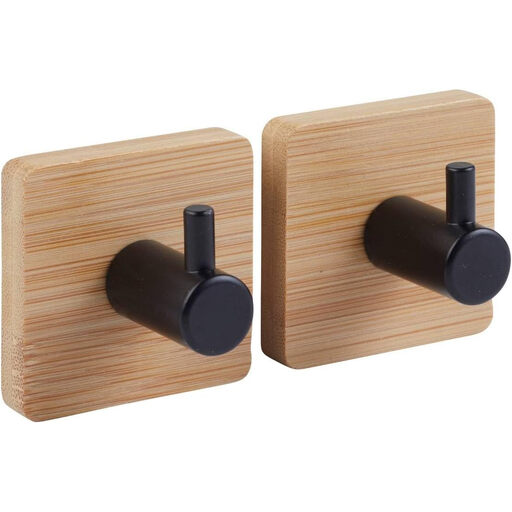
Why this product suits the profile: This two-piece set requires no drill and is suitable for lightweight items in the hallway, bedroom or bathroom. Each hook measures 4.5 × 4.5 × 3.6 cm.
The manageable set size makes planning easier. For heavy jackets or wet towels, the load limit should be checked before use.
Bamboo and steel material; FSC certification according to product information; simple adhesive installation for indoor use.
Why this product suits the profile: These wall-mounted double hooks combine aluminium with a decorative shape and are suitable for the hallway, bedroom, kitchen or bathroom. Installation is carried out with screws and wall plugs.
The stated load capacity of up to 11 pounds per hook makes load planning more transparent. A suitable wall anchor remains crucial.
Aluminium construction, rounded edges and rubber padding on the back according to the product description.

Why this product suits the profile: Ten hanging points provide extra space for families, multi-person households or small rooms without a separate cloakroom. Installation is drill-free by hanging it over the door.
The construction is not reliant on an adhesive surface. Before use, however, the door thickness, fit and sufficient clearance from the frame must be checked.
Ten hooks, steel material and a stated overall dimension of 19.5 × 12.5 × 41.7 cm.
We have compiled a complete, regularly updated list of products that fully meet these strict selection criteria and the safety regulations in force in the EU.
The mounting surface should be free of dust, grease and moisture. After pressing the hook on, the waiting time recommended by the manufacturer must be observed. Heavy items, persistent moisture and strong temperature fluctuations can reduce adhesion.
No. Over-door hooks are generally designed for standard interior doors. Check the door thickness, door gap, frame clearance and stability. Glass, unstable or very thin doors may be unsuitable. The permitted load must not be exceeded.
For lightweight towels, adhesive hooks on smooth tiles or glass may be sufficient. For heavy or wet bathrobes, securely screwed wall hooks or a suitably sized over-door hook rail are more sensible. The load capacity, mounting surface and the distance between individual hooks are decisive.