
Lieferung heute & morgen

Qualitätsgarantie

Willkommens-Angebote freischalten: KOSTENLOSE Lieferung | Bis zu 80 % RABATT | Kostenlose 30-Tage-JoyPlus-Testphase
App herunterladen
Wall hooks provide space-saving storage for coats, towels, bags, hats and accessories. However, not every coat hook is suitable for every wall or load. Attractive looks can conceal small contact surfaces, unsuitable wall plugs or poorly protected materials.
Before buying, households, families, tenants and homeowners should therefore check three common pitfalls:
You should identify the wall construction before installation. For solid walls, wall plugs for concrete or masonry are usually suitable. Plasterboard requires special cavity wall plugs. Tiles can crack or splinter when drilled, so it is important to use suitable drill bits, position the drill carefully and leave sufficient distance from the grout lines.
Tenants should also check whether drilling is permitted. Adhesive solutions can be an alternative for lightweight items. However, for heavy coats, rucksacks or several towels, they are only suitable when the load capacity, surface and manufacturer’s instructions are all compatible.
A stated load limit is only meaningful under specific installation conditions. For the KAPANOU model with six hooks, the product description states a maximum load of 30 kg. The individual double hooks are listed as supporting 11 lb or approximately 5 kg per hook. These figures must not be transferred to a different wall, different wall plugs or dynamic loads without checking first.
Do not use as a grab rail: wall hooks and wall-mounted coat racks are designed for hanging items, not for supporting people.
With wood and metal wall hooks, style and function come together. FSC-certified Rubberwood is listed as the wood material for some KAPANOU products. Depending on the model, the metal components are made from aluminium alloy or coated iron. Rounded edges can reduce the risk of textiles catching.
Moisture and corrosion are particularly important in bathrooms, on balconies and outdoors. A painted or surface coating can help protect the material, but it does not replace regular checks. A garden hose holder should be securely fixed to the wall and provide enough clearance for the hose diameter.
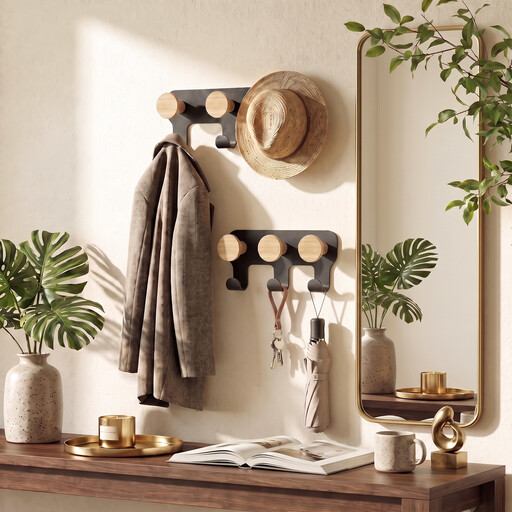
Why this product suits this profile: The two wall hooks are ideal for hallways, bedrooms or bathrooms when you need to accommodate several items of clothing but have limited wall space.
The product information states a load capacity of 11 lb per hook and rounded edges. Suitable wall fixings are still required before use.
Double hooks made from wood and metal, a grey rubber pad to protect the wall and screw fixing.
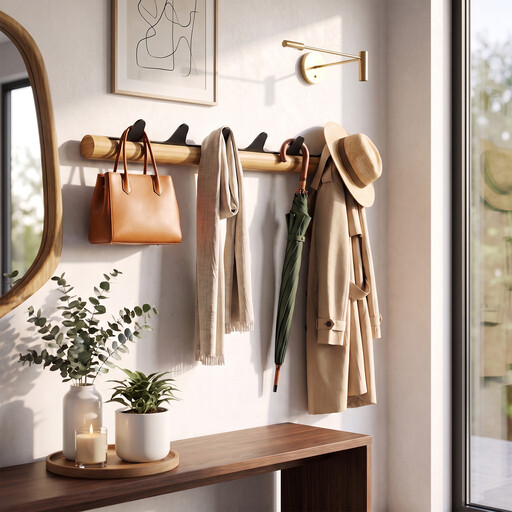
Why this product suits this profile: The continuous wall-mounted coat rack brings six coat hooks together in one place and is suitable for entrances, hallways, bedrooms or bathrooms.
The product description lists FSC-certified Rubberwood, a painted layer and aluminium alloy hooks. The 30 kg load rating only applies when installed correctly.
Six hooks, rounded edges and a combination of Rubberwood and aluminium alloy. According to the product information, the surface is designed to offer greater water resistance.
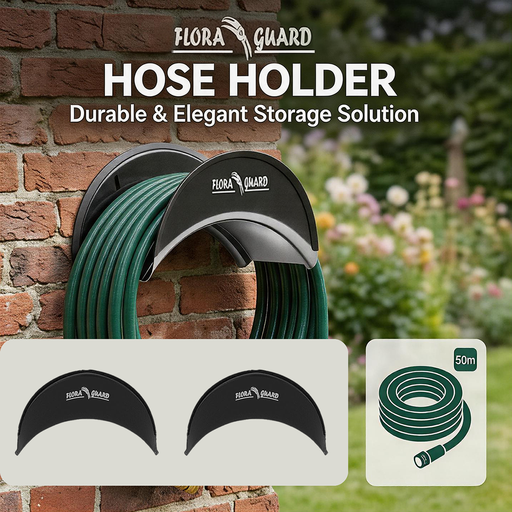
Why this product suits this profile: This wall-mounted hose holder is ideal for garden areas where you do not want a garden hose left on the ground and have limited floor space.
According to the product description, the holders are made from coated iron and have protective rubber strips. Load capacity depends on the wall, wall plugs and hose weight.
Set of two wall holders, 29 cm length, coated iron and a design for storing hoses close to the wall.
Alongside wall hooks, a few small helpers can make everyday household use even easier. A doorstop or door wedge prevents a door from hitting the wall, furniture or hooks when opened. The FLORA GUARD door wedge is made from rubber and has a stainless steel handle. According to the product information, the set of 4 is suitable for carpets, wood, tiles, and wooden, metal and glass doors. The wedge must be kept outside walkways, as it can create a trip hazard.
For organising the garden, a garden hose holder is more suitable than an ordinary coat hook. The wall-mounted hose holder should be positioned so that the hose can be wound up without sharp bends. Before installation, take the hose length, diameter and distance from the wall into account.
To find a suitable selection of additional holders, you can also browse the rubber holders category.
We have put together a complete, regularly updated list of products that fully meet these strict selection criteria and the safety regulations applicable in the EU.
First, check the wall material and the position of any cables or pipes. Then mark the drill hole and use a suitable wall plug. Screws should be inserted straight and tightened fully. When drilling tiles, work slowly and do not use the hammer setting. After installation, carefully test the fixing with a lightweight item.
This depends on the number of household members, the available wall width and the items to be hung. A few individual double hooks may be enough for a small hallway. A wall-mounted coat rack with six or eight hooks is a sensible choice when coats, bags and children’s belongings need to be stored together. Leave enough space between the hooks for bulky clothing.
Dust can usually be removed with a soft, dry cloth. Damp areas should then be dried. Aggressive cleaning products and scouring pads can damage paint, wood surfaces or metal coatings. You should also regularly check that the screws are tight and look out for visible corrosion.