
Lieferung heute & morgen

Qualitätsgarantie

Willkommens-Angebote freischalten: KOSTENLOSE Lieferung | Bis zu 80 % RABATT | Kostenlose 30-Tage-JoyPlus-Testphase
App herunterladen
Wall lamps provide light without taking up valuable space on furniture. In the living room, they can highlight pictures or shelves; in the bedroom, they serve as wall-mounted reading lights; and in the hallway, they offer space-saving indoor lighting. The choice ranges from modern metal wall lamps to natural bamboo wall lamps.
When buying online, however, colour and shape are not the only factors that matter. Missing information about the lamp holder, unsuitable IP ratings or a permanently integrated light source can mean that a wall light is not suitable for the room in everyday use. The following criteria will help you assess marketing claims objectively.
A delicate wall lamp may look attractive, but that does not automatically mean it provides enough light for reading or working. Important factors include the position of the bulb, how the light is distributed and whether the beam can be directed. A wall spotlight with an adjustable head is generally better suited to pictures, work surfaces or specific seating areas than a light with a fully enclosed shade.
An E14 wall lamp and an E27 wall lamp use different socket sizes. What is more, many models do not include a bulb. Before buying, check the following:
An integrated LED wall lamp can make it easier to find a suitable bulb. However, if the permanently installed light source fails, the entire light may need to be replaced, depending on its design.
Many decorative indoor wall lamps have an IP20 rating or do not specify an IP rating at all. This is relevant for dry areas such as living rooms, bedrooms or hallways, but says nothing about their suitability for splashing water. For bathrooms, covered outdoor areas or rooms with increased humidity, always follow the manufacturer’s information on the IP rating and approved installation locations.
Measure the available wall space, including the distance from doors, cupboards and pictures. Compact models measuring around 10 to 15 cm in width are suitable for narrow hallways or installation beside a bed. Larger lights with a projecting shade can make a stronger impression in a living room with an open wall.
An adjustable wall lamp is a sensible choice if you want to direct the light flexibly onto a book, wall decoration or console table. For even general lighting, models with a diffusing cover are more suitable.
E14 lamp holders are often used in compact lights, while E27 lamp holders offer a wider choice of standard bulbs. The permitted wattage is not the same as brightness. With LED bulbs, you should also consider lumens, colour temperature and, where applicable, dimmability.
Warm white light is often chosen for bedrooms and living rooms. An indication such as 3000 K describes the colour temperature, not the amount of light. For an integrated LED, the technical specifications should also state the wattage, whether it can be replaced and the type of connection.
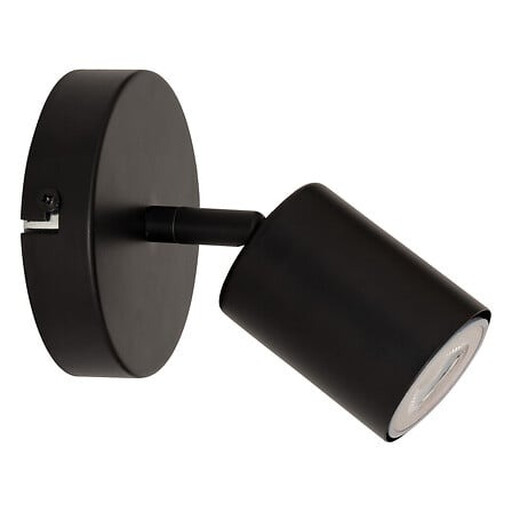
Why this product suits the profile: This compact black steel wall lamp measures 10.5 cm in diameter and 15 cm in height. Its adjustable spotlight is suitable for hallways, bedrooms or smaller living areas.
The product details specify the material, dimensions and adjustable light direction. This makes it easier to assess the space required before ordering.
Steel construction, low weight of 0.247 kg and an adjustable spotlight.
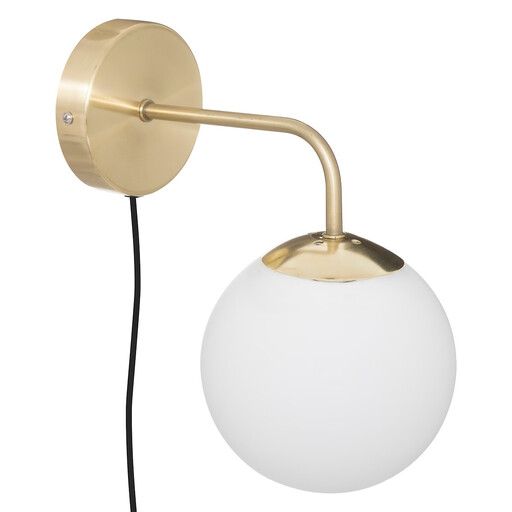
Why this product suits the profile: The combination of a metal base with a brass finish and a sandblasted glass shade is aimed at buyers who value clear material specifications and decorative design.
The specifications explicitly identify it as an indoor light with IP20, an E14 lamp holder, a maximum of 25 W and no bulb included.
Glass shade, dimensions of 26.5 × 25 × 15 cm and a stated two-year warranty.
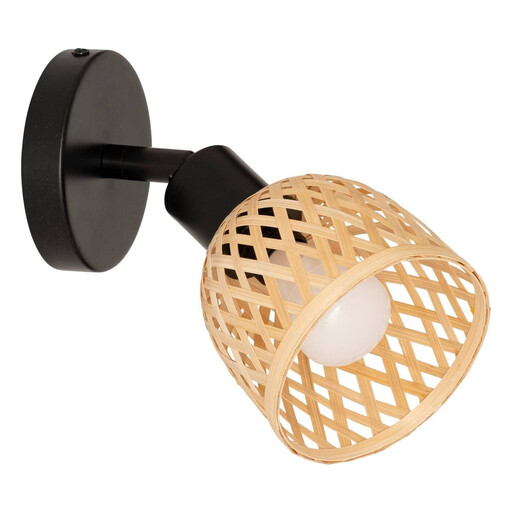
Why this product suits the profile: This light combines an adjustable spotlight with a shade made from FSC-certified bamboo. It can be used as either a wall light or a ceiling light indoors.
The maximum wattage of 25 W, the E14 lamp holder and the fact that no bulb is included are stated in the product details and can be checked before purchase.
FSC-certified bamboo shade, steel base, dimensions of 10 × 10 × 17.5 cm and an installation time of around 10 minutes.
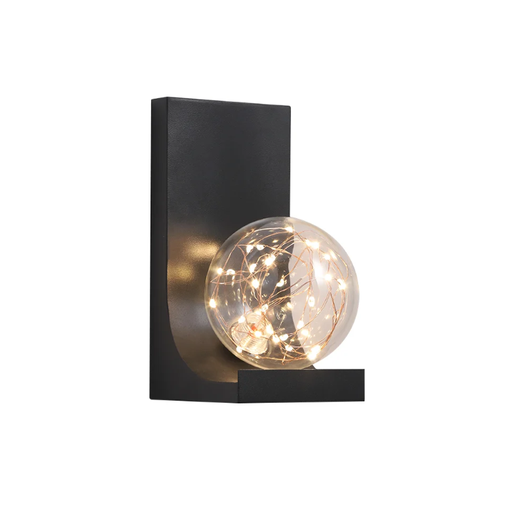
Why this product suits the profile: The flush-mount design and black metal housing are intended for hallways, bedrooms and other areas with limited depth.
The integrated 6 W LED is specified as non-replaceable. Before buying, consider this carefully against your preference for replaceable bulbs.
6 W integrated LED, warm white light, glass and metal construction, plus flush mounting.
We have put together a complete, regularly updated list of products that fully meet these strict selection criteria and the safety regulations applicable in the EU.
Before installation, check the wall material, cable routing and type of connection. Depending on the circumstances, fixed-wired lights may need to be installed by a qualified electrician. Models with an external cable and switch require a suitable socket and safe cable routing.
For a reading light beside the bed, the beam should not point directly into your eyes. In a hallway, a compact wall spotlight with a clearly defined direction is often more practical than a projecting shade. In the living room, two identical wall lamps can be mounted symmetrically on either side of a piece of furniture. For bamboo shades and open metal constructions, clean them with a soft, dry cloth.
An adjustable wall lamp or a wall spotlight with a precisely directional head is usually more practical for reading. Also check the installation height, the distance from the bed or armchair, the light colour and whether the bulb can be replaced.
E14 and E27 refer to different socket diameters. An E14 wall lamp requires a suitable E14 bulb, while an E27 wall lamp requires an E27 bulb. Both lamp holders can be used with LED bulbs, provided that the shape, wattage and manufacturer’s specifications are compatible.
Electricity consumption depends on the electrical power in watts and how long the light is used. With the same operating time, an integrated 6 W LED uses less electrical power in theory than a light with a higher wattage. For a fair assessment, you should also consider the luminous flux, stated lifespan and whether the light source can be replaced.