
Lieferung heute & morgen

Qualitätsgarantie

Willkommens-Angebote freischalten: KOSTENLOSE Lieferung | Bis zu 80 % RABATT | Kostenlose 30-Tage-JoyPlus-Testphase
App herunterladen
A well-chosen wall light can completely transform a room's atmosphere or enhance the security of your home's exterior. However, the selection is vast, and not every product lives up to its advertising. Many buyers are frustrated by lights that rust after one winter or by integrated LEDs that fail unexpectedly. As your Joybuy Product Recommendation Officer, I'll help you avoid these pitfalls and make an informed decision.
Before you decide on a model, you should be aware of the typical issues that can lead to disappointment.
outdoor wall light is not automatically suitable for every location on your fa?ade. A light with an IP44 rating is only protected against splashing water and should only be installed in covered areas, such as on a balcony or under an eave. It can be quickly damaged by rain on an unprotected exterior house wall.black or anthracite wall light, this quickly leads to rust spots and peeling paint outdoors. Look for precise specifications like die-cast aluminium or stainless steel.indoor LED wall light is energy-efficient, but if the light source is permanently integrated and no lifespan is specified, the entire lamp can become useless if it fails. Models with replaceable bulbs (e.g., GU10, E27) or high-quality integrated LEDs with a long, stated lifespan are the safer bet here.To make the right choice, focus on these three objective criteria.
The IP (Ingress Protection) rating indicates how well a light is protected against the entry of foreign objects (first digit) and water (second digit).
living room wall light or hallway. No protection against water.exterior house wall fully exposed to wind and weather.The material determines not only the look but also the lifespan of your wall lamp.
anthracite wall light) from fading.The choice of light source directly impacts atmosphere, maintenance, and energy consumption.
modern wall lamp and are very energy-efficient with a long lifespan (often 20,000 to 50,000 hours). The downside: the light source cannot be replaced.dimmable wall light requires both a dimmable bulb and a compatible wall switch.Here are some recommendations tailored to specific needs and use cases.
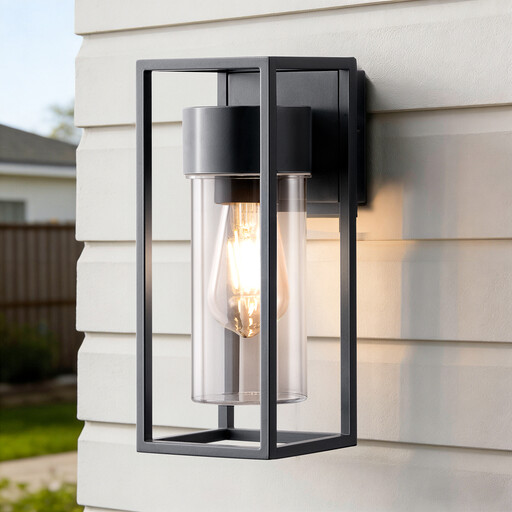
Why This Fits Their Persona: Ideal for anyone seeking a functional and flexible solution for a covered balcony, terrace, or entrance area. The simple, modern design complements many architectural styles.
The IP44 certification is clearly stated and suitable for its intended use (splash-proof areas). Thanks to the E27 socket, you aren't tied to a fixed bulb and can replace it at any time.
The housing, made of rust-resistant aluminium and plastic, is durable. The widened housing design makes changing the bulb easier.
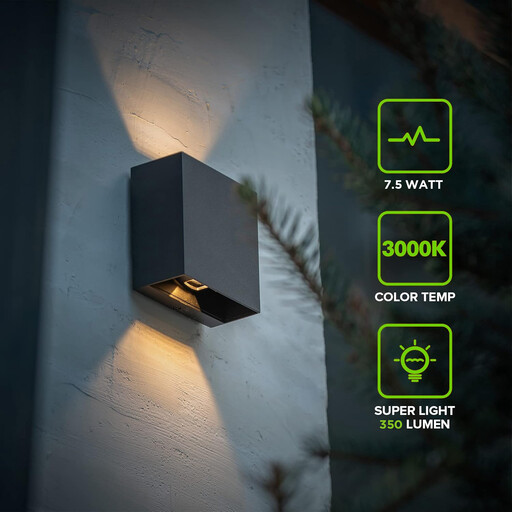
Why This Fits Their Persona: Perfect for homeowners who want to create a modern showcase of their fa?ade with targeted light accents. The up-down outdoor wall light produces stylish cones of light both upwards and downwards.
The housing made of powder-coated aluminium is explicitly described as rustproof and weather-resistant. The integrated LED has a specified lifespan of 50,000 hours, which minimises concerns about premature failure.
The beam angle is individually adjustable from 0 to 106 degrees, allowing for flexible and creative lighting design on the house wall. The warm white light colour (3000K) creates an inviting atmosphere.
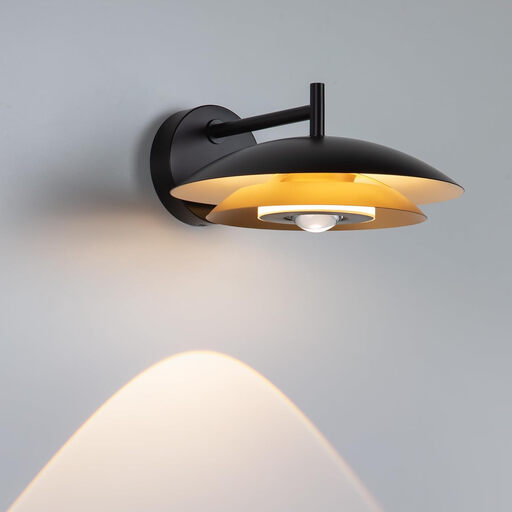
Why This Fits Their Persona: For design enthusiasts who want to add an elegant accent to their living room, bedroom, or hallway. The combination of gold-coloured metal and a glass globe is a clear statement in the Mid-Century style.
This model relies on high-quality, clearly declared materials: electroplated steel and hand-blown glass. Dimmability is explicitly mentioned as a feature achievable with a suitable bulb and switch, which ensures transparency.
The fixture is versatile and can be mounted as a wall or ceiling light. Compatibility with dimmers allows for seamless adjustment of the light mood, from bright and functional to a soft evening glow.
We have compiled a complete, up-to-date list of products that fully meet these strict selection criteria and German safety regulations.
It depends on the exact installation location. For a covered entrance or balcony, IP44 (protection against splashing water) is usually sufficient. For an unprotected house wall exposed to rain and snow, you should choose a light with at least IP54 (protection against dust and splashing water) or, even better, IP65 (protection against water jets).
The "K" stands for Kelvin and describes the colour temperature of the light. 3000K corresponds to a Warm White, which is perceived as cosy and inviting. It is ideal for living areas like the living room, bedroom, or for atmospheric outdoor lighting. Values around 4000K (Neutral White) appear more functional, while 5000K and above (Daylight White) produce a very cool, stimulating light often used for workspaces or purely for security lighting.
No, this is a common misconception. For a wall light to be dimmable, three components must be compatible: 1. The light fixture itself must be designed for dimming. 2. The bulb (if replaceable) must be marked as "dimmable." 3. You need a compatible wall dimmer switch. A standard on/off switch cannot regulate brightness. With LED lights, it is especially important to ensure compatibility between the light and the dimmer (e.g., leading-edge or trailing-edge dimmers).