
Lieferung heute & morgen

Qualitätsgarantie

Willkommens-Angebote freischalten: KOSTENLOSE Lieferung | Bis zu 80 % RABATT | Kostenlose 30-Tage-JoyPlus-Testphase
App herunterladen
A wall light can illuminate a hallway, serve as a wall-mounted reading light or create carefully positioned pools of light in the living room. The choice ranges from a classic E27 wall light and an integrated LED wall light to a weather-resistant outdoor wall light. However, design is not the only factor that matters.
Many disappointing purchases are caused by unclear information about the light source, an unsuitable IP rating or installation that is not possible in the intended location. This guide explains which features are important to consider before buying a wall light and which models suit different requirements.
A decorative wall light with an open shade may look appealing, but it does not automatically provide even room lighting. Visible bulbs or dark metal shades often create more strongly directed light. This can be useful in a hallway or on a staircase, but a single light is often not enough as the only source of illumination in a large living room.
Check whether the light is intended for accent lighting, reading or general room illumination. Information about lumens, light distribution and colour temperature can help you assess its performance.
With an integrated LED wall light, the LED module is permanently built in. This saves you from buying a separate bulb, but it can limit repairs or replacement in the event of a fault. With an E27 or E14 wall light, on the other hand, the bulb can be selected and replaced separately.
Look for wording such as “bulb included”, “integrated LED” or “replaceable bulb”. A low wattage alone says little about the actual brightness.
An indoor wall light without a stated IP rating should not be used outdoors, even in a sheltered area, or in damp zones. For an outdoor wall light, a specific rating such as IP44 is relevant. It describes protection against solid foreign objects and splashing water under the intended conditions.
In a bathroom or on an exterior wall, the installation location, distance from water and electrical installation must also be suitable for one another. For permanently wired lights, installation should be carried out by a qualified electrician.
For a wall light in the bedroom, a low-glare, directional light source is generally more practical than a model that emits very bright light in all directions. In the living room, combining ceiling lighting with a decorative wall light can create a more flexible distribution of light.
Compare the dimensions of the wall light with the available space. As well as height and width, the distance from the wall is important, particularly beside doors, beds and mirrors or in narrow hallways. A compact light approximately 10 to 12 cm wide is more likely to fit into smaller areas. Larger shades made from metal, glass or bamboo require more clearance.
If you are installing two wall lights, plan their positions and spacing symmetrically. Before installation, it is worth making a full-size paper template.
Check whether the wall light is designed for a fixed wall connection or for a visible cable supply. Some models are installed with screws, while others require an existing wall outlet and a wall switch. The accessories supplied may vary from one product to another.
The CE marking is visibly stated for several of the models listed. However, it does not replace checking whether the installation location, connection and IP rating are suitable for the specific application.
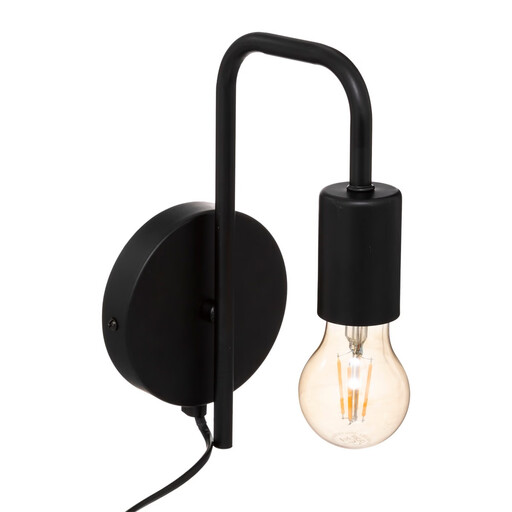
Why this product suits the profile: This black metal light has an E27 socket, a 180 cm cable and is designed for indoor use in kitchens, bedrooms, dining rooms or living rooms.
The replaceable light source is clearly distinguished from the fitting: the bulb is not included and can be chosen to provide the desired level of brightness.
E27 socket, maximum output of 40 watts and directional downlight; installed with screws.
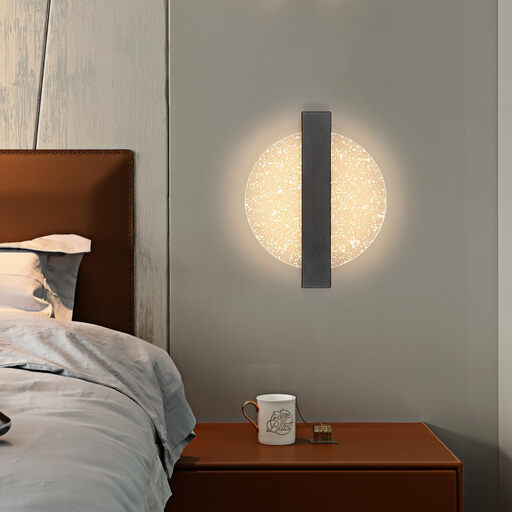
Why this product suits the profile: The round black design, integrated LED and warm white light are intended for modern bedrooms, living rooms, hallways and stairwells.
The specifications state both the power consumption of 12 W and the colour temperature of 3,000 K, as well as 1,500 lumens. This gives you a clearer idea of the lighting effect than the term LED alone.
Integrated 12 W LED, 3,000 K, stated luminous flux of 1,500 lumens and low-profile wall mounting.
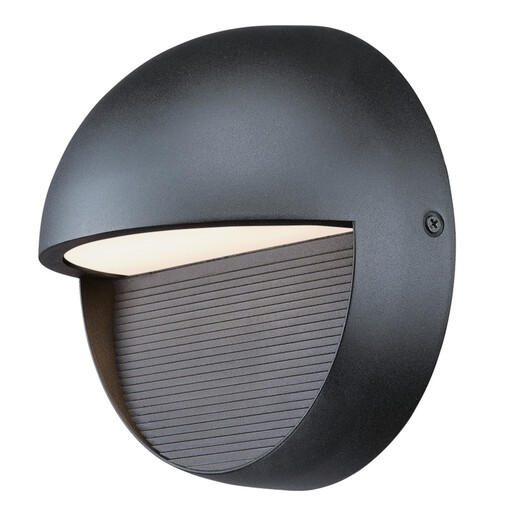
Why this product suits the profile: This outdoor wall light with a black housing, opal glass and IP44 splash protection is intended for entrance areas, patios or garden walls.
The specific IP44 rating distinguishes this model from indoor lights without a stated protection rating. Installation must preserve its protection against water.
Integrated 10 W LED, IP44 and dimming function with a compatible external LED dimmer; installation by a qualified electrician is recommended.
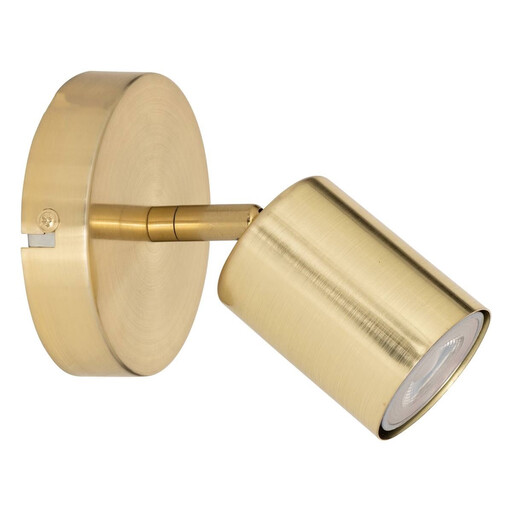
Why this product suits the profile: The adjustable spotlight is suitable for hallways, bedrooms or targeted accent lighting when you want to adjust the direction of the light regularly.
The movable light head is explicitly stated. This makes it easier to plan the light distribution before installation than with a fixed-direction wall light.
Compact 10 cm diameter, adjustable head and visible CE marking; intended for indoor use.
We have put together a complete, regularly updated list of products that fully meet these strict selection criteria and the safety regulations applicable in the EU.
In a bedroom, a wall light beside the bed can serve as a wall-mounted reading light. Make sure there is enough space around your head, that the switch is easy to reach and that the light is directed so it does not shine straight into your eyes.
In the living room, black wall lights, gold wall lights or models made from natural materials such as bamboo can be used as decorative additions. A light with a visible E27 bulb allows you to adjust the brightness and colour of the light at a later date. Adjustable spotlights are practical in home offices and kitchens when you want to illuminate worktops or shelves precisely.
Before buying, you should also clarify the following:
That depends on its design and intended use. As a general rule, a light should not cause glare at eye level. Beside a bed or sofa, the height should be adjusted to the seated or lying position, access to the switch and the beam of light. With a wall-mounted reading light, flexible positioning is particularly helpful.
Consumption depends on the power rating in watts and how long the light is used each day. A 10 W LED used for ten hours consumes 0.1 kWh. The actual running cost is calculated by multiplying this consumption by your individual electricity price. Wattage describes energy consumption, not brightness alone.
No. The product specifications must state that the light is dimmable. With integrated LEDs, you will also need a compatible dimmer. An E27 wall light is not automatically dimmable; both the bulb and the switch must be suitable for dimming.