
Lieferung heute & morgen

Qualitätsgarantie

Willkommens-Angebote freischalten: KOSTENLOSE Lieferung | Bis zu 80 % RABATT | Kostenlose 30-Tage-JoyPlus-Testphase
App herunterladen
A wall light can brighten a specific area, mark out a route in the hallway or serve as a decorative feature. Choosing one can be more complicated than product photos suggest. It’s not just the colour and shape that matter: you’ll also need to consider the connection type, bulb, IP rating, light colour and mounting distance.
A decorative wall light often provides accent or mood lighting rather than general illumination. That may not be enough on its own for a workspace, a long hallway or a kitchen. Figures such as lumens can help you assess brightness: the higher the luminous flux, the more visible light the fitting generally emits. The effect also depends on the wall colour, beam angle and lampshade.
An LED wall light may have an integrated light source or require a replaceable bulb. For a dimmable wall light, the fitting, bulb and dimmer must be technically compatible. Models with an E27 or E14 socket also usually come without a bulb. Do not exceed the maximum wattage.
For dry indoor spaces, a light fitting with IP20 is often sufficient. Bathrooms and other damp areas require a suitable IP rating. If no IP rating is stated, don’t assume the light is suitable for damp areas. For hard-wired models, always switch off the circuit at the fuse box before installation. If you’re unsure, consult a qualified electrician.
A living room wall light with a colour temperature of 2,700 to 3,000 Kelvin will generally feel warmer than one with 6,500 Kelvin. Warm white light is often well suited to living rooms and bedrooms, while cooler light tends to feel more functional. In hallways and stairwells, indirect up-and-down lighting can help with orientation without creating harsh pools of light.
Also check whether the fitting shines upwards, downwards, to the sides or in all directions. A closed shade reduces glare, but it can also limit how much light reaches the wall and room.
Look out for:
The distance from the wall affects whether a light will work well beside a bed, above a console table or in a narrow hallway. Slim aluminium or acrylic models are often a good fit for tight spaces. Metal and glass lights can make more of a statement, but need a secure fixing.
A black wall light often suits minimalist interiors, while a gold-coloured light or a design with wood or bamboo details can add a distinctive accent. Material alone, however, tells you nothing about brightness or electrical suitability.
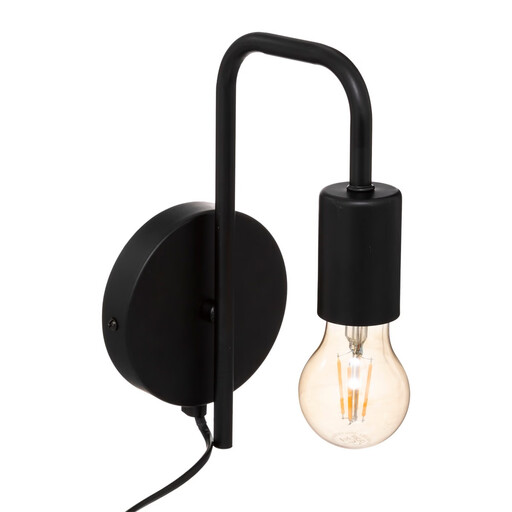
Why this product suits this profile: This compact black metal light has an E27 socket and is suitable for living rooms, bedrooms or dining areas. The replaceable bulb lets you choose the light colour and brightness to suit your needs.
The product details clearly state that it has an E27 socket, has a maximum output of 40 watts and comes without a bulb. This makes it easier to plan for any additional items you’ll need to buy.
Black metal, an E27 socket and a 180 cm cable. Designed for indoor use.
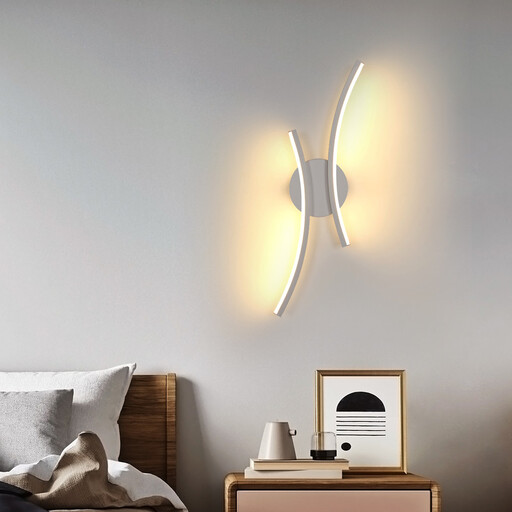
Why this product suits this profile: This white aluminium light pairs a flowing shape with light directed upwards and downwards. With an output of 20 watts and a colour temperature of 3,000 Kelvin, it’s designed for living rooms, bedrooms, hallways or home offices.
The light colour, power consumption and depth of around 5 cm are all clearly stated. This makes it easier to choose a light that suits your wall space and the atmosphere you want to create.
Integrated LED light source, warm white 3,000 Kelvin and an aluminium construction with a flowing light pattern.
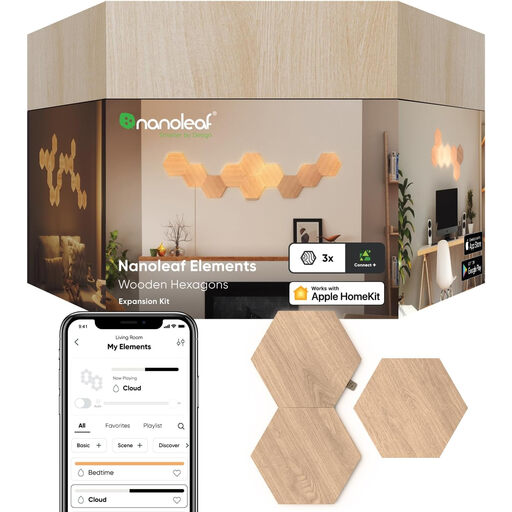
Why this product suits this profile: These modular panels are for anyone looking to use a smart wall light as customisable wall décor. They can be controlled via an app, touch controls or a voice assistant.
This is clearly an expansion pack containing three panels. Before installation, check that you have compatible base components and enough space for the complete setup.
Three modular panels, Wi-Fi and Thread connectivity, plus support for Alexa, Google Assistant and Apple HomeKit according to the product details.
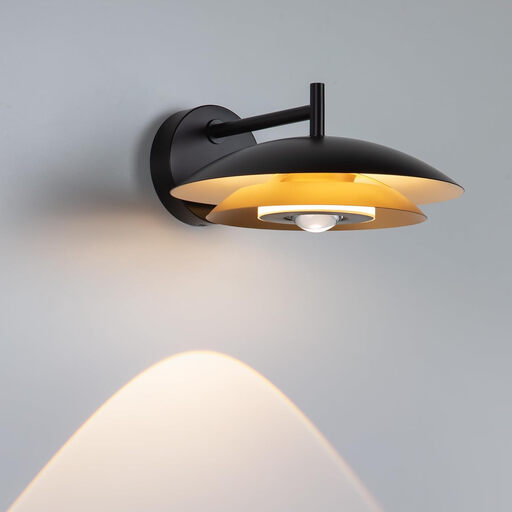
Why this product suits this profile: With its clear glass globe, this gold-coloured light makes a striking feature in a bedroom, living room or hallway, or beside a bathroom mirror, provided the installation conditions and IP rating are suitable for the location.
According to the product description, the dimming function requires a dimmable bulb and a compatible dimmer. You should also check separately that the IP rating is suitable for the intended installation location.
Clear glass globe, electroplated metal frame, dimmable with compatible components, and designed for wall or ceiling mounting.
We’ve put together a complete, regularly updated list of products that meet these strict selection criteria and fully comply with the safety regulations in force in the EU.
It depends on the room, the shape of the light and your line of sight. As a practical guide, a light in a living area is often positioned so that its light source won’t cause glare at eye level. When placing one beside a bed or mirror, think about how you’ll use it. Before drilling, it’s a good idea to check the position using the light’s overall dimensions.
Lifespan depends on the LED module, heat dissipation, how long the light is used for and the ambient temperature. Manufacturers’ lifespan figures are estimates, not a guarantee of how long a light will last. For integrated LEDs, check whether the module can be replaced. With E27 or E14 lights, the bulb can be replaced separately.
Running costs depend on the light’s power, how long it’s used each day and your electricity tariff. The basic calculation is: power in kilowatts × hours of use × price per kilowatt-hour. For example, a 10-watt light used for three hours a day consumes less energy than a 60-watt bulb used for the same length of time. What matters is the actual power consumption, not simply the label ‘LED’.