
Lieferung heute & morgen

Qualitätsgarantie

Willkommens-Angebote freischalten: KOSTENLOSE Lieferung | Bis zu 80 % RABATT | Kostenlose 30-Tage-JoyPlus-Testphase
App herunterladen
A wall light can guide you through a hallway, replace a bedside lamp or create an extra lighting zone in your living room. At first glance, the choice seems simple: compare colour, shape and price, then order the product. In practice, however, a few details can lead to a disappointing purchase. A light might not be compatible with your existing electrical installation, might not provide enough light in the spot you want, or might not be dimmable later on.
This buying guide shows what private buyers in the UK should look out for before making a purchase. It focuses on verifiable product data rather than pure marketing claims.
With a wall light with an E27 fitting or E14 fitting, the bulb is often not included. If you only order the light itself, you will also need to buy a suitable bulb. You must also pay attention to the maximum wattage. An E27 light with a maximum of 40 watts is not automatically suitable for a more powerful bulb.
With an LED wall light, on the other hand, the light source is often permanently integrated. This saves you buying a separate bulb, but it can limit future maintenance. If a non-replaceable LED fails, you may need to replace the entire light.
A dimmable wall light requires a compatible combination of light, bulb and dimmer switch. With fittings like E27 or E14, dimmability depends primarily on the bulb you use. With integrated LEDs, the manufacturer must explicitly state the dimming function.
If this information is missing, you should not use the light with an existing dimmer. Otherwise, you may experience flickering or limited functionality.
A decorative wall light for the living room, bedroom or hallway is not automatically suitable for the bathroom. The IP rating describes the level of protection against the ingress of solid objects and water. Some of the indoor lights listed here have no stated IP rating or are rated IP20. This means they are suitable for dry indoor areas, not for direct use in damp zones.
For wall mounting, you should also check the surface, wall plugs, cable routing and connection type. For a fixed mains connection, if you are unsure, an electrician is the right person to consult.
Colour temperature is measured in Kelvin:
An LED wall light with 3,000 Kelvin, for example, is specified as a warm white light source for bedrooms, living rooms, stairwells or hallways. You should also assess the actual brightness using the luminous flux in lumens.
Width isn't the only thing that matters. Also check the depth and the distance from the wall. In narrow hallways or next to a bed, a slim light can be more practical. An adjustable spot function allows for targeted direction, while a downward-facing light output highlights the area below the light.
A wall-mounted reading light should be positioned so that the light reaches the page of your book without shining directly into your eyes. For mounting next to the bed, cable routing, switch position and distance from the sleeping surface are also important.
Metal, glass, acrylic, aluminium and bamboo differ in terms of care, weight and appearance. A black metal wall light often looks clean and understated; a gold wall light with glass can create a stronger accent in the room. However, the fitting, maximum wattage, connection type and installation instructions remain the deciding factors.
For example, the Atmosphera Keli is specified with an E27 fitting, a 180-centimetre cable, a downward-facing light output and a maximum wattage of 40 watts. The bulb is not included, and the light is not dimmable. This data is more helpful for planning a specific use than a general description like "modern".
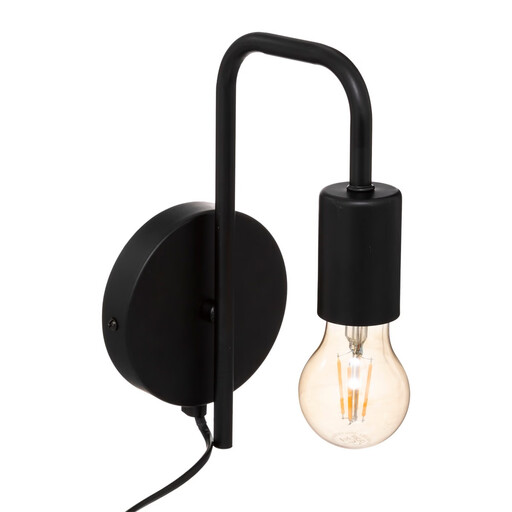
Why this product fits the profile: This compact black metal light uses a standard E27 fitting and is suitable, according to the product details, for bedrooms, living rooms, kitchens or dining areas.
The fitting, maximum wattage of 40 watts, cable and the fact that the bulb is not included are all clearly stated. This means you can plan for the additional purchase in advance.
E27 fitting, single light point, 12 centimetres wide and screw-mounted; the bulb is replaceable.
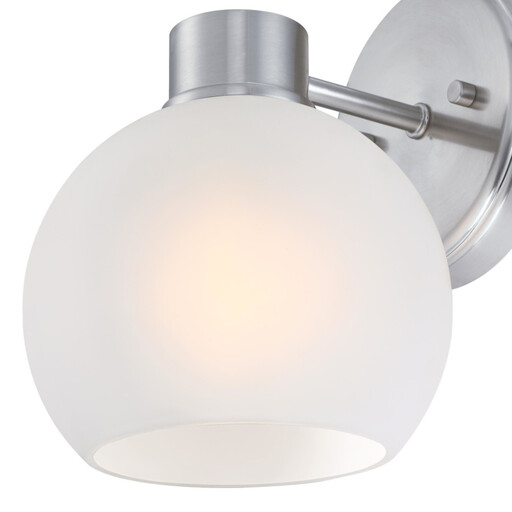
Why this product fits the profile: The combination of brushed nickel and opal glass suits neutrally decorated living and sleeping areas. The orientation can be adjusted upwards or downwards to suit the room.
The product details state 220–240 volts, an E27 fitting and a maximum of 60 watts. The bulb must be chosen separately.
Opal glass, 23 centimetres high, 17 centimetres wide and flexible mounting orientation.
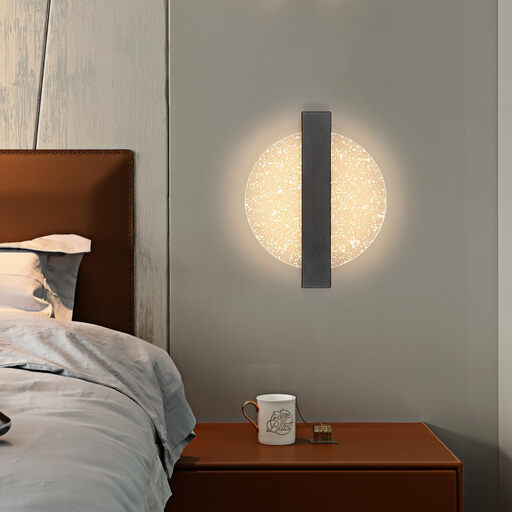
Why this product fits the profile: This round black LED wall light is specified for living rooms, bedrooms, hallways and stairwells, and provides warm white light at 3,000 Kelvin.
The specifications state 12 watts, 3,000 Kelvin and 1,500 lumens. This allows you to assess brightness and light colour before buying.
Integrated 12-watt LED, round shape, warm white light colour and flexible use as a hallway light or accent lighting.
We have put together a full, regularly updated list of products that fully meet these strict selection criteria and the safety regulations in force in the UK.
For the bedroom, warm white lights around 2,700 to 3,000 Kelvin are a good choice. A light with a replaceable bulb offers flexibility with brightness and light colour. As a wall-mounted reading light, it should be able to be directed specifically at the reading area or have a clearly defined light output.
The consumption depends on the wattage and the daily operating time. A 12-watt light that is on for five hours a day uses 0.06 kilowatt-hours per day. The actual running costs depend on the usage time and your local electricity price. With integrated LEDs, you should also check whether the light source is replaceable.
No. A light is only reliably dimmable if the bulb, light and dimmer are all compatible with each other. With an E27 or E14 wall light, you need a bulb that is explicitly marked as dimmable. With integrated LEDs, the dimming function must be stated in the technical product specifications.