
Lieferung heute & morgen

Qualitätsgarantie

Willkommens-Angebote freischalten: KOSTENLOSE Lieferung | Bis zu 80 % RABATT | Kostenlose 30-Tage-JoyPlus-Testphase
App herunterladen
A well-chosen wall light can illuminate a room precisely, make walkways safer, or highlight a wall as a design feature. However, unclear product specifications, unsuitable IP ratings, and non-replaceable bulbs often lead to poor purchasing decisions. This buyer’s guide from the Joybuy Product Recommendation Officer shows what British households should look for when choosing indoor and outdoor lights.
A decorative wall light can create a pleasant atmosphere in a bedroom, but it may not be sufficient as the sole light source for a workspace. Conversely, a very bright LED wall light in a hallway or next to a bed can feel uncomfortable. Before buying, you should decide whether the light will be used as general lighting, a reading light, an orientation light, or accent lighting.
With LED lights, the wattage primarily indicates energy consumption, not directly the brightness. For that, you need to look at the luminous flux in lumens. Colour temperature is given in Kelvin:
A wall light with warm white light at 3,000 Kelvin can create a homely atmosphere. However, whether the brightness is sufficient depends on room size, wall colour, beam angle and the number of lights.
An indoor wall light with IP20 is not automatically suitable for a balcony, terrace or bathroom. The IP code describes protection against solid objects and water. For covered outdoor areas, at least IP44 is usually specified. This means protection against solid objects larger than 1 millimetre and against splashing water from any direction.
The IP rating does not replace proper installation. Outdoor wall lights must be fitted so that water cannot enter connection points. For hardwired lights, installation by a qualified electrician is advisable, or required depending on the situation.
An integrated LED wall light is typically supplied with an LED module already fitted. This saves you searching for a compatible bulb, but if it fails, you may need to replace the entire light. With a wall light featuring an E27 fitting, you can choose the bulb separately and replace it later.
Therefore, check:
A slim light is suitable for narrow hallways or areas next to doors. For a bedroom light, you should also check how far it protrudes from the wall. Adjustable spots allow you to direct the light precisely, but they need enough space and a secure fixing.
Before buying, compare the height, width, depth or projection from the wall with the available mounting area. If installing multiple lights, a symmetrical arrangement is only recommended if furniture, mirrors and connection points allow it.
Aluminium can combine a low weight with a sturdy construction. Glass diffusers create either a clear or more diffused light distribution, depending on the design. Acrylic diffusers can spread the light evenly. What matters is not just the material name, but the actual build quality and how easy it is to clean.
For a modern wall light with indirect light, up-and-down lights are an interesting option. A light with a closed shade usually distributes the light more controllably and can be suitable for hallways or bedside tables.
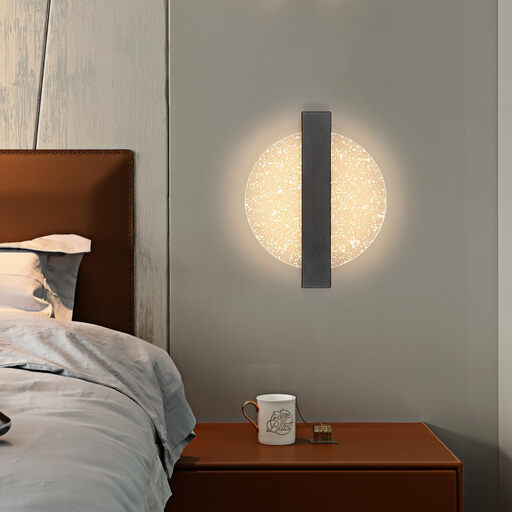
Why this product fits the profile: This round indoor wall light combines a compact design with integrated LED technology, 12 watts and warm white light at 3,000 Kelvin. It can be used as functional and decorative lighting in a hallway, bedroom or living room.
The specifications for power, colour temperature and luminous flux of 1,500 lumens make it easier to assess than relying on design promises alone. However, before installation, you should check whether a dimming function is needed.
Warm white light at 3,000 Kelvin, 1,500 lumens and an integrated 12-watt LED; according to the product description, it is designed for flexible wall mounting.
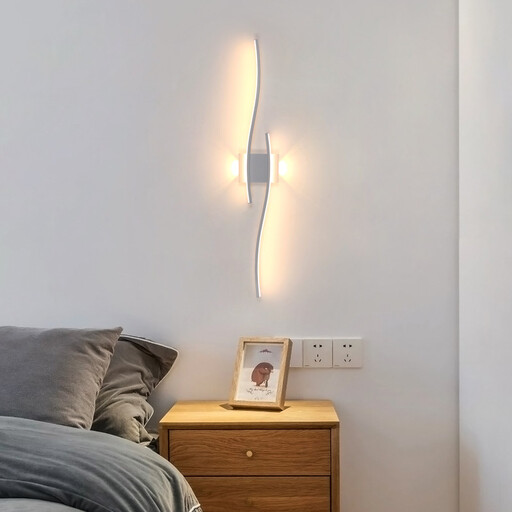
Why this product fits the profile: The combination of an aluminium housing, a matt finish and a translucent acrylic diffuser appeals to buyers who value material quality and even light distribution in a living room or bedroom.
The technical specifications state the material, finish and colour temperature. This allows you to compare the light more objectively with other models, rather than deciding based on shape alone.
Aluminium construction, acrylic diffuser and 3,000 Kelvin light; the product description highlights even light diffusion.
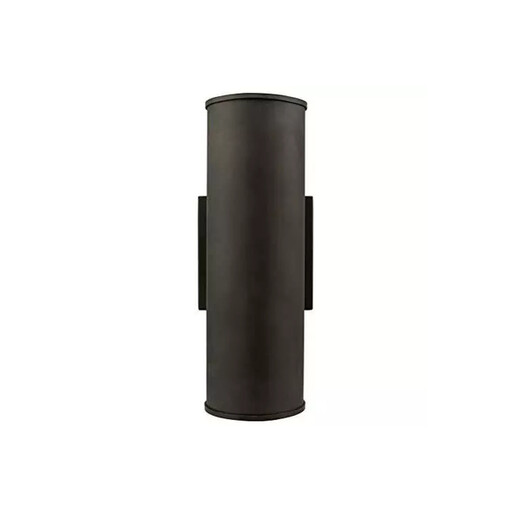
Why this product fits the profile: This outdoor wall light is designed for entrance areas, terraces, verandas and exterior walls. It combines up-and-down lighting with integrated LED technology and an IP44 rating.
The stated IP44 rating makes the intended use clearer. However, it does not replace correct sealing and installation by a qualified electrician.
IP44, two integrated 8-watt LEDs, 870 lumens and 3,000 Kelvin; the housing is described as weather-resistant.
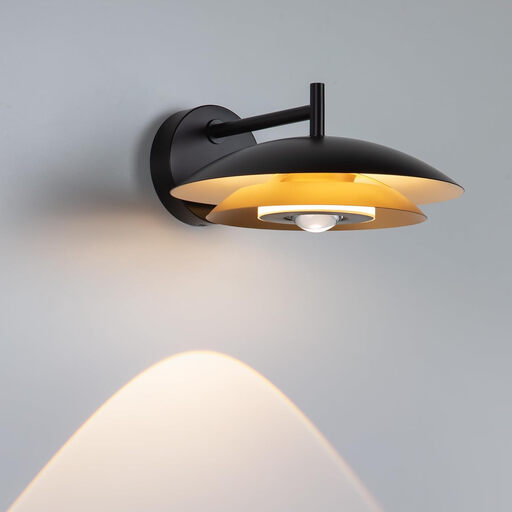
Why this product fits the profile: This light with a clear glass shade and metal frame is designed for living rooms, bedrooms, hallways or a vanity area. The dimming function requires a dimmable bulb and a compatible dimmer.
The product information clearly states the requirements for dimming. This avoids planning for a dimming function without a compatible bulb or suitable switch.
Dimmable with compatible technology, can be mounted on a wall or ceiling, clear glass shade with 360-degree light output according to the product description.
We have compiled a complete, regularly updated list of products that fully meet these strict selection criteria and the safety regulations in force in the EU.
For a living room, warm white models at around 2,700 to 3,000 Kelvin are often a good choice. What matters is whether the light is intended to illuminate the room generally, or just to accent a wall, a picture or a piece of furniture. Several lower-powered lights can provide a more even distribution than a single, very bright wall light.
The ongoing running costs depend on the wattage, daily usage time and your electricity tariff. An LED light typically uses less electrical power than older bulb types for the same brightness. For a fair assessment, you should look at wattage and lumens together. With integrated LEDs, you should also check whether the module is replaceable.
For battery-operated models or those powered by a plug-in transformer, installation is usually simpler. Lights that are hardwired to the mains should be installed by a qualified electrician for safety reasons. Before carrying out any work on the electrical system, the power supply must be switched off and secured against being switched back on.